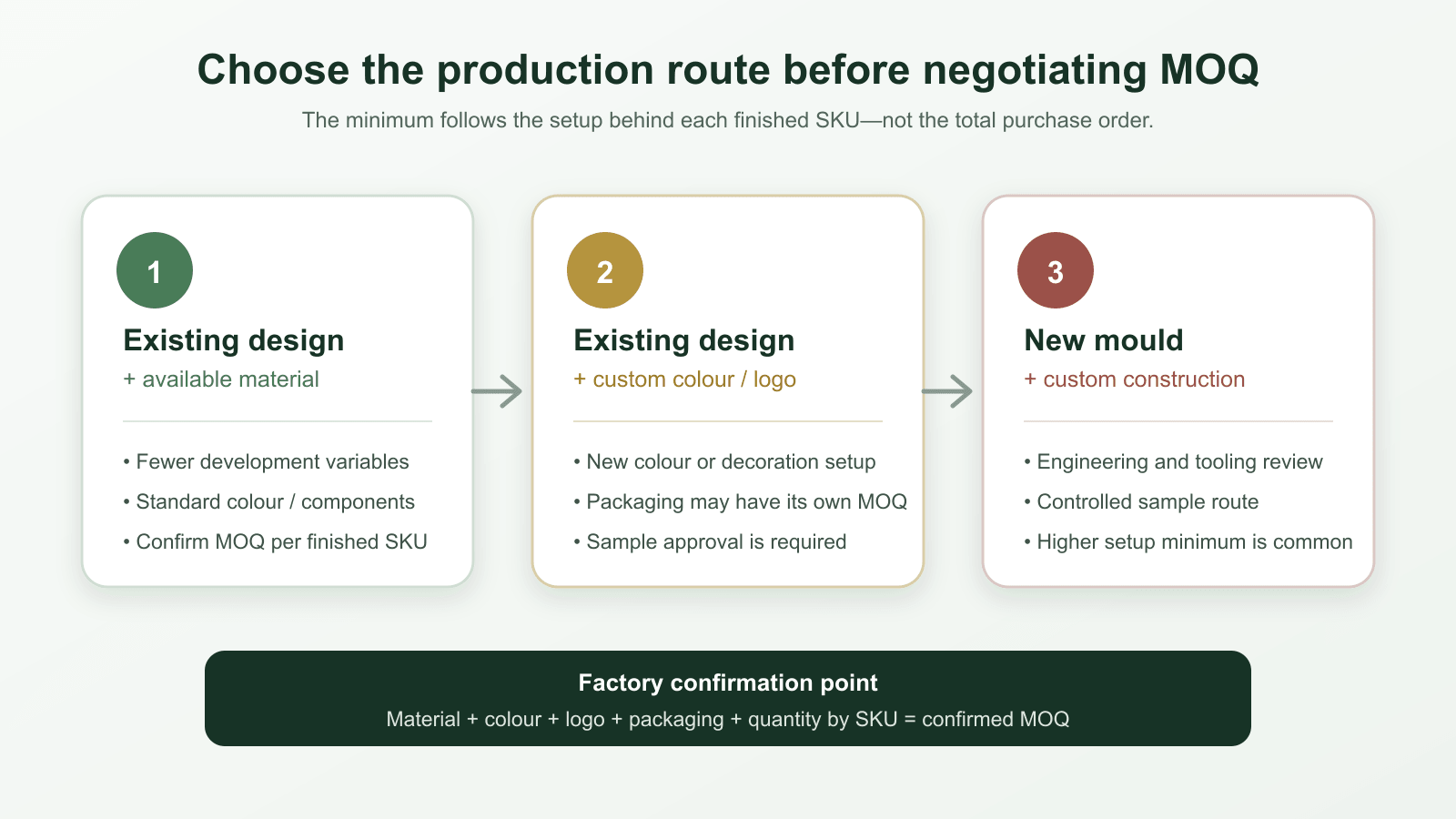
The MOQ for a custom hair accessory is normally set per SKU, not per purchase order. A change in material, body shape, colour, logo process, component, packaging or market requirement can create a separate setup and therefore a separate minimum. Two orders with the same total quantity can have very different production economics if one is a single proven design and the other is split across many colours and custom parts.
For planning—not as a universal quotation—JunYi Beauty currently uses the following starting points per SKU: 500 pieces for an existing cellulose-acetate clip design and 1,000 pieces or more for a custom acetate design; 500 pieces for an existing metal-clip design, while a custom metal design is reviewed according to its complexity; 1,000 pieces for an existing injection-moulded design and 3,000 pieces for a custom injection-moulded design; and 1,000 pieces for an existing brush or comb route and 3,000 pieces for a new-mould custom route. The confirmed MOQ still depends on the final design, material, colour split, components, logo and packaging.
First, define what the MOQ applies to
A supplier may say “MOQ 1,000,” but the useful question is “1,000 of what?” The minimum may apply to one body shape, one material batch, one colour, one logo artwork, one packaging format or one finished SKU. If the order is split into four colours, the factory may need four colour setups even though the purchase order total has not changed.
| Term | Practical meaning | Question to ask |
|---|---|---|
| Per design | One silhouette or construction | Can the same body be split across colours? |
| Per colour | One material or paint colour setup | What is the minimum per colourway? |
| Per SKU | One sellable combination of product, colour, logo and pack | Is the MOQ quoted per finished SKU? |
| Per material batch | Minimum sheet, resin, fibre or finish run | Can leftover material be held for a reorder? |
| Per packaging run | Minimum printed card, box, label or insert | Can generic packaging be used for the first order? |
Planning ranges by product route
The table below is a planning tool based on the factory’s current approved information. It should help a buyer build a sensible RFQ; it is not a price list or guaranteed acceptance threshold. Existing moulds, available material, colour splits, logo, packaging and order timing still need to be reviewed.
| Product / route | Current planning range | Main reason the minimum changes |
|---|---|---|
| Cellulose-acetate clips | Existing design: 500 pcs per SKU; custom design: 1,000+ pcs per SKU | Sheet availability, pattern/colour allocation, shaping and hand finishing |
| Metal clips | Existing design: 500 pcs per SKU; custom design: reviewed by complexity | Hardware/component batch, plating or finish setup, decoration |
| Injection-moulded plastic clips | Existing design: 1,000 pcs per SKU; custom design: 3,000 pcs per SKU | Machine setup, resin colour, mould cycle and assembly |
| Brushes and combs | Existing route: 1,000 pcs; new-mould custom route: 3,000 pcs | Body process, pin/bristle/cushion components, colour and assembly |
| Custom brush development | New-mould custom route: 3,000 pcs | The final construction, mould, components and packaging decide the confirmed minimum |
| Wheat-straw material | About 1,000 pcs in current factory planning | Compound/material preparation and production run |
| Coconut-fibre or coffee-ground material | About 10,000 pcs in current factory planning | Higher material-processing/batch requirement |
1. Existing mould or new shape
An existing mould can reduce tooling cost and shorten the route to a sample, but it does not automatically remove every minimum. Material, colour, components, decoration and packaging still have their own setup requirements. JunYi Beauty’s current factory information lists more than 2,000 existing moulds across brushes, combs and clips. A buyer can use that library to find a proven starting point, then confirm which changes remain feasible without new tooling.
A new proprietary shape requires engineering review, tooling and a controlled sample route. The factory’s approved planning information currently uses about 45 days for new-mould development and about 45 days for mass production excluding freight. Those lead times should be reconfirmed for each project because revisions, components and peak-season capacity can change them.
2. Material can create the real minimum
Cellulose acetate is processed from sheet rather than injected as a simple finished shape. MOQ therefore depends on the available sheet, pattern, thickness, cutting yield and how many styles or pieces can be allocated from that material. JunYi Beauty’s current product information lists acetate sheet thicknesses around 2.5–4 mm and allows buyer-supplied patterns to be reviewed. A common flat acetate comb is approximately 15 cm by 5.5 cm, but each design must be nested against the real sheet.
For injection-moulded products, resin colour and machine setup matter. For brushes, the body is only one part of the bill of materials: the cushion, pin or bristle type, tip treatment, handle, coating, logo and package can each create another supply minimum. Natural and alternative materials can have larger batch requirements than standard plastics, which is why an apparently simple material change may move a project from 1,000 to 10,000 pieces.
3. Colour splits turn one order into several production runs
A 3,000-piece order in one colour is not operationally identical to 3,000 pieces split across six colours. Each colour may require material allocation, colour matching, machine cleaning, spray setup or approval. Ask whether the factory allows the base MOQ to be divided and, if so, the minimum per colour.
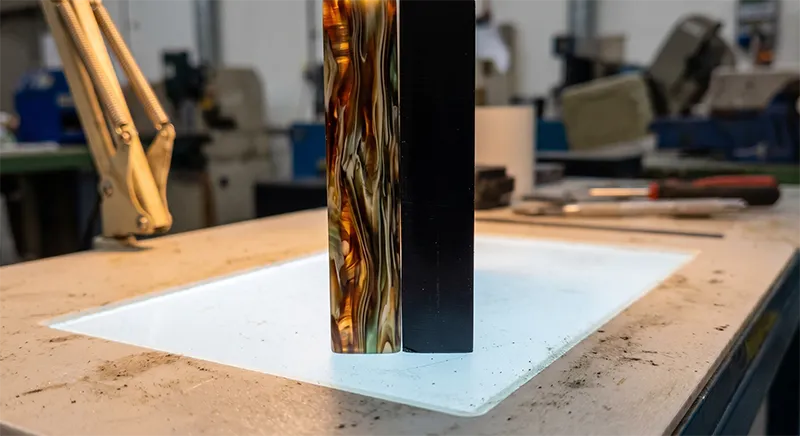
For patterned acetate, also ask whether the same sheet can be used across several shapes. For plastic or painted parts, confirm whether a colour is formed in the material or added as a finish. Those decisions affect consistency, durability, cost and the minimum viable batch.
4. Logo choice can add a tooling or manual-process minimum
Logo methods include laser engraving, silk-screen printing, pad printing, hot stamping, a metal plate and engraving with colour fill. The right method depends on the surface, curvature, colour count, required durability and brand look. A logo can be technically possible at a low quantity but uneconomical if a plate, jig, foil or manual fill process must be prepared for only a small run.
The factory has identified engraving with colour fill as a process with higher rework risk because the colour is filled by hand and may become uneven. That does not make the method unsuitable; it means the approval sample and inspection criteria need to define edge cleanliness, fill level and acceptable variation.
5. Packaging can have a different MOQ from the product
Printed backing cards, sleeves, gift boxes, labels and inserts are often sourced from a packaging partner. Their print minimum may be higher than the product minimum. A buyer testing a new SKU can ask whether a standard pouch or generic box with a label is acceptable for the first run, then move to fully printed packaging after demand is proven.
State the pack-out at quotation stage: individual bag or card, barcode, warning or material label, retail box, inner carton and master carton. JunYi Beauty’s current general carton planning is often around 100 pieces per carton, but actual carton quantity, dimensions and gross weight depend on product size and retail packaging.
A real example: why 500 pieces became 1,000
This is why buyers should not negotiate MOQ as an isolated number. Ask which material, component or setup creates the minimum, and which design changes could reduce it without weakening the product. A smaller order may be possible by using an existing mould, an available material, fewer colours or simpler packaging—but the factory must confirm the actual route.
6. Build an MOQ plan by SKU
| SKU planning field | Example entry | Why it matters |
|---|---|---|
| Body/design | Existing 11 cm acetate claw silhouette | Defines mould or shaping route |
| Material | 2.5–4 mm patterned acetate; sheet to be confirmed | Defines batch and cutting yield |
| Colour/pattern | Two patterns, 500 pcs each | May create separate material allocation |
| Hardware | Standard spring in approved finish | Component supply can set a minimum |
| Logo | One-colour pad print, same artwork | Plate/setup and inspection stay common |
| Packaging | Standard pouch + brand label | Avoids a high custom-box print minimum |
| Market | US adult accessory | Controls required labels and evidence questions |
7. Ask for three quantity scenarios, not one
A useful quotation can show the confirmed MOQ, the next efficient quantity break and a scale quantity—for example, the minimum, twice the minimum and a forecast reorder level. The goal is not to force a lower number; it is to see where fixed setup costs, packaging and material purchasing become more efficient.
- Scenario A: smallest viable order with existing mould/material and standard packaging.
- Scenario B: preferred launch order with final colour, logo and retail pack.
- Scenario C: reorder or scale quantity using the same approved specification.
- For each scenario: state units per SKU, tooling, sample cost, packaging, production lead time and freight basis separately.
When a lower MOQ is a bad bargain
A lower MOQ is useful only if the product still meets the intended specification. It can become a false saving when the buyer accepts an unsuitable material, weak component, poor logo method, incomplete packaging or no proper pre-production approval. It can also produce too many low-volume colourways to manage, creating stock fragments and inconsistent reorders.
Compare the total launch cost and risk: samples, tooling, unit price, packaging, inspection, freight and the cost of a failed SKU. A slightly larger run of one proven design may be safer than several tiny custom runs that each require a different setup.
Prepare the right facts before asking for a lower MOQ
Send the product reference, material, dimensions, quantity by SKU and colour, logo artwork, packaging, target market and launch timing. Ask the factory to identify which requirement creates the MOQ. Then decide whether to keep that feature, use an existing option, consolidate colours or plan a larger run.
JunYi Beauty manufactures custom brushes, combs, clips and claws with existing-mould and new-development routes. A project-specific review is needed before any MOQ, sample fee or lead time is confirmed.
Send the proposed SKU breakdown through our contact page so the factory can confirm the applicable route and minimum.