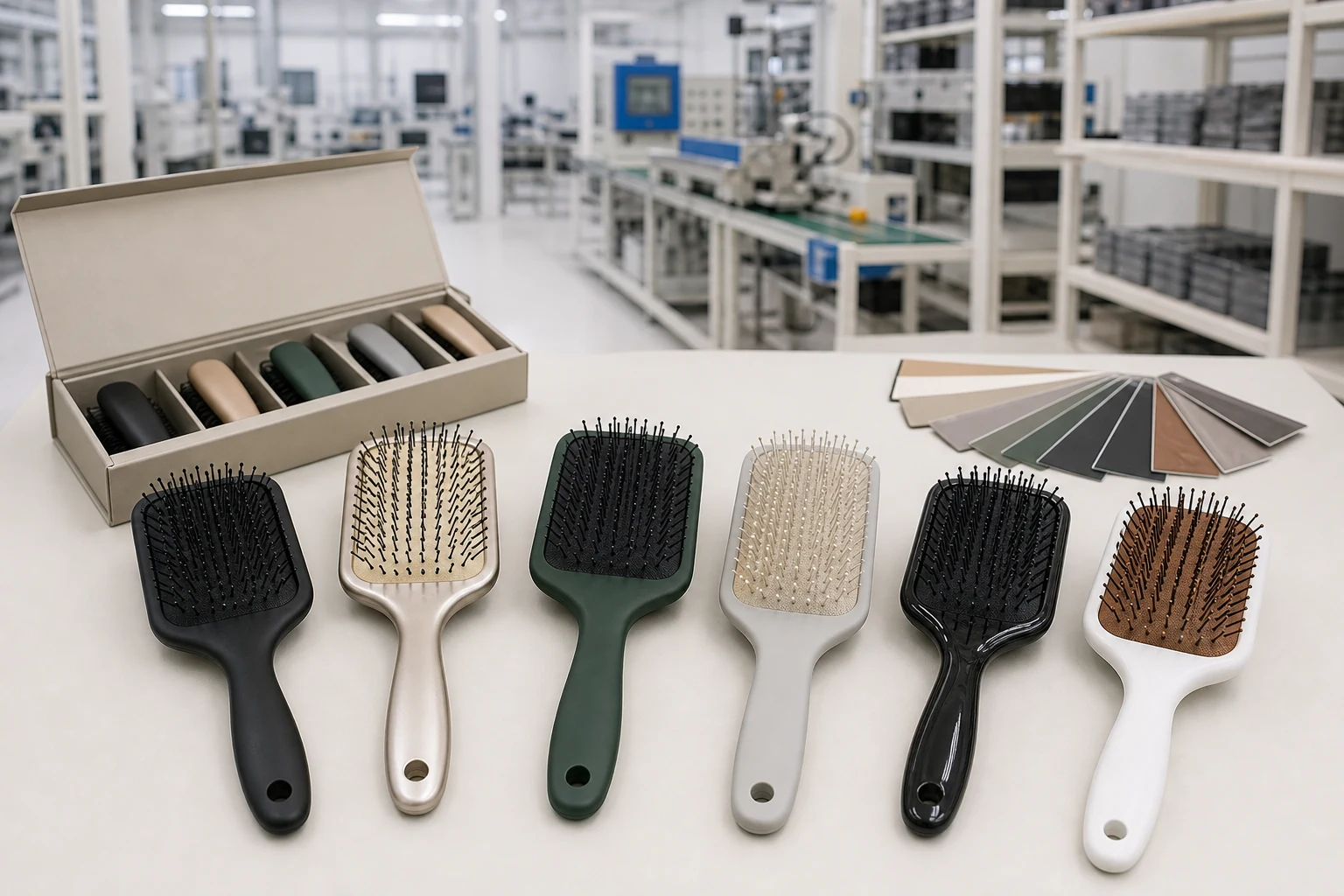
A custom hair brush or comb quotation is built from five separate cost blocks: material, tooling, order volume, bristle or tooth setting method, and branding and packaging. Buyers who compare only the per-unit price routinely misjudge total project cost, because tooling and sampling are charged once while the unit price falls as volume rises.
In short: the MOQ is 1,000 pieces per SKU, new tooling starts at approximately US$4,200 and is charged only when an existing mould cannot be used, and moving from 1,000 to 5,000 pieces reduces the unit price by roughly 10%. The sections below set out how each of those figures is arrived at, and which specification decisions move a quotation most.
The figures reflect standard OEM practice for hair brushes and combs produced in Guangdong. They are production parameters rather than a quotation — final pricing depends on the specification submitted. If you are sourcing hair accessories instead, the equivalent breakdown for clips is set out in our guide to the cost of manufacturing custom hair clips in China.
1. What Is the MOQ for Custom Hair Brushes and Combs?
The minimum order quantity for custom hair brushes and combs is 1,000 pieces per SKU. "Per SKU" means per finished variant: a paddle brush produced in three colours is three SKUs, not one, because each colour requires its own material batch and machine changeover. Integrated-moulded detangling brushes carry a higher entry quantity, typically 2,000 pieces per SKU, because the bristles and body are formed as a single TPE or PP piece and the moulding cycle is only economical at volume.
The MOQ is not an arbitrary threshold. It is the point at which the fixed costs of a production run — mould setup, colour matching, machine changeover, first-article inspection — can be absorbed without distorting the unit price. Below that quantity the setup cost per piece rises steeply enough that the quotation stops being competitive for both sides.
| Brush or Comb Type | Body Material | Setting Method | Entry MOQ (pcs/SKU) | Production Lead Time |
|---|---|---|---|---|
| Paddle brush | ABS or wood | Machine tufting | 1,000 | 30–45 days |
| Cushion brush | ABS + rubber pad | Machine tufting + pad bonding | 1,000 | 30–45 days |
| Round brush | ABS or ceramic / aluminium barrel | Machine or hand setting | 1,000 | 35–50 days |
| Vented brush | ABS | Machine tufting | 1,000 | 30–45 days |
| Detangling brush | TPE or PP | Integrated moulding | 2,000 | 25–40 days |
| Boar bristle brush | Wood or ABS | Hand setting | 1,000 | 40–60 days |
| Injection-moulded comb | ABS, PP or carbon fibre | Moulded teeth, deburred | 1,000 | 25–40 days |
| Wooden comb | Beech, walnut, sandalwood, bamboo | CNC cut, hand sanded | 1,000 | 35–50 days |
| Acetate comb | Cellulose acetate sheet | Sawn teeth, hand polished | 1,000 | 35–50 days |
Lead times above cover bulk production only. They exclude sampling, new mould development and international freight. For the full enquiry-to-delivery timeline, see our breakdown of lead time for custom hair accessories.
OEM production note: Count your SKUs before you compare quotations. Brands routinely brief "1,000 pieces" while specifying four colourways, which is a 4,000-piece order at MOQ, not a 1,000-piece one. Confirming the colour count at enquiry stage avoids a re-quote that costs a week.
2. Do You Have to Pay for a Mould, and How Much Does It Cost?
You pay for a mould only when your design cannot be produced from an existing one. A factory operating a large mould library — ours holds more than 2,000 active brush moulds across three brush facilities — can usually match a brand brief to a proven body shape, in which case tooling cost is zero and the mould development stage drops out of the schedule entirely. Most first orders from new brands are produced this way.
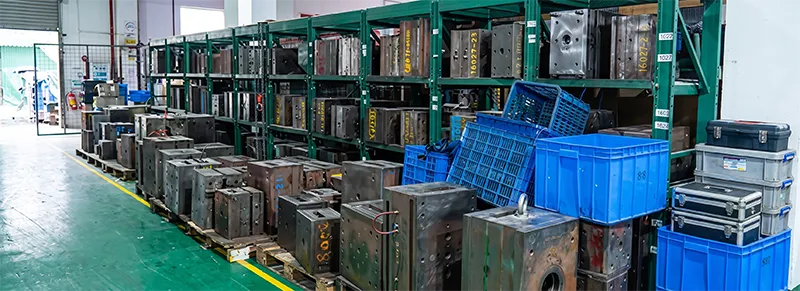
Where new tooling is required, a basic brush or comb mould starts at approximately US$4,200 (RMB 30,000). That figure covers a single-piece body — a standard paddle back, a handle profile, or a moulded comb. Designs built from several moulded components are quoted above it, because each additional part needs its own cavity: a detachable handle, a separate cushion frame, or a two-material body are all separate tooling lines on the same quotation.
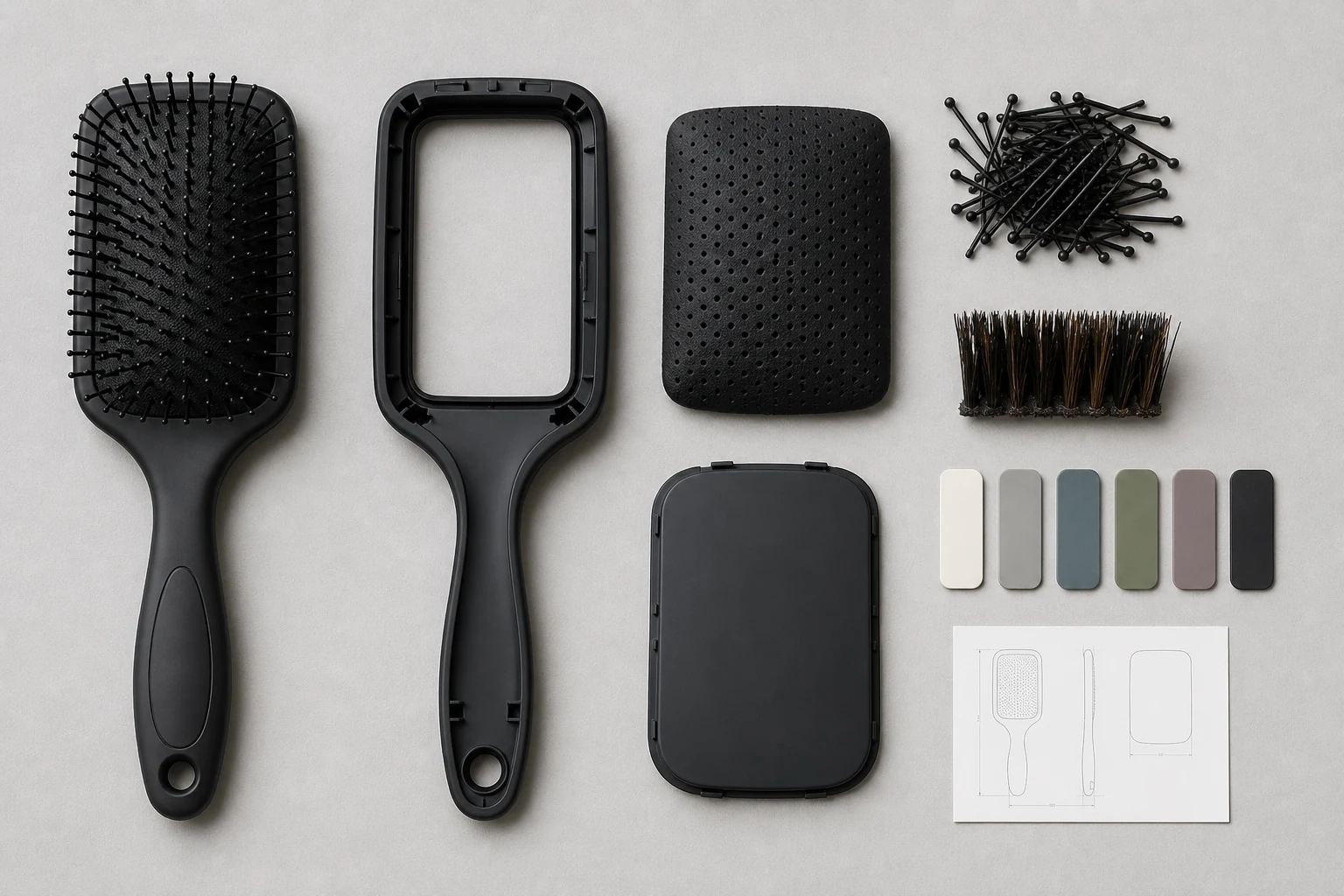
Three points decide where a quotation lands above that baseline:
- Cavity count. A single-cavity mould is the cheapest to cut and the slowest to run. Multi-cavity moulds cost more upfront and produce several pieces per cycle, which lowers the unit price on large orders. The trade-off is worth modelling before committing.
- Steel grade. Harder tool steel costs more and survives more shots before refurbishment. For a design a brand expects to reorder for years, the higher grade is the cheaper decision.
- Geometry. Vent slots, undercuts and integrated bristle geometry all add machining complexity. A flat-back paddle body is the simplest brush mould; a vented round barrel with an internal ceramic sleeve is among the most involved.
| Tooling Type | What It Produces | Indicative Cost | Development Time |
|---|---|---|---|
| ABS injection mould, single-piece body | Paddle backs, handles, injection-moulded combs | From approx. US$4,200 (RMB 30,000) | 30–45 days |
| Additional moulded component | Detachable handle, cushion frame, second material | Quoted per part, added to the base mould | 30–45 days |
| Round brush barrel section | The barrel only — one per diameter (25 / 32 / 43 / 53 mm) | Approx. US$2,800 (RMB 20,000) per diameter | 30–45 days |
| Acetate shaping mould | Pressed acetate comb and clip forms | Lower than injection tooling | 20–30 days |
| CNC programme (wood) | Wooden comb and handle profiles — no steel mould required | No steel tooling charge | 7–14 days |
Round brushes are the case brands most often misjudge, usually in the pessimistic direction. Extending a range across diameters does not mean paying for a complete new mould each time: the end caps and handle carry over, and only the barrel section is diameter-specific — approximately US$2,800 (RMB 20,000) per additional diameter. A four-size range is therefore one body mould plus three barrel sections, not four full tooling charges.
Wooden combs and wooden brush handles avoid steel tooling altogether. They are CNC-cut from a programme, which is faster and cheaper to originate but carries a higher per-unit labour cost, because sanding and finishing stay manual. For a short first run, wood is often the cheapest route to a genuinely custom shape.
OEM production note: Ask for the mould list before you ask for a quote. If an existing profile is within a few millimetres of the brief, adopting it removes the tooling cost and several weeks from the schedule — and on a first order that is almost always a better use of budget than a bespoke silhouette no customer will consciously notice. A mould paid for by the buyer is, under standard OEM terms, physically retained by the factory for production use; whether it can later be transferred elsewhere is a contract question, and it should be settled in writing before the tooling deposit is paid.
3. How Much Does the Unit Price Drop Between 1,000 and 5,000 Pieces?
Moving from the 1,000-piece MOQ to a 5,000-piece order reduces the unit price by approximately 10%. That is the working figure for a standard custom brush or comb, and it is worth stating plainly because expectations on this point are unrealistic in both directions. Buyers who assume a five-fold order buys a 40% discount are disappointed; buyers who assume volume changes nothing leave margin on the table.
The reason the figure sits around 10% rather than higher is that the unit price falls only because fixed costs are divided across more pieces — the material itself does not get materially cheaper. Knowing which costs are fixed and which are variable is what lets a buyer predict the price break instead of negotiating blind.
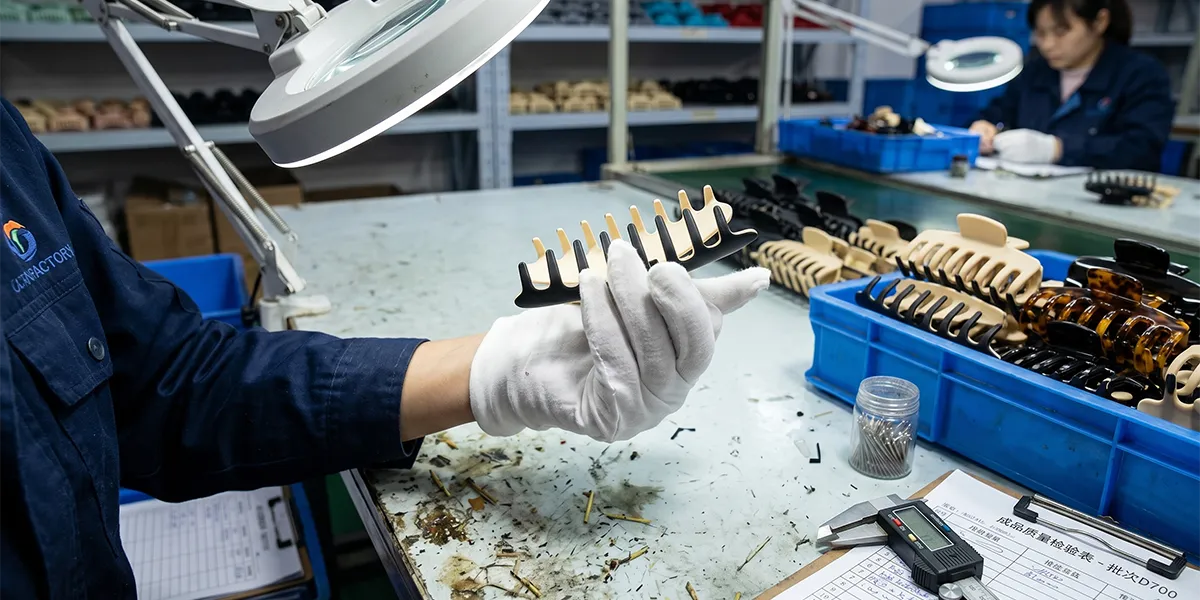
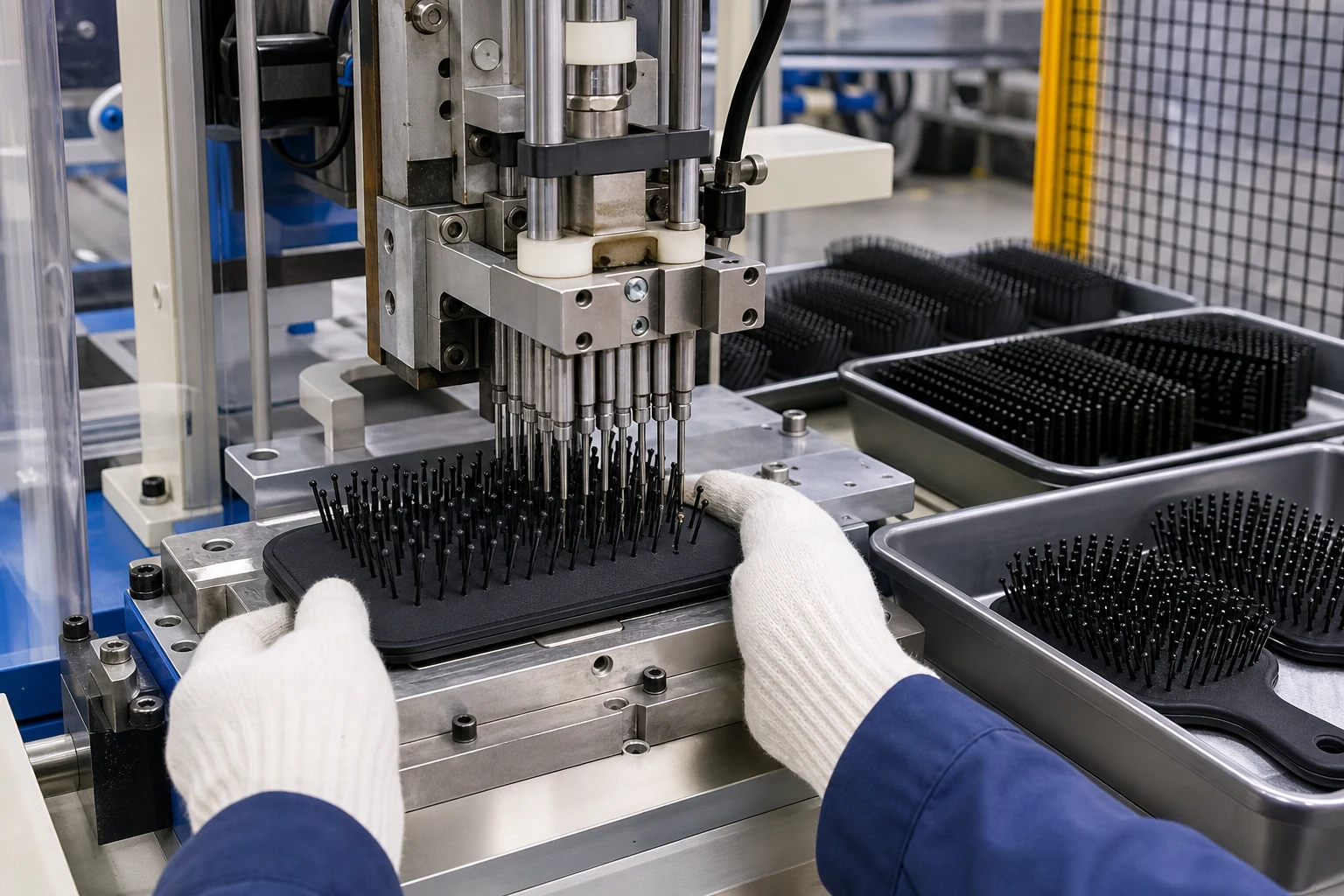
The machine in the video is the clearest illustration of the point. Configuring it — tuft pattern, insertion depth, bristle density — costs the same whether the run that follows is 1,000 pieces or 10,000. That setup is the fixed cost being spread.
| Fixed Per Production Run (amortises with volume) | Variable Per Piece (does not amortise) |
|---|---|
| Mould setup and machine changeover | Body material and bristle material |
| Colour matching and first material batch | Bristle-setting machine time |
| Bristle machine configuration (pattern, depth, density) | Surface treatment consumables — lacquer, plating solution, ink |
| First-article inspection and line setup | Assembly and hand-finishing labour |
| Printing screen or transfer film origination | Individual packaging |
Because the saving comes from spreading the left-hand column, it is not evenly distributed across a product line. Machine-tufted brushes are dominated by setup cost, so they track the 10% figure closely. Hand-set boar bristle brushes and hand-polished acetate combs carry a much larger share of manual labour, which scales with quantity and does not amortise — the volume saving on those is real but flatter. Brands that apply a single volume discount across a mixed range consistently over-forecast their margin on the hand-finished SKUs.
Two practical consequences follow. First, the unit price quoted at MOQ is not representative of the price at scale and should not be used to model long-term margin. Second, when testing a new design, the cheapest total-cost route is usually to order at MOQ from an existing mould, validate demand, then commit to tooling and volume on the reorder.
4. What Costs Sit Outside the Unit Price?
The quoted unit price is an FOB figure covering production and delivery to the port. Several project costs sit outside it, and they are the most common reason a landed cost lands above budget.
| Cost Item | When It Applies | Typical Figure |
|---|---|---|
| Pre-production sample | Per design, before bulk approval | US$40–100 per design, usually deducted from the first bulk order |
| Mould or tooling fee | Only for designs not in the mould library | From approx. US$4,200 for a single-piece body; additional components quoted per part |
| Logo origination | Screen printing and heat transfer only | One-off per artwork; a logo embossed into the mould carries no per-unit cost |
| Custom packaging | Branded box, sleeve, hang tag, insert card | Quoted per component; often exceeds the brush cost on gift-set SKUs |
| Third-party inspection | If the buyer appoints an external inspector | Buyer's account |
| Freight and duty | All orders | Sea 15–20 days to US West Coast, 25–30 days to US East Coast, 25–35 days to Northern Europe; air 5–7 days |
Payment terms follow standard OEM practice: a production deposit of 30% confirms the order and books the production slot, with the balance settled against shipping documents. Tooling, where required, is normally invoiced separately and in full before mould cutting begins, because the mould is cut specifically for that buyer's design.
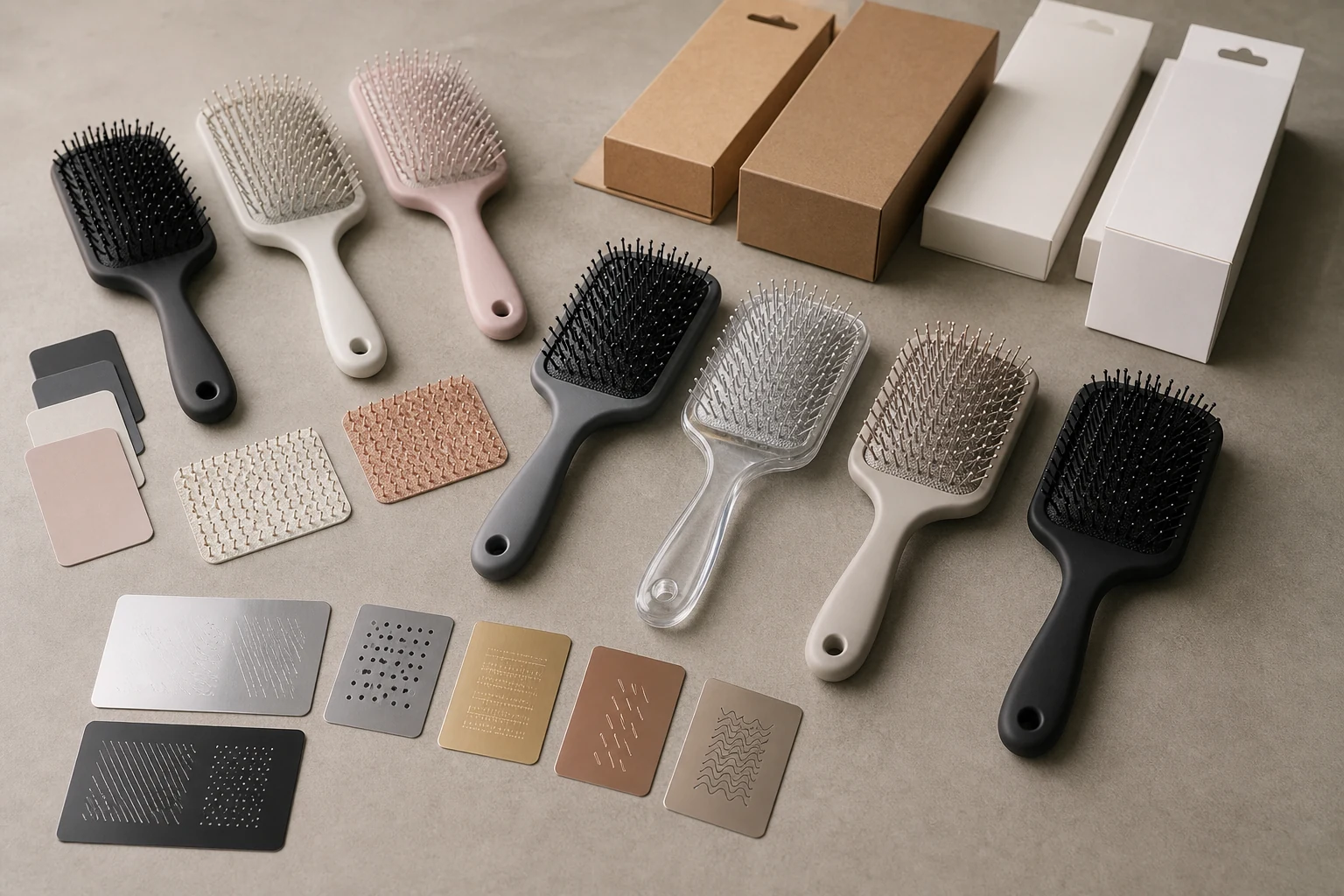
The single largest avoidable cost on a first project is logo method. A logo embossed or debossed directly into the injection mould is formed during moulding and adds nothing per unit. Screen printing, heat transfer and electroplated badges each add a per-unit charge that compounds across the whole order. Choosing the branding method before the mould is cut, rather than after, is worth more than most unit-price negotiation. The trade-offs are set out in our guide to hair brush logo printing methods.
5. Which Specification Decisions Move the Price Most?
Four decisions account for most of the spread between a low and a high quotation on the same brush shape.
Body material
Injection-moulded ABS is the lowest-cost body and the fastest to produce. Wood requires CNC cutting, sanding and finishing, all labour-intensive. Cellulose acetate is the most expensive of the common materials — the raw sheet costs more than petroleum-based plastic, and the process is cut, heat, shape, hand-polish rather than a single moulding cycle.
Bristle type and setting method
Machine-tufted nylon is the cost baseline. Epoxy ball tips are added in a secondary operation. Boar bristle is hand-set and carries both a higher material cost and a materially longer production window — 40 to 60 days against 30 to 45 for a machine-tufted paddle. Mixed boar-and-nylon heads sit between the two. Our bristle specification guide covers the full range and how each behaves in production.
Construction complexity
A cushion brush needs a pneumatic rubber pad bonded to the head, which adds roughly 10–15% to the per-unit cost against a basic paddle brush of the same size. Vented bodies require vent-slot geometry in the mould, adding tooling complexity but very little per-unit cost once the mould exists.
Surface treatment
Matte and gloss lacquer are standard. Rubberised soft-touch coating, electroplating and water-transfer patterns each require dedicated equipment and add both unit cost and process time. Treatment choice also constrains the logo method, since not every ink adheres to every finish — which is why the two decisions should be made together rather than sequentially. See our overview of hair brush surface finishes.
6. How Should a Buyer Structure a First Order?
The lowest-risk structure for a first custom brush or comb project is: existing mould, MOQ quantity, one or two colourways, embossed logo. That combination carries no tooling cost, the shortest lead time and the smallest inventory commitment, while still producing a genuinely branded product.
Design freedom can then be added on the reorder, once the SKU has sold through and the volume justifies it. Brands that invert this order — commissioning custom tooling across five colourways before any sell-through data exists — carry the tooling cost, the longest lead time and the largest inventory risk simultaneously.
To get an itemised quotation rather than a single number, submit the full specification at enquiry: brush or comb type, body material, size, bristle or tooth specification, surface treatment, logo method and placement, packaging, quantity per SKU, and number of SKUs. A quotation that separates material, tooling, treatment, branding and packaging is the only kind that supports meaningful supplier comparison — a single bundled unit price cannot be compared across factories.
If you are still deciding how much design control you need, our comparison of OEM versus ODM covers where the responsibility sits in each model.
7. Conclusion
The three numbers that matter on a first custom brush or comb project are simple enough to hold in your head: 1,000 pieces per SKU, tooling from approximately US$4,200 and only when an existing mould will not do, and roughly 10% off the unit price at 5,000 pieces.
Everything else is a consequence of those three. Tooling is avoidable on a first order and often should be. Volume discounts are real but modest, and they arrive only on the parts of the process a machine performs. The costs that break a budget are rarely the unit price — they are the sample fees, the packaging, the logo method chosen after the mould was cut, and the freight nobody quoted.
Our custom hair brush and custom hair comb pages set out the available shapes, materials, bristle options, finishes and packaging in specification form, which is the fastest way to assemble a brief that returns an itemised quote.
A sample round is the cheapest way to confirm specification and price before paying for tooling. Our samples and prototypes page explains what the sampling process involves and how long it takes.