Hair brushing is the act of drawing a bristled tool through the hair to detangle, smooth, distribute natural oils, and style. It is one of the oldest and most universal grooming practices — and one surrounded by persistent myths about its effect on hair growth. The most enduring claim is that frequent, vigorous brushing stimulates the scalp and causes hair to grow faster. This belief has been passed through generations, most notably in the form of the "100 brush strokes a day" rule.
The short answer: brushing does not make hair grow faster. Hair growth rate is a biological constant determined by genetics, hormones, and systemic health — not by mechanical stimulation from a brush. However, the relationship between brushing and hair health is real, and understanding what brushing actually does (and does not do) provides a more useful framework than the myth itself.
1. How Hair Actually Grows
To understand why brushing cannot accelerate growth, it is necessary to understand how hair growth works at the follicular level.
Each hair strand grows from a follicle embedded approximately 3–4 mm beneath the scalp surface. The follicle contains a cluster of cells called the dermal papilla, which receives blood supply and generates the keratin protein that forms the hair shaft. Hair growth occurs in three cyclical phases:
- Anagen (growth phase): The active growth period during which the follicle produces new hair cells. This phase lasts 2–7 years and determines the maximum length hair can reach. Approximately 85–90 percent of scalp hair is in the anagen phase at any given time.
- Catagen (transition phase): A brief period of approximately 2–3 weeks during which the follicle shrinks and detaches from the dermal papilla. Growth stops.
- Telogen (resting phase): The follicle remains dormant for approximately 3 months before shedding the hair strand and re-entering the anagen phase. Normal daily shedding of 50–100 hairs is the result of follicles completing the telogen phase, according to the American Academy of Dermatology.
The speed at which hair grows during the anagen phase is approximately 1.25 cm (half an inch) per month, or roughly 15 cm (6 inches) per year. This rate is governed by genetics, age, hormonal balance, and nutritional status. No external mechanical action — including brushing, combing, or scalp massage — can change the follicle's genetically programmed growth rate.
2. What Brushing Actually Does for Hair
While brushing does not accelerate growth, it produces several measurable effects on hair and scalp health. Understanding these effects explains why well-brushed hair often appears healthier and longer — even though the growth rate has not changed.
Distributes Natural Oils (Sebum)
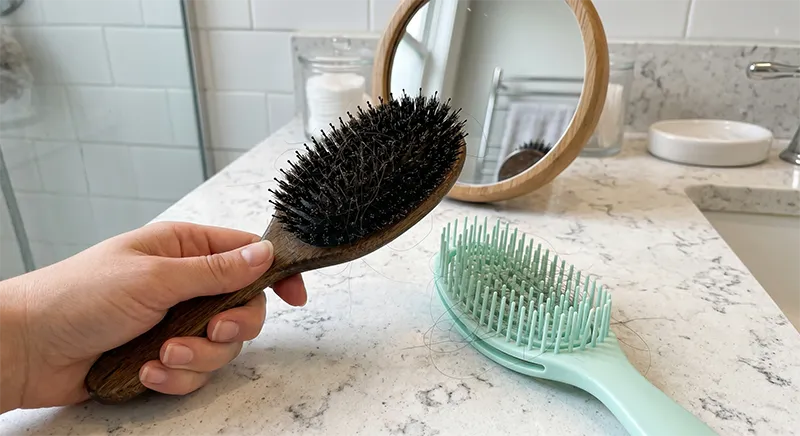
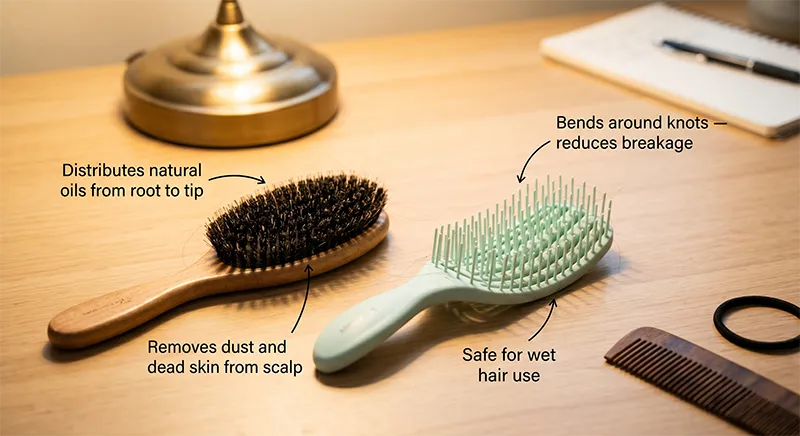
The scalp produces sebum — a natural oil that moisturises and protects the hair shaft. Without brushing, sebum concentrates near the roots while the mid-lengths and ends remain dry. Brushing, particularly with natural boar bristles, carries sebum along the full length of the hair shaft. This creates a protective coating that adds shine, reduces friction between strands, and makes the hair more resistant to breakage.
Stimulates Scalp Circulation
Gentle brushing temporarily increases blood flow at the scalp surface. Improved circulation delivers oxygen and nutrients to the dermal papilla, supporting healthy follicle function. However, the increase is modest and temporary — comparable to the effect of a scalp massage. There is no clinical evidence that this short-term circulation boost translates to a measurable increase in growth speed.
Removes Loose Hair and Debris
Daily brushing removes shed hairs that are already detached from the follicle, along with dust, dead skin cells, and product residue. This prevents buildup that can clog follicles and create an unhealthy scalp environment.
Reduces Breakage (When Done Correctly)
Gentle brushing with the right tool prevents small tangles from becoming large knots, which require more force to remove and cause more breakage. By managing tangles proactively, brushing helps hair retain its full length — which can create the appearance of faster growth, even though the actual growth rate is unchanged.
3. Common Brushing Myths Debunked
Several widely repeated claims about brushing and hair growth lack scientific support. The following table separates fact from fiction.
| Claim | Verdict | Explanation |
|---|---|---|
| Brushing 100 strokes per day makes hair grow faster | Myth | No scientific basis. Excessive brushing increases cuticle friction, causing split ends, breakage, and mechanical damage that actually shortens visible hair length. |
| Brushing stimulates dormant follicles | Myth | Follicle activation is controlled by hormonal signals and the dermal papilla cell cycle, not by surface-level mechanical stimulation from a brush. |
| More brushing equals healthier hair | Myth | Over-brushing damages the cuticle layer. Research indicates that 91 percent of women perform at least one damaging hair practice daily, with excessive brushing among the most common. |
| Brushing distributes natural oils and improves hair condition | Fact | Boar bristle and mixed-bristle brushes effectively transport sebum from the roots along the hair shaft, improving moisture distribution and adding shine. |
| Brushing temporarily increases scalp blood flow | Fact | Gentle brushing does increase surface circulation, though the effect is modest and has not been shown to accelerate follicular growth rate. |
| Brushing helps retain hair length by reducing breakage | Fact | Proper brushing with appropriate tools prevents tangles from escalating into breakage points, allowing hair to retain its full grown length. |
4. How to Brush Hair Correctly for Maximum Benefit
Since the benefits of brushing come from oil distribution, gentle detangling, and debris removal — not from stimulating growth — the technique matters more than the frequency.
Frequency
Once or twice daily is sufficient for most hair types. Brushing should be performed as needed for detangling and styling, not as a repetitive ritual. Curly and textured hair may require less frequent brushing, as excessive manipulation disrupts curl pattern and increases frizz.
Technique
- Start from the ends and work upward in short sections, clearing tangles progressively rather than pulling from root to tip.
- Use gentle, controlled strokes. If resistance is felt, stop and work through the knot from below rather than forcing through from above.
- For thick or long hair, divide into sections and brush each section individually.
- Never brush soaking wet hair with a standard stiff-bristle brush. Wet hair is up to 50 percent weaker than dry hair due to hydrogen bond disruption. Use a flexible detangling brush or wide-tooth comb on damp hair.
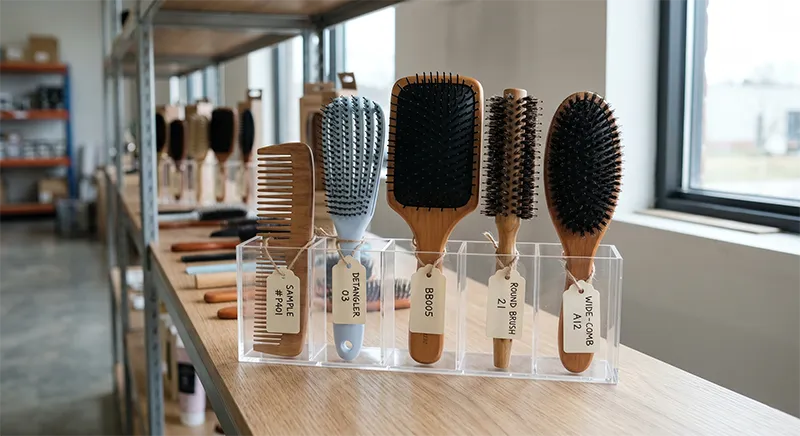
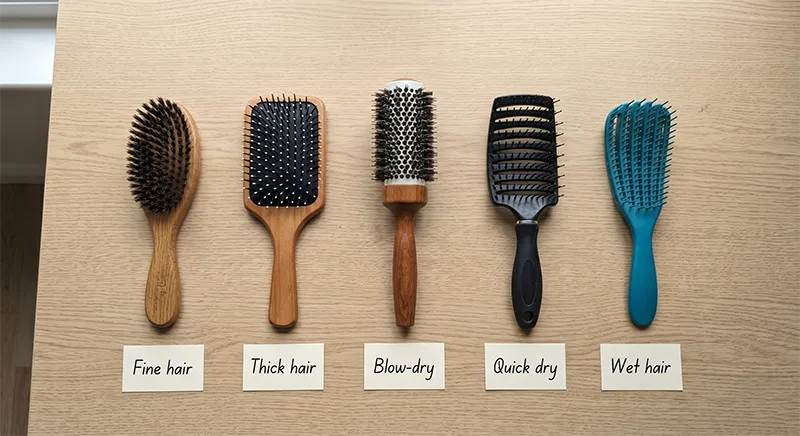
Brush Selection by Hair Type
| Hair Type | Best Brush | Why |
|---|---|---|
| Fine, straight | Boar bristle or soft cushion brush | Distributes oils without overloading fragile strands. Gentle enough to avoid breakage. |
| Thick, coarse | Paddle brush with nylon or mixed bristles | Firm bristles penetrate dense hair. Wide head covers more surface area per stroke. |
| Curly, coily | Detangling brush (flexible bristles) or wide-tooth comb | Flexible bristles bend around curl pattern rather than disrupting it. Best used on damp, conditioned hair. |
| Wavy | Vented brush or detangling brush | Preserves wave structure while removing tangles. Vented design accelerates blow-dry time. |
| Wet hair (any type) | Flexible detangling brush | TPE or flexible nylon bristles deflect around knots on weakened wet hair without pulling. |
For a comprehensive overview of brush types and their functions, see the complete guide on types of hair brushes.
5. What Actually Affects Hair Growth Rate
If brushing does not accelerate growth, what does? The factors that genuinely influence hair growth rate are biological, not mechanical.
- Genetics: The primary determinant of growth rate, maximum hair length, hair density, and follicle cycling patterns. Genetic programming controls how long each follicle remains in the anagen (growth) phase.
- Hormones: Androgens, thyroid hormones, and oestrogen all influence hair growth. Hormonal imbalances — including those caused by thyroid disorders, pregnancy, or menopause — can significantly alter growth rate and hair density.
- Nutrition: Hair follicles require iron, zinc, biotin, vitamin D, and protein to produce healthy keratin. Deficiencies in these nutrients can slow growth and produce weaker, more breakage-prone hair.
- Age: Hair growth rate declines gradually with age. The anagen phase shortens, follicle density decreases, and hair diameter reduces — producing progressively thinner, slower-growing hair over time.
- Scalp health: Conditions such as dandruff, seborrheic dermatitis, and folliculitis can impair follicle function and reduce growth. Maintaining a clean, healthy scalp environment supports optimal follicle performance.
- Damage avoidance: While not a growth accelerator, preventing breakage through proper brushing, minimal heat styling, and avoidance of harsh chemical treatments allows hair to retain its full grown length — which is the most practical way to achieve longer hair. For information on hair porosity and its effect on damage susceptibility, see the guide on low porosity hair.
6. Does Brushing Cause or Prevent Hair Loss?
A related concern for many consumers is whether brushing causes hair loss, or conversely, whether it can prevent it. The answer depends on the type of hair loss involved.
Normal Shedding vs Breakage
Seeing hair in the brush after brushing is normal. Most of this hair is already in the telogen (shedding) phase and has detached from the follicle — brushing simply collects it. Normal daily shedding of 50–100 hairs is not hair loss; it is the natural completion of the growth cycle. The hairs are replaced by new growth from the same follicles.
Brushing-Related Breakage
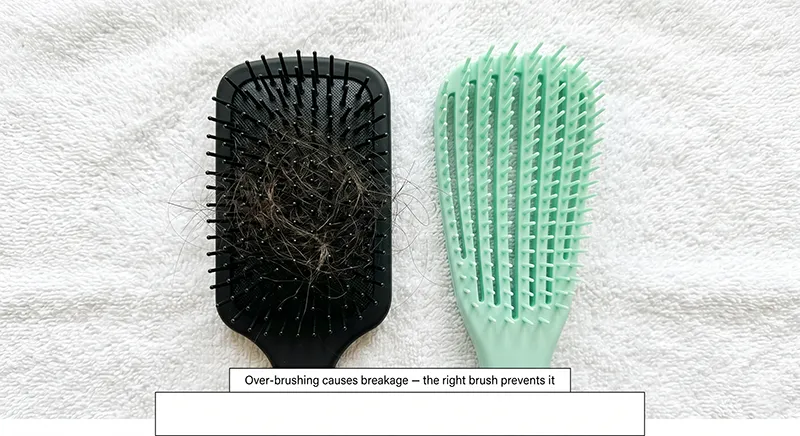
Improper brushing — using excessive force, brushing wet hair with stiff bristles, or over-brushing — can cause hair to break along the shaft. Broken hairs do not fall from the follicle; they snap partway along their length, producing shorter fragments that create the appearance of thinning. This is mechanical damage, not follicle-level hair loss, and it is entirely preventable through correct tool selection and technique.
Genetic Hair Loss (Androgenetic Alopecia)
Brushing can neither cause nor prevent androgenetic alopecia, the most common form of hair loss. This condition is driven by follicle sensitivity to dihydrotestosterone (DHT) — a hormonal process that no amount of brushing can influence. Individuals experiencing pattern hair loss should consult a dermatologist rather than adjusting brushing habits.
For an overview of how different brush types interact with hair health, see the guide on who should and should not use a boar bristle brush.
7. Conclusion
Brushing hair does not make it grow faster. Hair growth rate is a biological constant governed by genetics, hormones, and nutrition — not by mechanical stimulation from a brush. The "100 strokes a day" rule has no scientific foundation and, if followed literally, causes more damage than benefit through cuticle friction and mechanical breakage.
What brushing does do is support the conditions that allow hair to retain its full grown length. By distributing natural oils, gently removing tangles before they escalate, and clearing debris from the scalp, proper brushing helps hair look longer, healthier, and shinier — not because it grew faster, but because less of it broke off along the way.
The most impactful brushing decision is tool selection. Using a brush that matches the hair type — boar bristle for fine hair, flexible detangling for wet or curly hair, wide-tooth comb for textured hair — determines whether brushing protects or damages the hair. For brands and retailers building hair brush product lines, educating consumers on this distinction through packaging inserts and product descriptions improves satisfaction and reduces returns. Manufacturers such as JunYi Beauty produce brushes across all major categories, from boar bristle to flexible TPE detangling designs, at the company's Dongguan production facility. For the full range of available styles, see the hair brush product catalogue. For an overview of manufacturer options, see the guide on top 10 custom hair brush manufacturers.