The terms claw clip, jaw clip, and barrette appear across product listings, beauty tutorials, and salon supply catalogues — often with little explanation of how they relate to each other. For anyone shopping for hair accessories or assembling a product line, the confusion is understandable: are claw clips and jaw clips different products? How does a barrette compare to either? And which one is actually the right choice for a given hair type or styling goal?
The short answer is that claw clips and jaw clips are the same product with two different names. Barrettes, on the other hand, are a fundamentally different clip type with a different mechanism, different hold characteristics, and different use cases. This guide clarifies the terminology, compares the two distinct clip categories in detail, and covers which option works best for different hair types and styling scenarios.
1. Claw Clip and Jaw Clip: Two Names, One Product
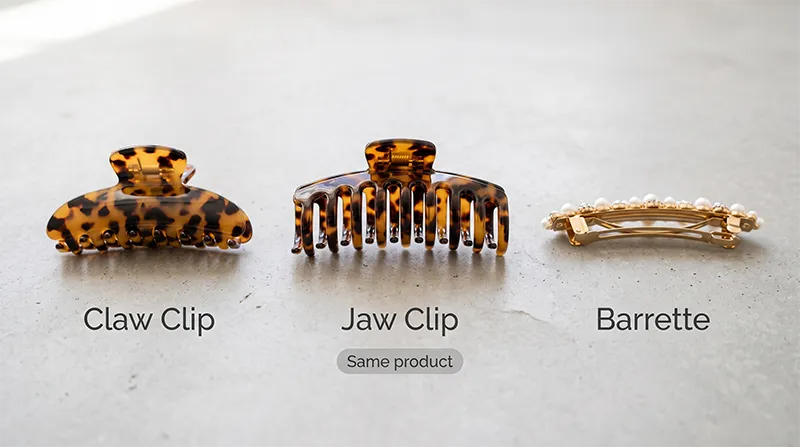
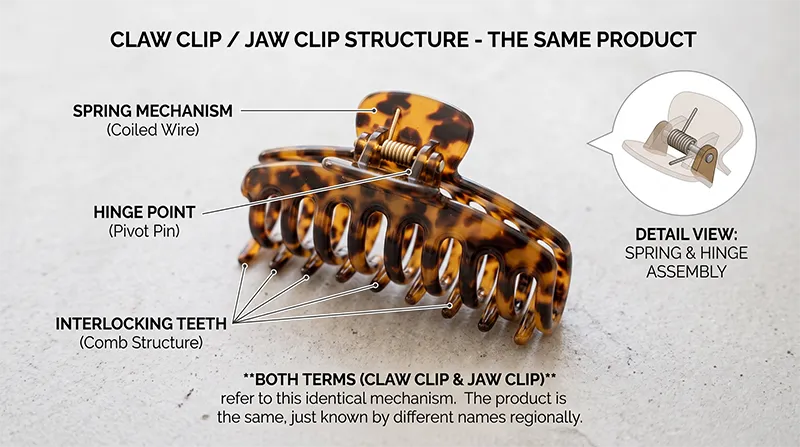
A claw clip and a jaw clip are the same hair accessory. Both refer to a spring-loaded clip with two sets of interlocking teeth (or prongs) connected by a hinge and spring mechanism. When squeezed, the two halves open; when released, the teeth interlock to grip a bundle of hair.
The naming difference is simply a matter of convention. "Claw clip" is the dominant term in consumer retail and social media — it references the claw-like appearance of the interlocking teeth. "Jaw clip" is more commonly used in professional salon supply, manufacturing catalogues, and B2B trade contexts — it references the jaw-like opening-and-closing motion of the mechanism. Some regions and retailers also use the term "butterfly clip" for larger versions of the same product.
There is no structural, functional, or quality difference between a product labelled "claw clip" and one labelled "jaw clip." They use the same spring mechanism, the same interlocking tooth design, and are produced using the same manufacturing processes. When evaluating products, the specification that matters is size, material, tooth count, and spring tension — not which name appears on the label.
2. What Is a Barrette? A Fundamentally Different Design
A barrette is a hair clip that uses a hinged clasp mechanism — completely different from the spring-and-tooth system of a claw clip. A standard barrette consists of a decorative top piece and a metal clasp bar on the underside. To use it, the clasp is opened, a section of hair is placed over the bar, and the clasp is snapped shut to lock the hair in position.
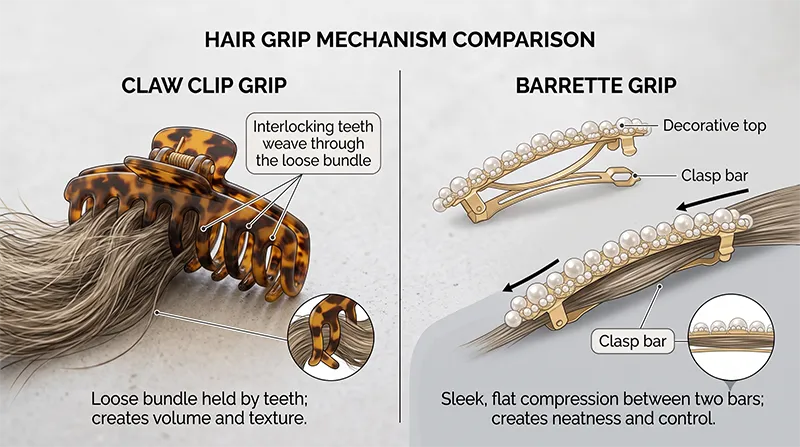
The key mechanical difference is that a barrette holds hair by pressing it flat against a bar, while a claw clip holds hair in a loose, gathered bundle between interlocking teeth. This distinction affects everything — the type of hold produced, the hairstyles each clip can create, the amount of creasing that results, and the hair types each one works best with.
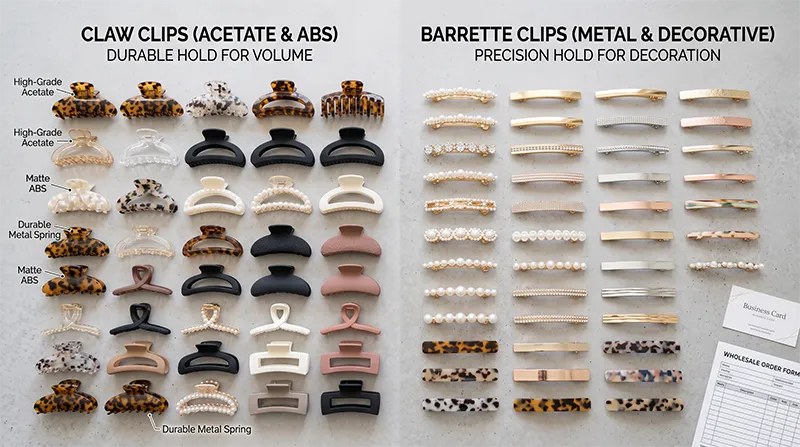
Barrettes range from small accent pieces (3–4 cm) to oversized statement designs (12 cm or more). The decorative top can be made from cellulose acetate, metal, resin, ABS plastic, or fabric-covered frames. Because the top surface is visible when worn, barrettes are generally treated as fashion accessories, while claw clips are more often viewed as functional styling tools.
3. How Each Clip Holds Hair: Mechanism Comparison
The grip mechanism determines how each clip interacts with hair — and explains most of the practical differences between the two types.
Claw Clip (Jaw Clip) Mechanism
The claw clip uses a torsion spring to drive two sets of interlocking teeth together. Hair is gathered into a loose bundle and placed between the open jaws; when released, the teeth close around the hair from both sides. The hold is distributed across multiple teeth rather than concentrated at a single pressure point. This produces a loose, voluminous hold that does not flatten hair against the head.
Barrette Mechanism
A barrette uses a hinged clasp with a locking bar. Hair is laid flat over the bar, and the clasp snaps shut to press the hair against the decorative top piece. The hold is tight and flat — hair is compressed between two parallel surfaces. This produces a sleek, controlled look but creates more tension and compression than a claw clip. The clasp must close completely to hold, which means barrettes have a narrower effective range of hair volume — too little hair and the clasp does not engage properly; too much hair and it will not close or will pop open under tension.
4. Claw Clip vs Barrette: Side-by-Side Comparison
| Feature | Claw Clip (Jaw Clip) | Barrette |
|---|---|---|
| Mechanism | Spring-loaded interlocking teeth | Hinged clasp with locking bar |
| Hold type | Loose, gathered bundle | Flat, compressed against bar |
| Volume preservation | High — maintains hair's natural shape | Low — flattens hair at contact point |
| Creasing | Minimal | Moderate to high |
| Hair damage risk | Low (if properly sized) | Moderate (tension at clasp point) |
| Best hairstyles | Casual updos, loose twists, quick holds | Half-up styles, sleek looks, decorative accents |
| Hair volume range | Wide — works on thin to very thick hair | Narrow — limited by clasp capacity |
| Typical materials | Acetate, ABS, nylon | Acetate, metal, ABS, fabric-covered |
| Fashion positioning | Functional tool → fashion crossover | Primarily decorative / fashion accessory |
| Price range (retail) | $5–35 | $8–50 |
| Ease of use | One-handed operation | Requires two hands |
| Sleep-friendly | Yes (oversized, loose) | No (rigid, uncomfortable) |
For a more detailed breakdown of all clip categories — including snap clips, bobby pins, banana clips, and French barrettes — see the complete guide on types of hair clips.
5. Which Clip Works Best for Each Hair Type
| Hair Type | Better Option | Why |
|---|---|---|
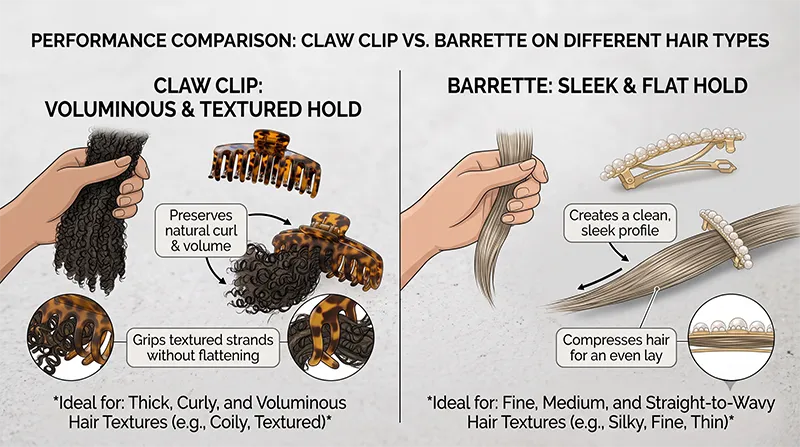
| Fine, straight | Barrette | Flat clasp grips fine hair effectively; claw clips may slide out of very fine hair without enough volume to grip |
| Medium, wavy | Either | Both work well; claw clips for casual looks, barrettes for polished styling |
| Thick, coarse | Claw clip | Interlocking teeth handle high volume; barrette clasps struggle to close around thick bundles |
| Curly, coily | Claw clip | Loose hold preserves curl pattern; barrettes flatten curls at the contact point |
| Long hair | Claw clip | Large claw clips can hold the full weight of long hair; barrettes may pop open under tension |
| Short hair (chin-length) | Barrette | Small barrettes can secure sections too short for a claw clip to grip |
A practical rule: if the goal is to hold a large volume of hair in a quick, casual style with minimal damage, a claw clip is almost always the better choice. If the goal is a polished, decorative look that holds a smaller section of hair in a precise position, a barrette is more appropriate. For guidance on selecting clips that minimise hair damage and creasing, see the guides on claw clips that do not damage hair and hair clips that do not leave creases.
6. When to Use Each: Styling Scenarios
Choose a Claw Clip When:
A claw clip is the right choice for quick, effortless styling where speed and hair protection are priorities. Common scenarios include: getting hair up and off the face during work, exercise, or travel; creating a loose, textured updo for casual occasions; holding hair in place during skincare or makeup routines without leaving creases; protecting curls overnight by securing hair in a loose pineapple hold; and transitioning between "hair up" and "hair down" throughout the day without committing to a styled look that is difficult to undo.
Choose a Barrette When:
Barrettes are the better option when the clip itself is part of the finished look. Common scenarios include: half-up hairstyles where the clip is visible and intended to be decorative; formal or professional settings where a polished appearance is required; securing side-swept bangs or face-framing sections with a small accent clip; adding a fashion element to an otherwise simple hairstyle; and bridal or event styling where the clip serves as a jewellery-like accessory.
When Either Works
For everyday office wear with medium-thickness hair, both types are viable. The choice comes down to personal preference and dress code — claw clips read as casual-to-smart-casual, while barrettes read as polished-to-formal. Many people keep both types available and switch based on the occasion.
7. Material and Quality: What to Look For
Regardless of whether the choice is a claw clip or a barrette, two material factors affect daily performance more than any other specification.
Spring or clasp quality. For claw clips, the spring determines how long the clip maintains its grip before loosening. Low-quality springs lose tension within weeks of daily use, causing the clip to slide out of hair. For barrettes, the clasp mechanism must snap shut cleanly and stay locked — a clasp that pops open unexpectedly defeats the purpose of the accessory. In both cases, the internal hardware (spring steel or clasp wire) is the component most directly linked to product lifespan. A detailed look at torsion spring mechanics explains why spring steel grade affects clip durability.
Surface finish at contact points. The edges and surfaces where the clip contacts hair should be smooth and free of rough spots, mould lines, or burrs. Rough contact surfaces cause friction damage, snagging, and sharper creases. Cellulose acetate clips can be polished to mirror-smooth surfaces, which is one reason acetate claw clips and barrettes are preferred in premium product lines. For a material-level comparison, see the guide on acetate vs plastic hair clips.
Sizing. Claw clips are available from approximately 4 cm (mini) to 14 cm (oversized). The correct size depends on hair volume — using a clip that is too small forces hair into an unnaturally tight grip, increasing tension and breakage. Barrettes range from 3 cm accent clips to 12 cm statement pieces, with the clasp capacity determining the maximum hair volume each size can hold.
8. Conclusion
The confusion between claw clips, jaw clips, and barrettes is primarily a naming issue. Claw clips and jaw clips are the same product — a spring-loaded clip with interlocking teeth designed for loose, voluminous holds. Barrettes are a separate category entirely, using a hinged clasp that presses hair flat for a sleek, decorative finish. The best choice depends on hair type, intended hairstyle, and whether the clip is meant to be functional, decorative, or both.
For both clip types, the quality of the spring mechanism and the smoothness of the contact surface are the two specifications that most directly affect daily performance and hair health. Manufacturers such as JunYi Beauty, operated by Dongguan JunYi Beauty Technology Co., Ltd., produce both claw clips and barrettes across acetate, ABS, and metal material lines — with adjustable spring tension and polished finishing as standard production specifications. The full range of clip designs, including custom tooth geometry and clasp options, is available for review in the claw clip product catalogue.