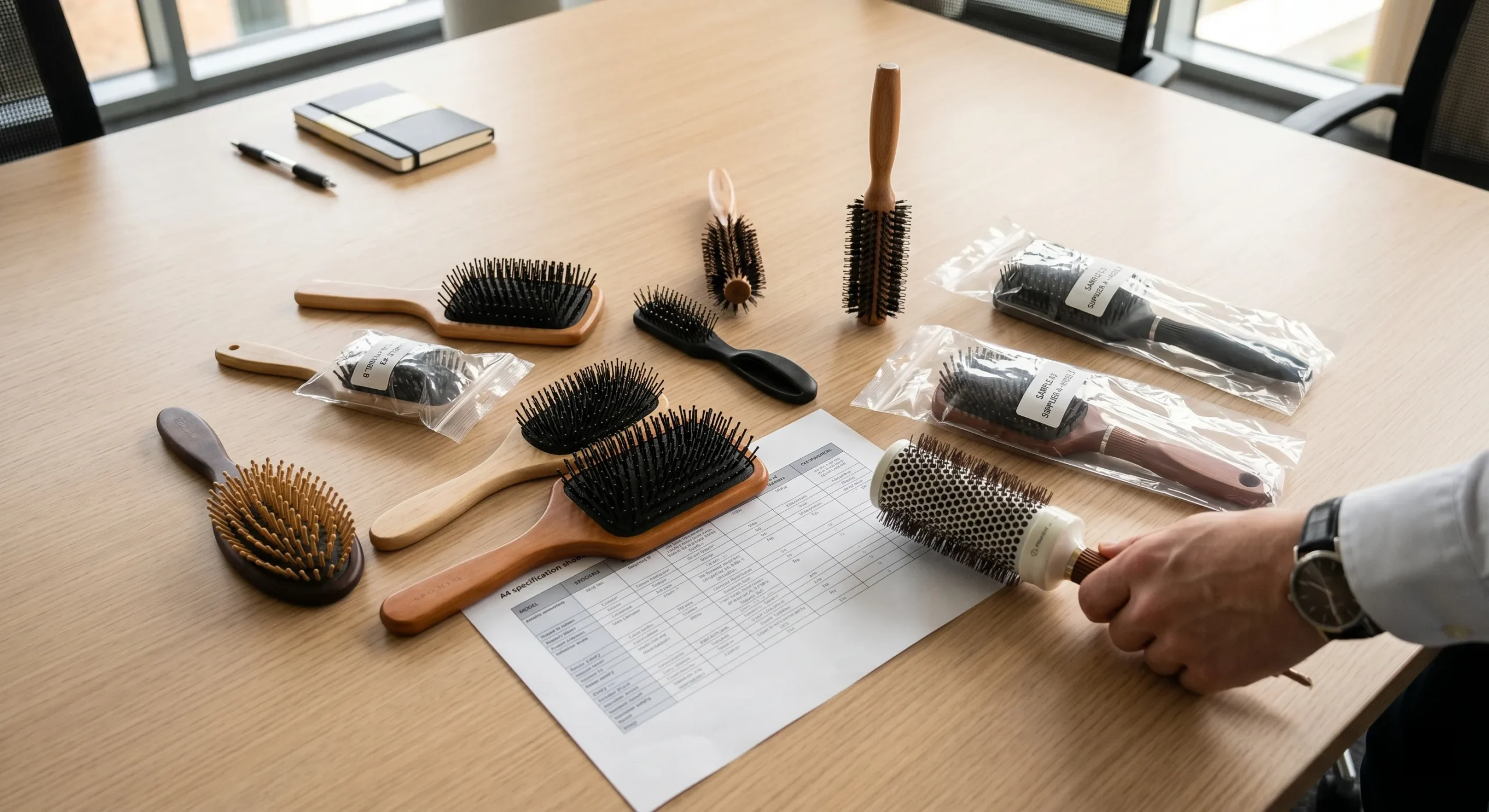
Assembling a hair brush product line involves more than listing brush shapes in a catalogue. Each brush type — paddle, round, cushion, detangling, boar bristle — carries a distinct production process, cost structure, and minimum order threshold. Choosing the wrong mix leads to tooling investment in slow-selling SKUs, inflated per-unit costs on low-volume models, and gaps in the assortment that send buyers to competitors with broader catalogues.
This guide breaks down the major hair brush categories from an OEM sourcing perspective: what each brush type is built for, how its construction differs on the production line, what drives its per-unit cost, and where it fits in a well-structured product portfolio. The specifications, MOQ ranges, and lead times referenced throughout reflect real manufacturing conditions from factories operating at scale in the Guangdong production cluster.
1. Common Types of Hair Brushes by Shape and Function
Hair brushes are most commonly classified by their head shape and intended function. The following categories represent the core product types found across retail, salon, and e-commerce channels worldwide.
Paddle Brush
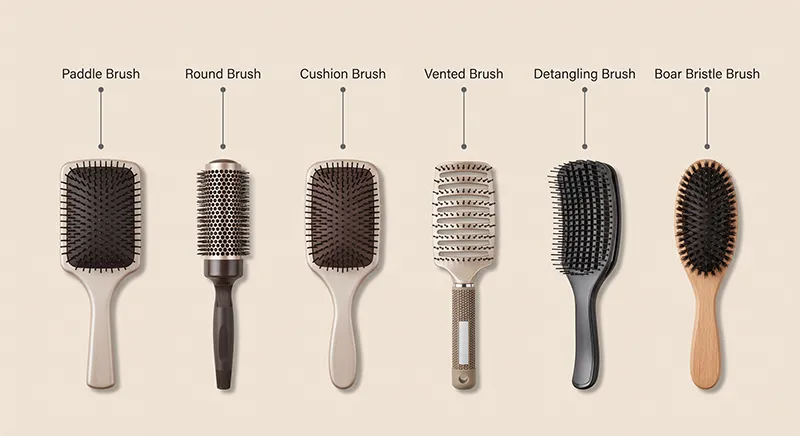
The paddle brush features a broad, flat rectangular or oval head with a cushioned base. It is designed primarily for detangling and smoothing long, straight, or slightly wavy hair. The large surface area covers more hair per stroke, making it efficient for daily brushing. Paddle brushes are among the highest-volume SKUs in any hair brush product line.
OEM production note: Paddle brushes use standard injection-moulded ABS or wooden bodies with machine-tufted bristles — the most cost-efficient combination in hair brush manufacturing. Mould availability is high across established factories, which keeps tooling costs low and allows MOQs to start from 1,000 pieces per SKU. Lead times typically run 30–45 days. For brands launching a new line, the paddle brush is often the first SKU to tool because it delivers the widest market coverage at the lowest entry cost.
Round Brush
Round brushes have a cylindrical barrel wrapped with bristles on all sides. They are used primarily during blow-drying to create volume, curl, or wave. Barrel diameters typically range from 25 mm to 55 mm — smaller barrels produce tighter curls, while larger barrels create loose waves and body. Round brushes are a staple in professional salon tool kits.
OEM production note: Round brush production requires barrel-specific tooling — each diameter (25 mm, 32 mm, 43 mm, 53 mm) needs its own mould. Ceramic or aluminium barrel options add a secondary material process and raise per-unit cost by approximately 15–25% compared to standard ABS barrels. Brands planning a professional salon line should budget for 3–4 barrel size moulds upfront. Lead times run 35–50 days, with hand-set bristle versions extending toward the upper range.
Cushion Brush
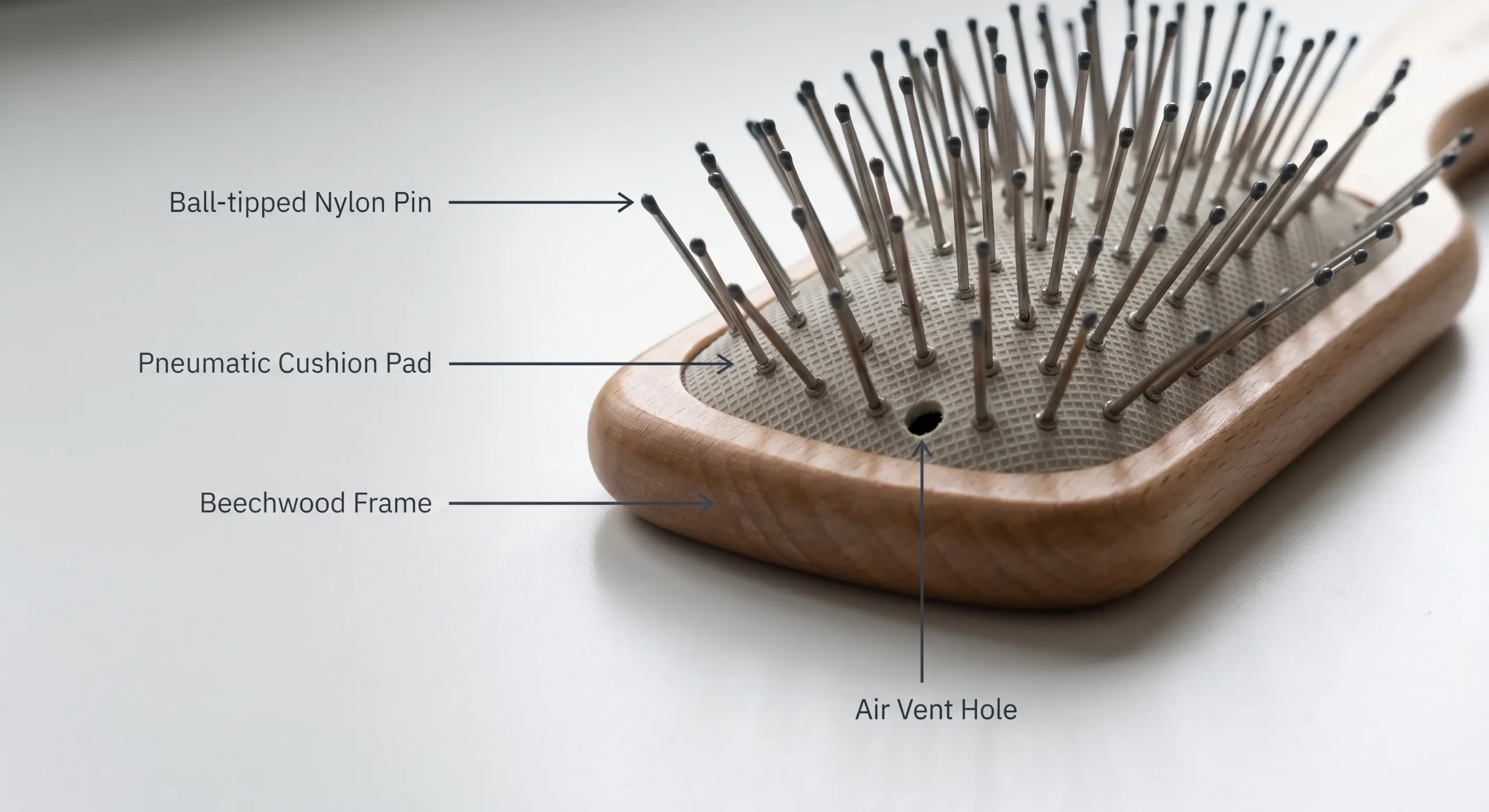
A cushion brush has a soft, air-filled rubber pad from which nylon or mixed bristles extend. The flexible cushion conforms to the scalp's contour, reducing pulling and tension during brushing. This design is widely used for general daily grooming and is suitable for most hair types.
OEM production note: Cushion brush assembly involves a pneumatic rubber pad bonded to the brush head — this additional component adds roughly 10–15% to the per-unit cost compared to a basic paddle brush. Pad durometer (hardness) affects the brush's flex behaviour and can be specified during OEM development. The breathing hole diameter is another adjustable specification. MOQs align with standard paddle brushes at 1,000–3,000 pieces, with lead times of 30–45 days.
Vented Brush
Vented brushes feature openings in the base that allow airflow from a blow dryer to pass directly through the brush head. This accelerates drying time and reduces heat damage. The design is commonly used in salons for rough-drying and quick styling sessions.
OEM production note: Vented brushes require moulds with integrated vent slot geometry, which slightly increases tooling complexity compared to solid-base paddle brushes. However, per-unit production cost remains comparable since the bristle-setting process is identical. Vented brushes tend to sell through salon-supply channels rather than mass retail, so brands should align order quantities with their distribution reach — over-ordering a salon-focused SKU is a common sourcing mistake.
Detangling Brush
Detangling brushes use flexible, widely spaced bristles that bend around knots rather than pulling through them. They are effective on both wet and dry hair, across all textures from fine straight to thick curly. This category has experienced significant retail growth over the past decade, driven by brands emphasising gentle, breakage-free brushing.
OEM production note: Detangling brushes are produced via integrated moulding — the bristles and body are formed as a single TPE or PP piece rather than inserted separately. This eliminates the bristle-setting step but requires higher-precision tooling and raises minimum order quantities to 2,000–5,000 pieces per SKU. Custom bristle flexibility, spacing patterns, and handle ergonomics are all adjustable at the mould design stage. Lead times are 25–40 days, shorter than most other brush types due to the simplified assembly.
Retailers and brand operators looking to review factory-direct hair brush collections can compare paddle, round, cushion, and detangling models within a single product line.
2. Specialty and Professional Hair Brush Types
Beyond the core categories, several specialty brush types serve niche styling functions or professional salon requirements.
Teasing Brush (Backcombing Brush)
A teasing brush is a narrow, densely packed brush used to create volume at the root by backcombing sections of hair. It typically features tightly arranged boar or synthetic bristles on a slim, elongated head. Teasing brushes are standard tools in bridal styling, editorial work, and updo preparation.
Thermal Brush
Thermal brushes incorporate a metal or ceramic barrel that retains heat during blow-drying. This allows the brush to function similarly to a curling iron, adding shape and hold while drying. Thermal round brushes are commonly specified in professional salon procurement.
Scalp Brush (Shampoo Brush)
Scalp brushes are designed for in-shower use, featuring short, flexible silicone or rubber bristles that massage the scalp during washing. They promote circulation and help distribute shampoo evenly. This category overlaps with the broader scalp massager segment. For sourcing information on silicone shampoo brushes designed for OEM scalp care lines, factory-direct catalogues offer a range of durometer and bristle pattern options.
Smoothing Brush
Smoothing brushes combine dense bristle patterns — often a mix of boar and nylon — with a flat or slightly curved head. They are used for finishing and adding shine to dry hair, particularly in straight and sleek styling routines.
3. Bristle Types and Material Comparison
The bristle material is arguably the most important specification in hair brush design. It directly affects performance, target market positioning, and per-unit cost.
Boar Bristle
Natural boar bristles are harvested from domestic boar hair. They contain keratin — the same structural protein found in human hair — which allows them to grip and distribute natural scalp oils (sebum) along the hair shaft. Boar bristle brushes are positioned in the mid-to-premium segment and are favoured for fine to normal hair types. They produce a smooth, polished finish but offer limited detangling power on thick or curly hair.
Nylon Bristle
Nylon is a synthetic material that can be manufactured to precise specifications for diameter, rigidity, and tip shape. Nylon bristles provide firm detangling action, resist heat well during blow-drying, and generate less static than natural alternatives in many conditions. Ball-tipped nylon bristles are standard in mass-market brushes, adding comfort and preventing scalp scratching.
Mixed Bristle (Boar + Nylon)
Mixed-bristle brushes combine shorter boar bristles with longer nylon pins. The boar bristles smooth and distribute oils while the nylon bristles handle detangling and provide structural reach. This combination targets the broadest consumer segment, offering both performance and a premium feel.
The following table summarises the key differences between common bristle materials:
| Feature | Boar Bristle | Nylon | Mixed (Boar + Nylon) | Wooden Pins |
|---|---|---|---|---|
| Origin | Natural (animal) | Synthetic | Combined | Natural (wood) |
| Detangling Power | Low–Medium | High | Medium–High | Medium |
| Oil Distribution | Excellent | Minimal | Good | Minimal |
| Heat Resistance | Low | Medium–High | Medium | Low |
| Static Control | Moderate | Good | Good | Excellent |
| Cost Position | Mid–Premium | Low–Mid | Mid–Premium | Mid–Premium |
| Best For | Fine, straight hair | Thick, curly hair | All types | Sensitive scalp |
Wooden-pin brushes in particular have gained traction among brands positioning around sustainability and natural materials. For a detailed breakdown of the benefits and sourcing considerations for this subcategory, see our guide on why use a wooden hair brush.
4. Building a Hair Brush Product Line: Assortment Logic for B2B Buyers
For brand owners and procurement teams assembling a hair brush range, the question is not simply which brush works for which hair type — it is which combination of SKUs covers the broadest addressable market at the lowest total tooling and inventory cost. Product line architecture decisions made at the sourcing stage determine sell-through rates, return percentages, and long-term reorder patterns.
Core assortment: the four-SKU foundation
Market data across retail and e-commerce channels consistently shows that four brush types account for the majority of consumer purchase volume: paddle, round, cushion, and detangling. A product line built on these four categories covers the primary use cases — daily grooming, blow-dry styling, gentle brushing, and wet-hair detangling — across fine, medium, thick, and curly hair textures. For a new brand entering the market, starting with this four-SKU foundation minimises tooling investment while maximising category coverage.
Extension strategy: when to add specialty SKUs
Beyond the core four, specialty brush types should be added based on channel positioning and target consumer profile rather than added indiscriminately:
- Salon and professional channels: Add thermal round brushes (ceramic or aluminium barrel) and teasing brushes. These are expected items in professional tool kits and signal product credibility in the salon-supply segment. Thermal rounds require barrel-specific moulds at each diameter, so start with two sizes (32 mm and 43 mm) before expanding.
- Natural and wellness positioning: Add boar bristle brushes and wooden-pin models. These carry higher per-unit cost but support premium price points and align with sustainability messaging. Boar bristle brushes require hand-setting, which limits production speed — plan lead times of 40–60 days and MOQs starting from 500 pieces.
- Scalp care and self-care crossover: Add silicone shampoo brushes. This category has grown significantly through social media-driven demand and overlaps with the broader scalp massager segment. Production uses silicone injection moulding with relatively low tooling costs.
- Mass retail and value positioning: Prioritise detangling brushes and cushion brushes in multi-pack or family sets. These generate volume through repeat purchases and gift-set bundling. Integrated-moulded detangling brushes offer the lowest per-unit cost at scale, making them well-suited for value-tier product lines.
Common assortment mistakes in B2B sourcing
Three recurring errors emerge in hair brush product line planning. First, over-investing in round brush diameter variants — offering five or six sizes fragments inventory across slow-moving SKUs. Two to three sizes typically capture over 80% of round brush demand. Second, omitting a detangling option from mass-market lines — this category has become a baseline consumer expectation, and its absence is increasingly noticed in retail shelf reviews. Third, sourcing boar bristle brushes at mass-market MOQs without a clear premium positioning strategy — the higher production cost only works when retail pricing reflects the material value.
Brands serving diverse consumer demographics should plan their assortment against the following framework, which maps brush type to market segment and production parameters:
| Market Segment | Core SKUs | Extension SKUs | Typical Range Size | Entry Tooling Budget |
|---|---|---|---|---|
| Mass retail | Paddle, Cushion, Detangling | Vented, Round (2 sizes) | 4–6 SKUs | Low–Medium |
| Professional / Salon | Round (3 sizes), Thermal, Paddle | Teasing, Smoothing | 6–9 SKUs | Medium–High |
| Premium / Natural | Boar Bristle, Cushion, Wooden-pin | Mixed-bristle, Scalp brush | 4–7 SKUs | Medium–High |
| E-commerce / DTC | Detangling, Paddle, Cushion | Travel-size, Set bundles | 3–5 SKUs | Low |
Understanding hair porosity and its effect on styling tool selection can further refine assortment decisions when targeting specific consumer demographics. For the specification detail behind the highest-volume category, see our custom paddle hair brush guide.
5. Manufacturing Considerations for Hair Brush Production
From a sourcing perspective, hair brush production involves several key manufacturing processes that influence product quality, lead time, and per-unit cost.
Handle Production
Plastic handles are produced via injection moulding — molten polymer is injected into precision moulds and cooled to form the final shape. Wooden handles require CNC cutting, sanding, and finishing. Bamboo handles have gained traction in sustainability-focused product lines, though they require additional moisture-resistance treatment.
Bristle Setting
Bristle insertion methods vary by brush type. Machine-set bristles are tufted into pre-drilled holes in the brush head and secured with wire staples or anchors. Hand-set bristles, common in premium boar-bristle models, involve individual tuft placement for higher density and consistency.
Cushion Assembly
Cushion brushes require a pneumatic rubber pad bonded to the brush head. A small breathing hole allows air to escape when bristles are pressed, creating the characteristic flex that cushion brushes are known for. Pad durometer and adhesive selection directly affect product lifespan.
Brands evaluating factory-direct partnerships for OEM hair brush manufacturing services should review mould library availability, bristle-setting methods, and cushion assembly capabilities before placing initial orders.
For a closer look at how multi-stage quality inspection is applied across brush production — from raw material checks through finished product testing — see our quality control process overview.
The following table outlines typical production specifications across major brush categories:
| Brush Type | Primary Material | Bristle Setting Method | Typical MOQ Range | Lead Time Estimate |
|---|---|---|---|---|
| Paddle Brush | ABS / Wood | Machine tufting | 1,000–3,000 pcs | 30–45 days |
| Round Brush | ABS / Ceramic barrel | Machine / hand setting | 1,000–3,000 pcs | 35–50 days |
| Cushion Brush | ABS + rubber pad | Machine tufting + pad bonding | 1,000–3,000 pcs | 30–45 days |
| Detangling Brush | TPE / PP | Integrated moulding | 2,000–5,000 pcs | 25–40 days |
| Boar Bristle Brush | Wood / ABS | Hand setting | 500–2,000 pcs | 40–60 days |
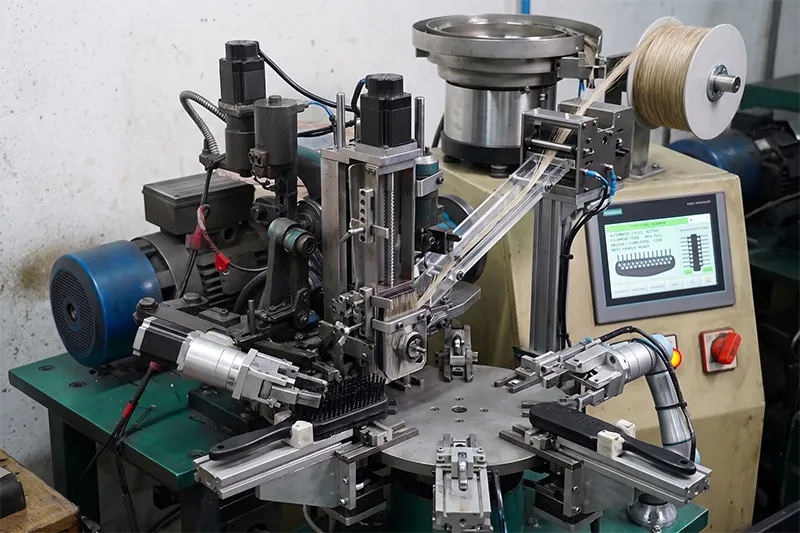
6. Key Factors for B2B Brush Sourcing
When evaluating hair brush suppliers, several factors beyond product design affect long-term partnership viability.
- Mould library depth: Manufacturers with extensive existing mould libraries — sometimes exceeding 2,000 active moulds — can significantly reduce tooling costs and lead times for new product launches. Access to proven mould designs also lowers the risk of defects in initial production runs.
- Certification coverage: International buyers increasingly require compliance documentation. Relevant certifications for hair brush manufacturing include ISO 9001 quality management systems, BSCI for social compliance auditing, and GRS (Global Recycled Standard) for products incorporating recycled materials.
- Material traceability: For brands marketing natural or sustainable brushes, supply chain transparency on bristle origin (boar hair sourcing regions, wood species, recycled plastic content) is becoming a standard buyer expectation rather than a premium differentiator.
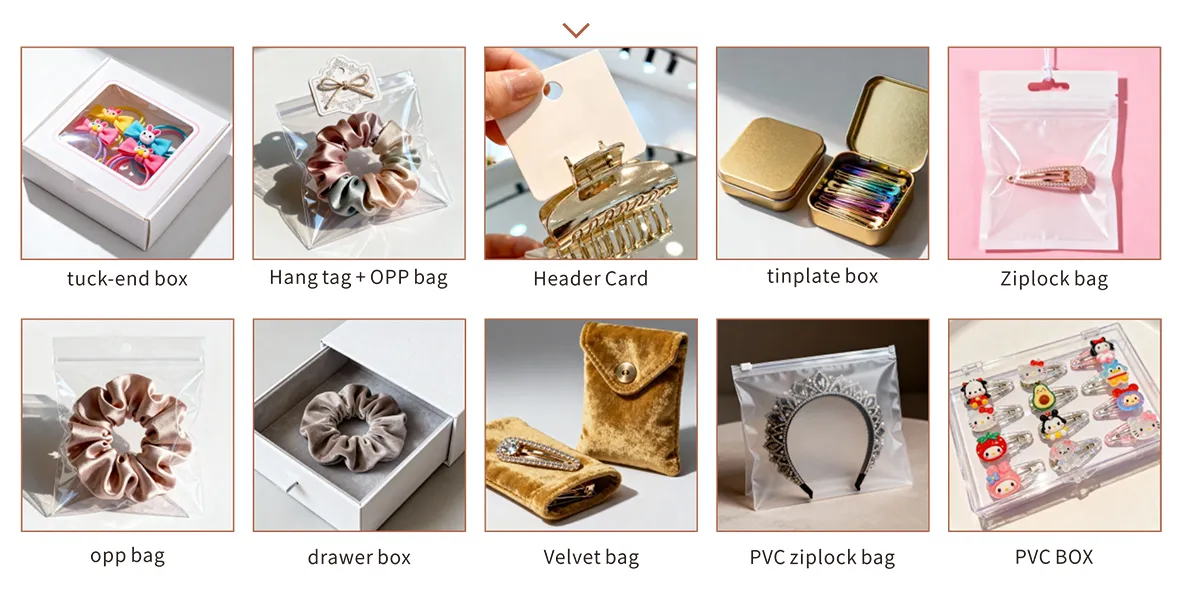
- Customisation scope: OEM capabilities typically include handle colour and finish selection, bristle type and configuration, logo embossing or pad printing, custom packaging, and retail-ready display options. The depth of customisation available varies considerably between manufacturers.
For a side-by-side comparison of manufacturers offering OEM brush production with certified facilities, see our guide to the top 10 custom hair brush manufacturers. Brands expanding beyond brushes into complementary categories such as hair comb product series or hair clip collections often consolidate sourcing with a single manufacturer to streamline logistics and quality control.
7. Conclusion
Hair brushes encompass a broad product category with meaningful functional differences between types. From paddle brushes designed for efficient daily detangling to precision round brushes built for professional blow-dry styling, each design serves a distinct purpose shaped by head geometry, bristle material, and intended hair type.
For B2B buyers building or expanding hair brush product lines, selecting the right combination of brush types, bristle materials, and construction methods determines both market fit and long-term brand positioning. Manufacturers such as JunYi Beauty, which maintains over 2,000 active production moulds and integrated bristle-setting facilities in Dongguan, represent the type of factory-direct OEM partner suited for brands requiring both product breadth and production scalability. Our custom paddle hair brush and round hair brush pages set out the handle materials, bristle configurations and packaging options available in each category.
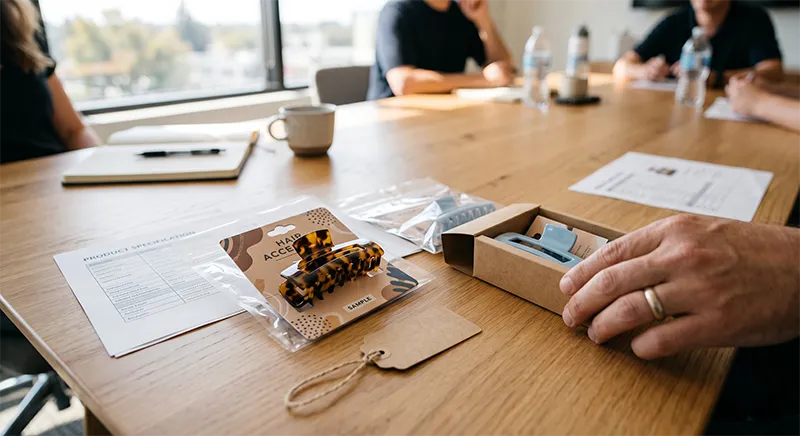
Once you have narrowed down the brush types for your range, testing a sample of each is the lowest-risk next step. Our samples and prototypes page explains how to request stock samples or develop a custom prototype.