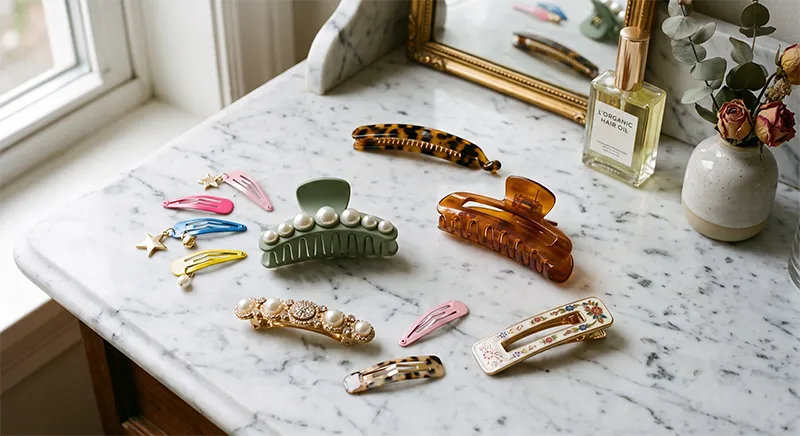
Hair clips sit in millions of people's daily routines — holding ponytails in place during workouts, pinning back bangs on video calls, and creating quick updos before heading out the door. Yet a recurring question follows almost every clip purchase: do hair clips actually damage hair? The short answer is that clips themselves are not inherently harmful, but the way they are used, how long they stay in, and what they are made of all influence whether a clip protects hair or slowly weakens it.
This guide breaks down the science behind how hair clips interact with the hair shaft and follicle, which types of clips carry the most risk, and what practical steps keep hair healthy while still enjoying the convenience of clip-based styling. Every recommendation below is grounded in dermatological research on traction, friction, and mechanical stress.
How Hair Clips Physically Affect the Hair Shaft
Hair damage from clips operates through two distinct mechanisms: traction and friction. Traction refers to the pulling force a clip places on the hair root and follicle. Friction refers to the surface-level rubbing between the clip material and the outer cuticle layer of the hair strand. Both mechanisms can cause damage independently, and they frequently compound each other when a clip is worn for extended periods.
The hair cuticle is the outermost protective layer of each strand, composed of overlapping keratin scales arranged like roof shingles. When a clip grips hair tightly, the mechanical pressure can lift or chip these cuticle scales, exposing the softer cortex beneath. Research published in the Journal of Cosmetic Science has demonstrated that repeated friction against the cuticle increases surface roughness and reduces tensile strength, making strands progressively more prone to snapping.
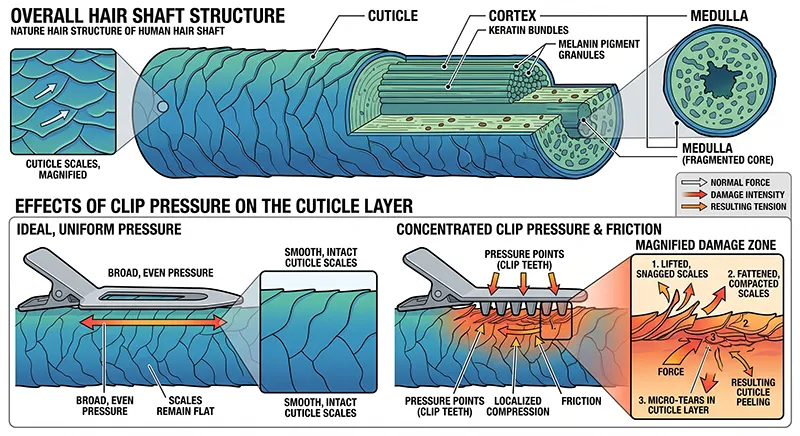
At the follicle level, traction creates a different kind of problem. Continuous pulling gradually weakens the dermal papilla — the structure at the base of the follicle responsible for generating new hair growth. A clinical study published in the Indian Journal of Dermatology, Venereology and Leprology found that 30 percent of adult female patients with traction alopecia in the study were using large hair clips combined with tight ponytail styles, even without chemical treatments or heat damage involved.
Hair Breakage vs. Hair Loss: Understanding the Difference
One of the most common sources of confusion around clip-related damage is the difference between breakage and actual hair loss. Breakage occurs along the hair shaft — a strand snaps partway down its length because the cuticle and cortex have been weakened by friction, dryness, or mechanical stress. The follicle remains intact and continues producing new hair normally.
Hair loss, by contrast, involves the follicle itself. When a clip exerts enough traction over enough time, it can damage the follicle to the point where growth slows, thins, or stops. Dermatologists classify this as traction alopecia, and the National Institutes of Health clinical overview describes it as a condition that follows a biphasic pattern: the early stage is non-scarring and fully reversible once traction is removed, while chronic, long-term traction can cause permanent scarring of the follicle.
| Factor | Breakage | Hair Loss (Traction Alopecia) |
|---|---|---|
| Where it occurs | Along the hair shaft | At the hair follicle |
| Primary cause | Friction, cuticle damage | Sustained pulling force on the root |
| Reversibility | Broken strand cannot be repaired; new growth is unaffected | Reversible in early stages; potentially permanent if chronic |
| Visual signs | Short broken hairs, split ends, frizz at clip contact points | Thinning at temples or crown, receding hairline near clip zones |
| Timeline | Can appear within weeks of rough handling | Develops over months to years of repeated tension |
Most people who experience clip-related damage are dealing with breakage rather than true hair loss. The visible sign is a cluster of short, flyaway hairs near the crown or temples — exactly where clip teeth tend to grip the hardest. Recognising the difference early makes it possible to adjust habits before any follicle-level damage begins.
Which Hair Clip Types Are Safest? A Side-by-Side Comparison
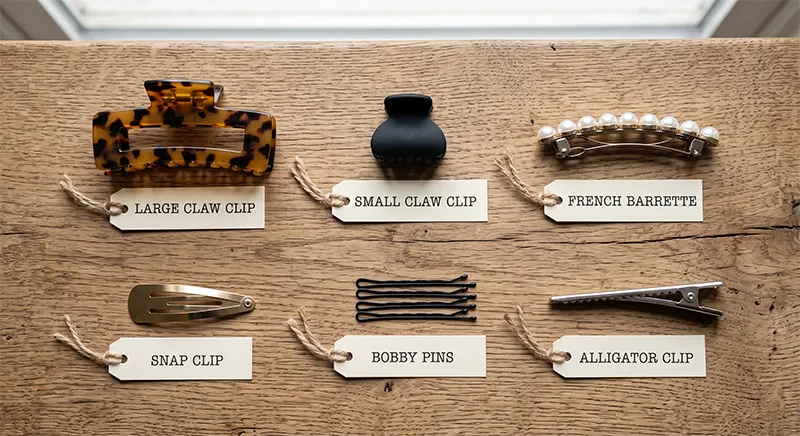
Not all clips carry the same risk profile. The amount of potential damage depends on the clip's grip mechanism, contact surface area, material, and how it distributes pressure across the hair. Below is a comparison of the most common clip categories ranked by their relative safety when used correctly.
| Clip Type | Grip Mechanism | Pressure Distribution | Damage Risk (Correct Use) |
|---|---|---|---|
| Claw clip (large) | Spring-loaded interlocking teeth | Wide — spreads force across many strands | Low |
| French barrette | Tension bar with clasp | Medium — concentrated along a flat bar | Low to moderate |
| Snap clip | Spring-loaded flat prongs | Narrow — pinches a small section | Moderate |
| Bobby pin | Friction compression against scalp | Very narrow — constant pressure on a few strands | Moderate |
| Alligator clip | Serrated metal teeth | Narrow — teeth dig into a thin layer of hair | Moderate to high |
| Small metal snap clip (cheap) | Spring-loaded with sharp edges | Very narrow — can cut into shaft | High |
Large claw clips consistently rank as the gentlest option in hairstylist and trichologist recommendations. The interlocking teeth spread grip force across a wide section of hair instead of concentrating it on a narrow band. This matters because traction damage correlates directly with pressure per unit area — the smaller the contact zone, the higher the stress on each individual strand. For a deeper look at selecting low-damage claw clips by material and tooth design, the guide on what claw clips don't damage hair covers specific selection criteria.
How Clip Material Affects Hair Health
The material a clip is made from directly influences how much friction it generates against the hair cuticle. Smooth, polished surfaces slide over strands with minimal resistance, while rough or porous surfaces catch on lifted cuticle edges and accelerate wear.
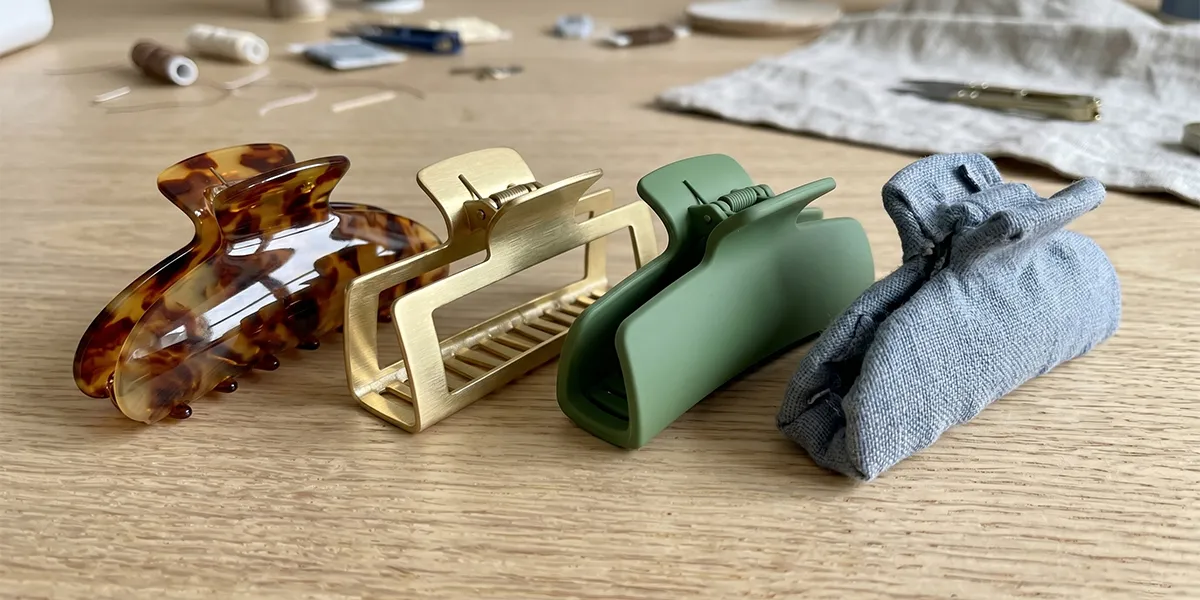
Cellulose acetate — a plant-derived thermoplastic — is widely regarded as one of the safest clip materials. Its naturally smooth, non-porous surface produces very low friction against the hair shaft, and it does not generate static charge the way standard injection-moulded ABS plastic does. Static contributes to tangling and flyaway, which increases the likelihood of snagging when a clip is removed.
Metal clips occupy a middle ground. High-quality metal clips with polished finishes and rubber-coated tips can be perfectly safe. However, cheap metal clips with rough stamped edges or burrs along the hinge can physically cut into the hair shaft. Metal also conducts heat, which creates an additional risk during blow-drying — the clip absorbs heat from the dryer and transfers it to the strands it is gripping, potentially causing localised thermal damage. The Philip Kingsley Trichology Clinic specifically advises against concentrating heat on metal clips during styling for this reason.
For readers comparing acetate and standard plastic in more detail, the guide on types of hair clips explains how material choice affects both durability and hair interaction across every major clip category.
Why Hair Type Changes the Risk Level
The same clip can be perfectly safe on one person's hair and damaging on another's. Hair type, thickness, porosity, and pre-existing condition all influence how vulnerable strands are to mechanical stress from clips.
Fine hair is the most susceptible to breakage from clips. Each strand has a smaller diameter, which means less structural material to resist compression and friction. Fine hair also tends to tangle more easily, increasing the chance of snagging when a clip is inserted or removed. Lightweight clips with smooth surfaces — especially acetate or satin-wrapped designs — are the safest pairing for fine hair.
Thick or coarse hair faces a different challenge. Thicker hair requires stronger clip tension to stay secured, which means more force is transmitted to the follicle. A small clip that is forced to hold a large volume of thick hair concentrates excessive pressure on a narrow band of strands. Sizing up to a larger clip solves this by distributing the grip across a wider area.
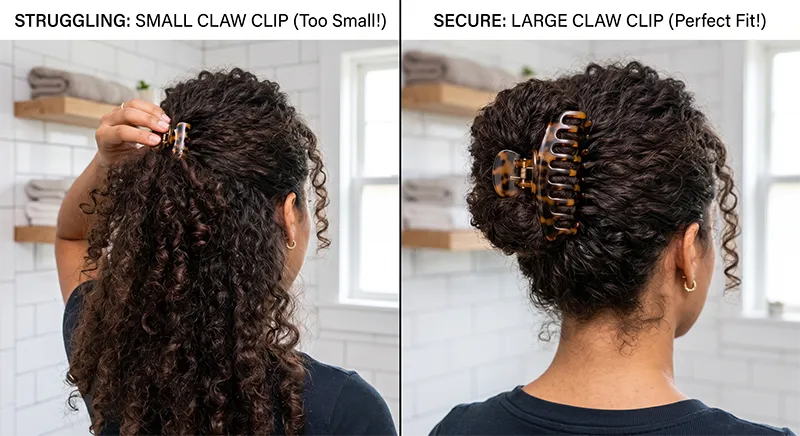
Curly and coily hair types carry additional vulnerability. Research published in the International Journal of Dermatology has shown that tightly coiled hair has an elliptical cross-section and a curved follicle structure, which lowers its resistance to tensile stress at each bend point. Clips with wide-spaced, smooth teeth that do not crush curl pattern — such as large acetate claw clips — minimise disruption to the curl structure while still providing a secure hold.
Wet hair is significantly more fragile than dry hair regardless of hair type. As Healthline's dermatology review explains, when hair absorbs water the cortex swells and the cuticle scales lift, reducing the strand's tensile strength. Applying a tight clip to wet hair amplifies breakage risk considerably. If a clip must be used on damp hair, a loose claw clip is the safest option. For additional techniques on handling wet hair with accessories, the article on hair clips that don't leave creases includes several relevant tips.
Six Safe Styling Habits That Prevent Clip Damage
Preventing clip damage does not require giving up clips altogether. A few habit adjustments eliminate the vast majority of risk while keeping clips as a practical, everyday styling tool.
Rotate clip placement daily. Wearing a clip in the exact same position every day concentrates traction on the same group of follicles. Shifting the clip position by even a centimetre each day distributes the stress across different sections. This single habit is one of the most effective ways to prevent localised thinning.
Match clip size to hair volume. A clip should close comfortably without having to force the spring. If the clip barely closes around the gathered hair, the spring tension is too high and the teeth are pressing too hard into the strands. Sizing up to the next clip size immediately reduces per-strand pressure.
Remove clips before sleeping. Overnight wear exposes hair to hours of friction against the pillow while the clip maintains constant compression. Metal clips can also dig into the scalp during sleep, causing discomfort and localised irritation. A loose braid or satin scrunchie is a safer overnight alternative.
Limit continuous wear to four to six hours. Even a well-fitted, high-quality clip generates cumulative traction over a full day. Giving hair a break after several hours allows the follicle to recover from low-level mechanical stress before it accumulates into visible damage.
Handle clips gently during insertion and removal. Forcing a clip open or snapping it shut on hair causes a brief but intense spike of mechanical force. Opening the clip fully before positioning it around the hair, then releasing the spring slowly, avoids the sudden pull that chips cuticle edges and breaks weakened strands.
Inspect clips regularly for wear. A clip that was smooth when new can develop rough spots, cracked edges, or misaligned teeth over time. These defects catch and snag hair on every use. Replacing worn clips promptly is a low-cost way to prevent ongoing friction damage. Exploring different clip categories periodically is also worthwhile — the guide to different types of hair pins covers several gentle alternatives like U-shaped pins and hair sticks.
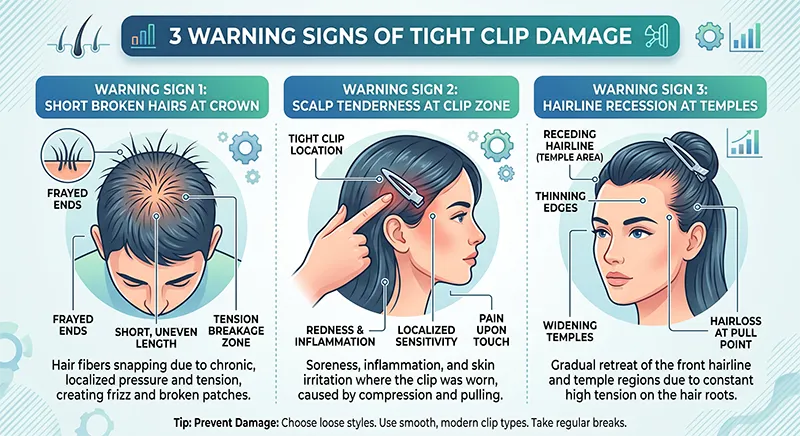
Warning Signs That a Clip Is Damaging Hair
Clip-related damage tends to develop gradually, which makes it easy to overlook until the effects become visible. Knowing what early warning signs to look for allows timely adjustment before any lasting harm occurs.
The most common early indicator is a cluster of short, broken hairs at the crown or temples — the areas where clip teeth grip most firmly. These broken strands stand up against the direction of surrounding hair and create a frizzy, uneven texture at the clip contact zone. If new short hairs keep appearing in the same area despite otherwise healthy hair care habits, the clip placement is the most likely cause.
Scalp tenderness or soreness that persists after removing a clip is another signal. Mild tenderness lasting a few minutes is normal after any updo, but soreness that continues for thirty minutes or more suggests the clip was applying excessive traction to the follicles during wear.
Over a longer timeline, gradual thinning at the temples or along the hairline where clips are habitually placed warrants attention. Comparing current hairline photos with images from twelve to eighteen months earlier can reveal subtle recession that is difficult to notice day to day. If thinning is observed, switching to looser styling and consulting a dermatologist or trichologist early gives the follicles the best chance of recovery.
Clips vs. Hair Ties — and the Bottom Line on Clip Safety
A common follow-up question is whether clips are better or worse for hair than traditional hair ties. Standard rubber or elastic ties squeeze the hair bundle in a tight ring, concentrating force radially toward the centre. The constant inward pressure, combined with friction during removal, makes traditional elastics one of the most common causes of breakage. Clips, by contrast, grip hair between two surfaces rather than wrapping around it, allowing strands to sit more loosely with less compression. This structural difference is why hairstylists frequently recommend clips as a gentler daily alternative to tight ponytails.
Satin scrunchies occupy a middle ground — they grip through gentle friction and smooth fabric, making them a safer tie-based option for people who prefer the ponytail look. For readers interested in additional material safety comparisons across accessory types, the article on pros and cons of metal hair accessories offers a broader perspective.
Hair clips do not inherently damage hair. The risk lies in how they are used — excessive tightness, prolonged wear in one position, sharp or rough materials, and incorrect sizing are the real culprits behind clip-related breakage and, in extreme cases, traction alopecia. Choosing smooth, well-made clips in the correct size, rotating placement daily, removing clips before bed, and limiting continuous wear to a few hours keeps hair healthy while preserving all the convenience and styling versatility that clips provide.
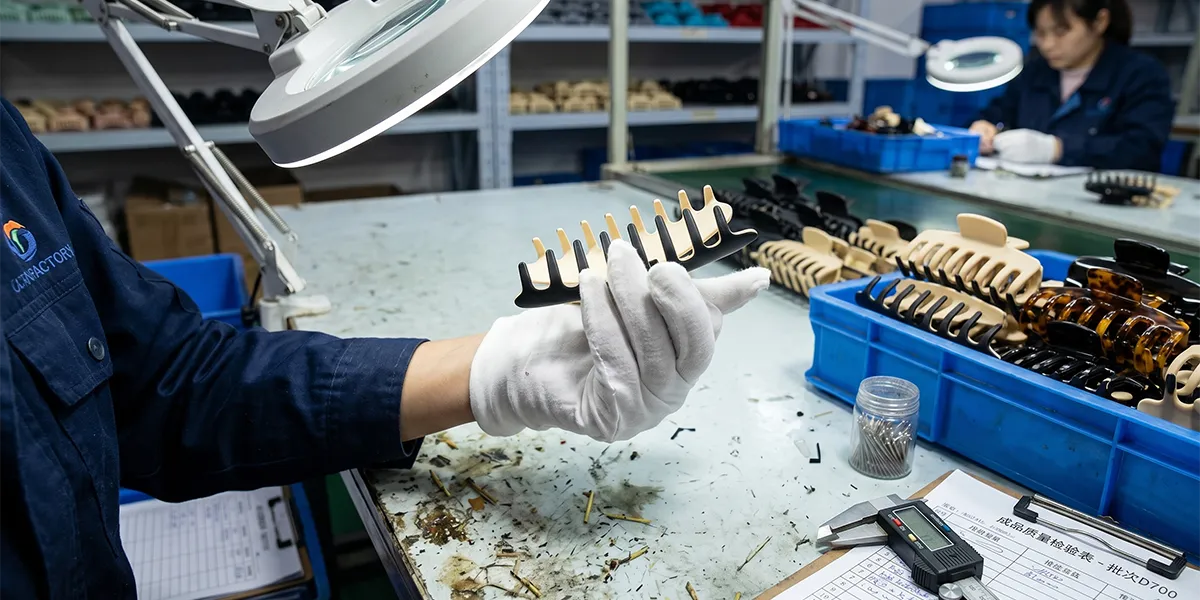
For brands and retailers sourcing hair clips for quality-conscious consumers, manufacturing precision directly affects clip safety. Smooth tooth edges, calibrated spring tension, and polished surface finishes are not cosmetic details — they are functional safety features. Manufacturers like JunYi Beauty, with ISO 9001:2015 certified production processes and in-house quality control across every clip category, produce accessories where material grade and finish consistency are built into the manufacturing standard rather than treated as an afterthought.