A custom claw clip manufacturer is a factory that produces claw-style hair clips to a buyer's specifications — including material, shape, colour, surface finish, logo placement, and packaging — for wholesale, private label, or OEM distribution. For brands entering or expanding in the hair accessories market, selecting the right manufacturer determines product quality, margin structure, lead time, and the scope of design differentiation available.
This guide covers the end-to-end process of ordering branded claw clips from a manufacturer: from material selection and design specification through to sampling, production, and shipment. It is written for brand owners, e-commerce operators, and distributors sourcing custom hair claws at commercial volume.
Why Claw Clips Are a High-Demand Product Category
Claw clips have transitioned from a basic utility hair accessory to a fashion-forward styling staple. Social media platforms have driven sustained consumer interest in oversized, textured, and material-differentiated claw clips — creating a market environment where differentiated design and premium materials command meaningful price premiums over commodity alternatives.
For B2B buyers, this means the category supports both high-volume commodity production and lower-volume premium lines. The key commercial decision is whether to compete on price with standard ABS injection-moulded clips or differentiate on material and design with acetate, metal, or wood options. Understanding the material landscape is the essential first step before engaging a manufacturer. For a broader overview of how claw clips fit into the wider clip category, the types of hair clips guide compares six major clip styles with material and sourcing details.
Claw Clip Materials: Selecting the Right Base
The material chosen for a custom claw clip determines its weight, feel, durability, price point, and target market positioning. Four materials dominate commercial claw clip production, each with distinct manufacturing processes and cost structures.
Cellulose Acetate
Acetate is a plant-derived thermoplastic produced from wood pulp or cotton fibres. It is the premium material choice for claw clips, valued for its dense, glass-like appearance, natural translucency, and the rich, layered colour patterns (such as tortoiseshell) that it produces. Acetate clips are cut from flat sheets, heated, shaped, and hand-polished — a labour-intensive process that results in higher per-unit costs but a distinctly premium product. Acetate also generates less static than petroleum-based plastics, which is a functional selling point for hair-conscious consumers.
ABS Plastic
ABS (acrylonitrile butadiene styrene) is the most widely used material in mass-market claw clip production. It is lightweight, injection-mouldable at low tooling costs, and available in a broad range of surface finishes — from high-gloss to matte to metallic. ABS clips are produced at significantly higher volumes and lower per-unit costs than acetate, making them the default choice for brands competing primarily on price or targeting high-turnover retail channels.
Metal
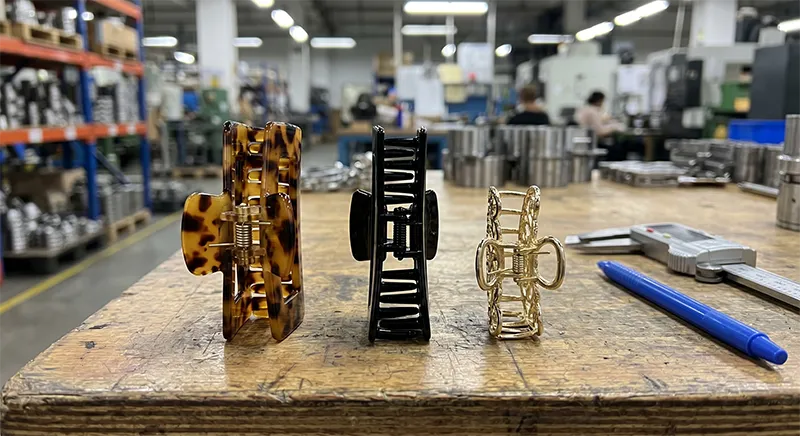
Metal claw clips — typically zinc alloy, stainless steel, or aluminium — occupy the high-end segment. They offer superior durability and a distinctive aesthetic that ranges from minimalist brushed finishes to ornate plated designs. Metal clips are heavier than plastic alternatives, which limits their suitability for very thick or heavy hair unless the spring mechanism is engineered to match. Metal claw clips are also the most common choice for brands targeting the jewellery-adjacent accessories market.
| Factor | Cellulose Acetate | ABS Plastic | Metal (Zinc Alloy) |
|---|---|---|---|
| MOQ per SKU | 300–500 units | 1,000 units | 500–1,000 units |
| Unit cost range | Medium–High | Low–Medium | Medium–High |
| Production method | Sheet cutting + hand polishing | Injection moulding | Die casting + plating |
| Lead time (existing mould) | 6–8 weeks | 4–6 weeks | 6–8 weeks |
| Colour options | Tortoiseshell, marble, solid, translucent | Unlimited — any Pantone colour | Gold, silver, rose gold, chrome, matte |
| Best for | Premium, eco-conscious brands | Mass retail, DTC, fashion-forward | Jewellery-adjacent, luxury lines |
| Static behaviour | Low — anti-static properties | Moderate — can generate static | None |
For a detailed technical comparison of acetate versus ABS in clip production — covering mechanical properties, environmental profiles, and cost structure differences — the site's material comparison resources provide additional guidance for sourcing decisions.
How to Order Custom Branded Claw Clips: Step by Step
The ordering process for custom claw clips follows a standardised workflow that most established manufacturers support. Understanding each stage in advance helps buyers set accurate expectations for timeline, cost, and decision points.
Step 1: Define the Product Specification
Before contacting a manufacturer, buyers should have a clear specification brief that includes the target material (acetate, ABS, metal), approximate clip size (small, medium, large, or jumbo), desired surface finish (glossy, matte, rubberised, plated), logo or branding requirements (embossing, debossing, laser engraving, pad printing), target retail price point, and estimated order volume per SKU. A well-prepared brief reduces back-and-forth communication and shortens the quoting stage.
Step 2: Request Quotations and Evaluate Manufacturers
Submit the specification brief to two or three shortlisted manufacturers and request itemised quotations. A professional quotation should separate material cost, mould or tooling cost (if applicable), surface treatment cost, branding cost, and packaging cost. This level of detail enables meaningful comparison between suppliers. For guidance on evaluating manufacturer options, the top 10 hair clip manufacturers guide profiles verified factories with capability and certification data.
Step 3: Confirm Samples
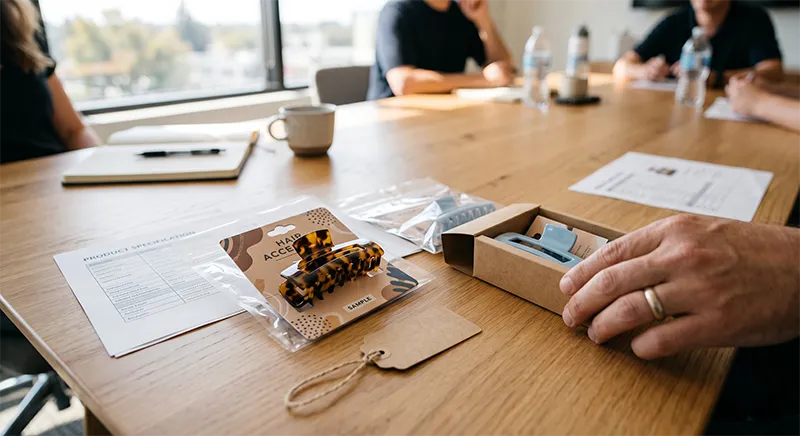
Always request physical pre-production samples before committing to a bulk order. Evaluate samples for material quality, colour accuracy, spring mechanism strength, hinge durability, surface finish consistency, and overall weight and feel. This is the last opportunity to request design adjustments before production tooling is finalised. Sample turnaround is typically 5 to 7 days for designs using existing moulds.
Step 4: Approve and Enter Production
Once samples are approved, the manufacturer proceeds with bulk production. Production timelines vary by material and order volume — ABS clips are typically the fastest to produce due to injection moulding efficiency, while acetate clips require additional hand-polishing time. Buyers should confirm a production schedule with milestone check-ins for quality inspections at key stages: raw material incoming, mid-production, and pre-shipment final inspection.
Step 5: Quality Inspection and Shipment
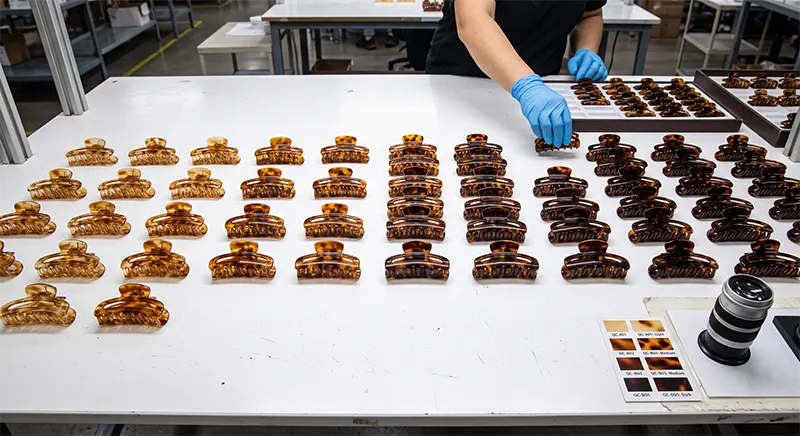
Before shipment, a final quality inspection should verify that bulk production matches the approved sample in all respects — including dimensional accuracy, colour consistency, spring function, and branding placement. Many buyers engage third-party inspection services (such as SGS Consumer Goods or Bureau Veritas) for independent verification. For a detailed breakdown of how lead times break down across each production stage, see the lead time guide for custom hair accessories.
Customisation Options for Branded Claw Clips
The range of customisation available for claw clips is broader than many first-time buyers expect. Understanding what can be customised — and at what cost and timeline impact — enables brands to maximise product differentiation within their budget.
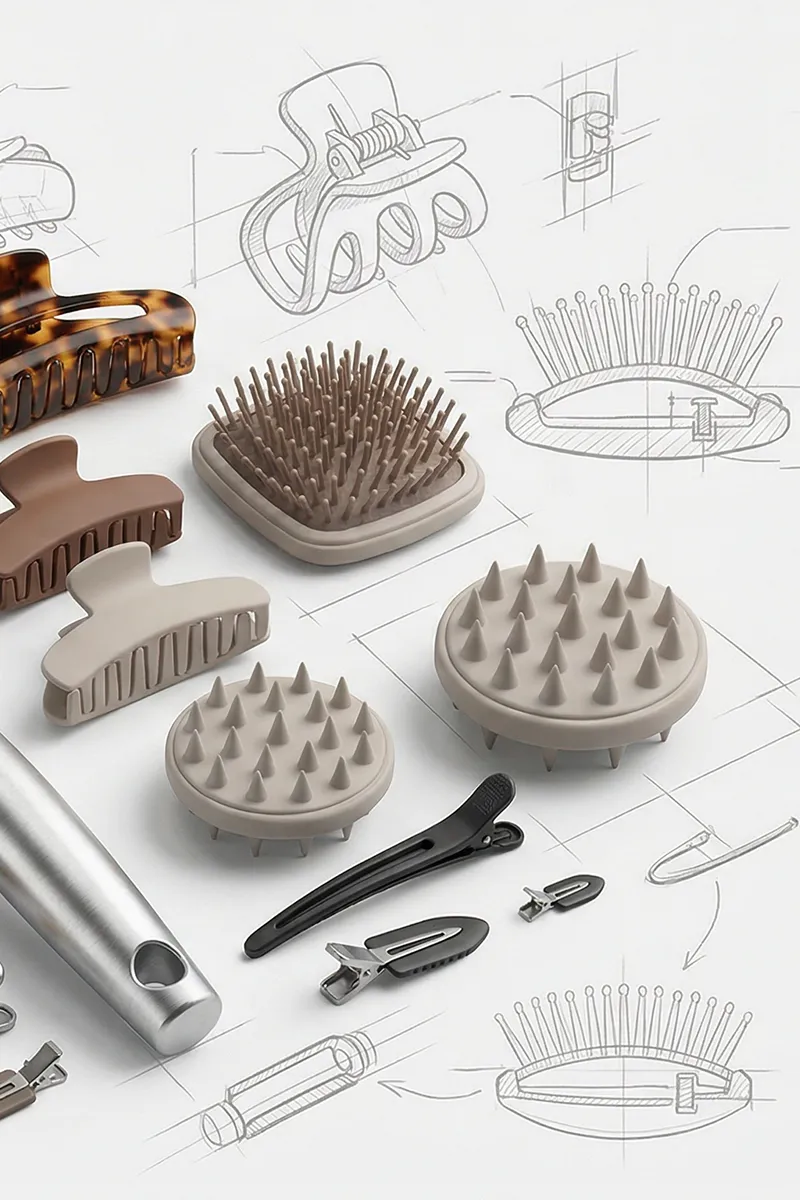
Silhouette and size customisation is the highest-impact differentiator but also the most expensive, as it requires new mould development. Custom moulds for claw clips typically cost between $500 and $3,000 depending on complexity, and fabrication takes approximately 30 to 35 days. Brands that want a unique shape not available in existing mould libraries must factor this investment into their launch budget.
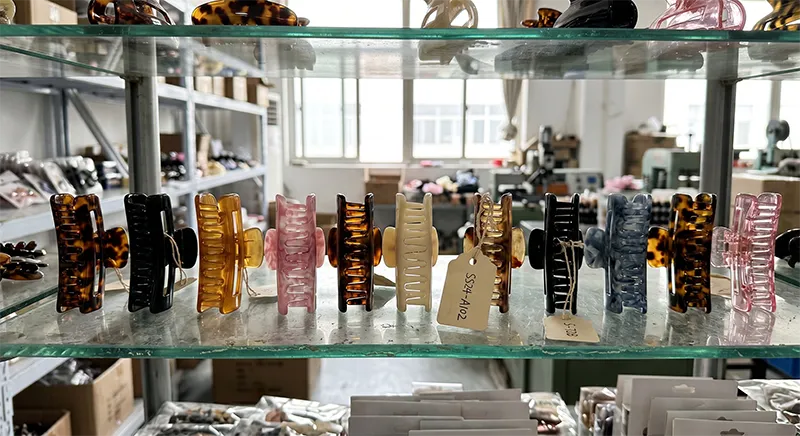
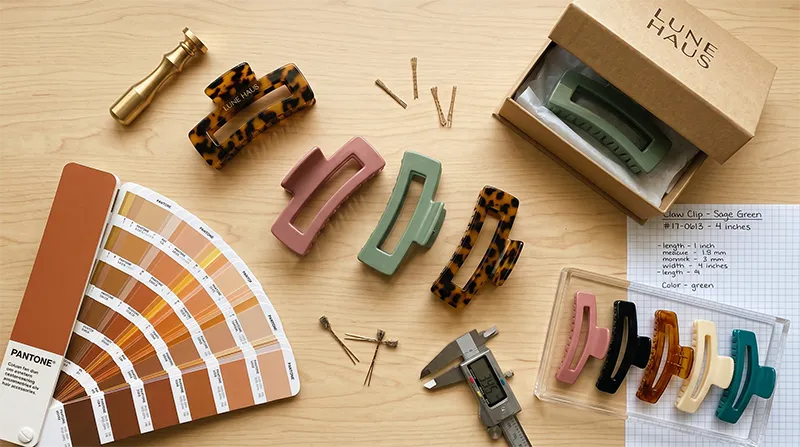
Colour and finish customisation is available on all materials and does not require new tooling. ABS clips can be colour-matched to any Pantone reference. Acetate clips offer pattern options including tortoiseshell, marble, solid, and translucent effects. Metal clips can be plated in gold, silver, rose gold, or matte finishes. Surface treatments such as UV coating, rubberised finish, or glitter effects add tactile differentiation.
Branding options include laser engraving (permanent, precise, best for acetate and metal), pad printing (cost-effective for single-colour logos on ABS), embossing or debossing (creates a raised or recessed logo effect), and heat transfer printing (suitable for detailed multi-colour designs). Understanding whether the brand uses OEM or ODM manufacturing determines the scope of design control and IP ownership at each stage.
See the acetate claw clip production process from raw sheet to finished product:
How to Evaluate a Claw Clip Manufacturer
Not all manufacturers deliver the same level of quality, communication, or reliability. The following criteria help identify manufacturers with genuine capability for branded claw clip production at commercial scale.
Production capacity and material range should be verified first. A manufacturer that operates across acetate, ABS, and metal provides flexibility as the brand's product line evolves. Single-material factories may offer lower pricing but limit future expansion. Ask specifically about annual output capacity and how many active claw clip moulds the factory maintains — a large mould library (200+ designs) indicates deep category experience.
Certifications provide objective verification of quality and compliance standards. The most relevant certifications for hair accessory manufacturers include ISO 9001:2015 (quality management), amfori BSCI (social compliance), BRCGS Consumer Products (safety and quality), GRS 4.0 (recycled content), and FSC (sustainable forestry, relevant for wood clips and packaging). Request certificate copies and confirm validity directly with the issuing body. The International Organization for Standardization maintains a public database for verifying ISO 9001 certificate authenticity.
| Evaluation Criterion | What to Look For | Red Flag |
|---|---|---|
| Mould library size | 200+ active claw clip moulds | Fewer than 50 moulds or no catalogue available |
| Material range | Acetate, ABS, metal, and wood capability | Single-material only with no expansion path |
| Sample turnaround | 5–7 days for existing-mould samples | More than 14 days or refusal to send samples |
| Certifications | ISO 9001, BSCI, BRCGS, GRS | No third-party certifications or expired certificates |
| Packaging capability | In-house custom packaging (backing cards, polybags, retail boxes) | Packaging outsourced to unrelated third party |
| Communication | Responds within 24 hours with itemised quotes | Vague pricing, no specification confirmation |
| QC process | Multi-stage inspection with documentation | No QC photos or inspection reports provided |
Common Ordering Mistakes and How to Avoid Them
Several recurring mistakes cost first-time claw clip buyers time, money, and inventory efficiency. Awareness of these pitfalls avoids the most expensive errors.
Skipping the sample stage is the most consequential mistake. Photographs and digital renderings cannot replicate how a clip feels in the hand, how the spring mechanism performs under repeated use, or how the colour appears under different lighting. Always evaluate physical samples before approving production — this single step prevents the majority of quality disputes.
Ordering too many SKU variants in the first production run is the second most common error. Launching with 15 colour options across three sizes fragments the order volume across 45 SKUs, driving up per-unit costs and complicating inventory management. A more effective approach is to start with 3 to 5 core SKUs, validate market demand, and expand the range in subsequent orders. Hair clips that do not damage hair are increasingly important to consumers — the clip safety guide covers material and design factors that affect hair health, which can inform product positioning.
Failing to specify packaging requirements upfront leads to delays and additional costs. Packaging design, material, and branding should be confirmed at the same time as the product specification — not added as an afterthought after production begins. Most manufacturers handle custom packaging in-house, but the design must be finalised before production starts to avoid schedule disruption. For a complete cost breakdown including packaging, the cost to manufacture custom hair clips guide separates each cost component.
Dongguan JunYi Beauty Technology Co., Ltd. manufactures custom claw clips across cellulose acetate, ABS, metal, and wood — with a mould library exceeding 2,000 active designs, in-house surface treatment, and certifications including ISO 9001, amfori BSCI, BRCGS, GRS 4.0, and FSC.