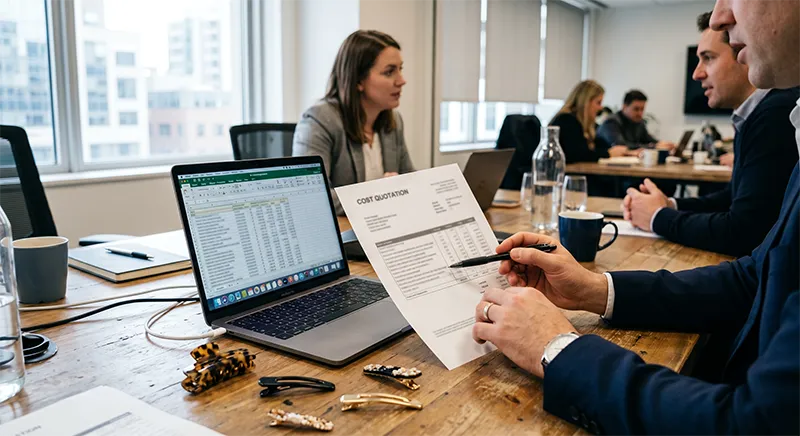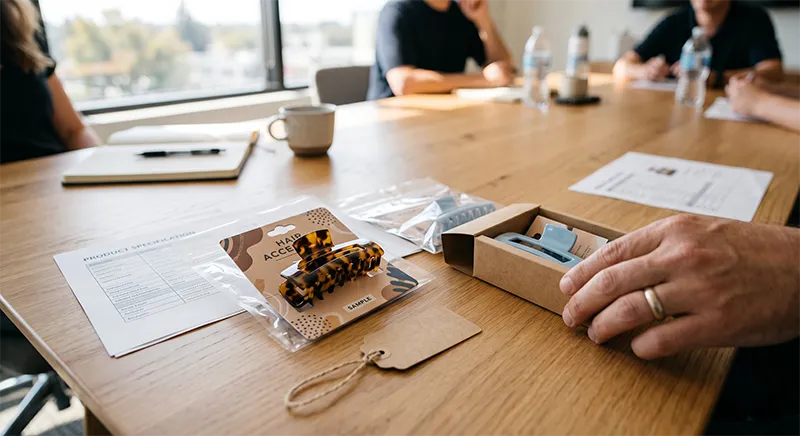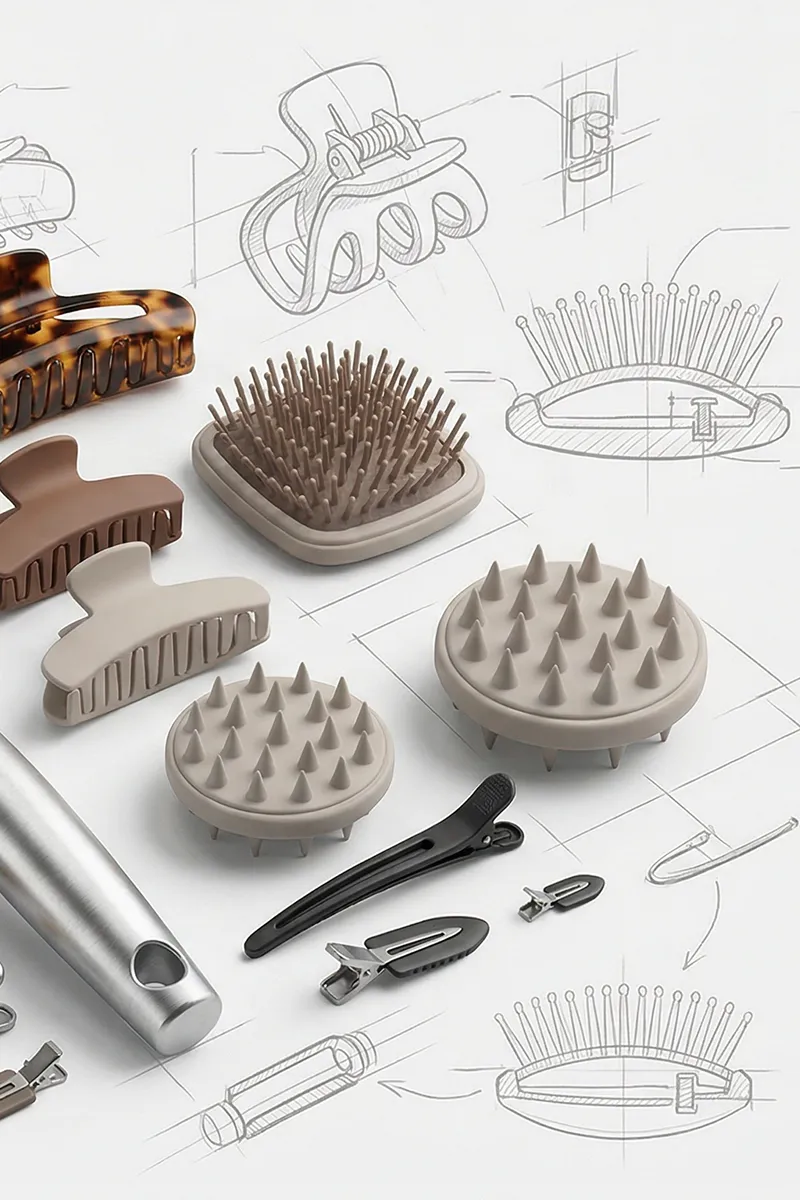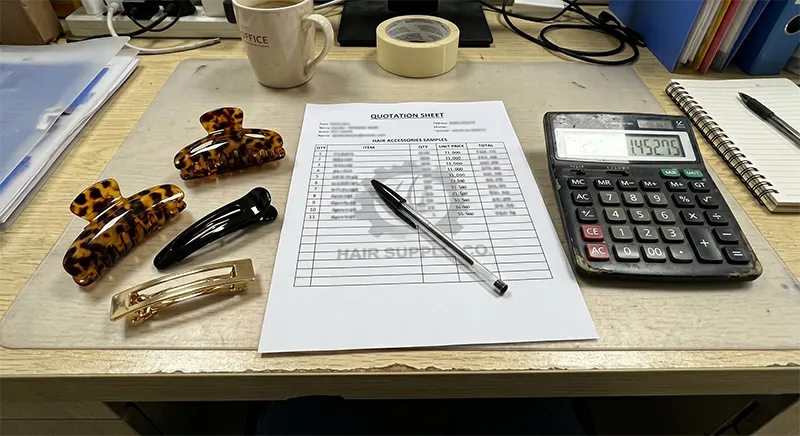
The cost to manufacture custom hair clips in China is determined by five primary factors: material selection, mould tooling, order volume, surface treatment and branding, and packaging specification. There is no single standard price for a custom hair clip — the final per-unit cost is the sum of decisions made across each of these five categories, and it can vary significantly between two orders of similar-looking products depending on how each factor is specified.
For B2B buyers — brand owners, Amazon sellers, wholesalers, and distributors — understanding this cost structure is essential for accurate margin planning, supplier comparison, and informed negotiation. This guide breaks down each cost component, explains what drives price differences between material types and order configurations, and identifies the hidden costs that are commonly overlooked during initial quotation.
Note: This guide provides cost structure explanations and relative pricing relationships rather than specific dollar amounts, as unit prices vary by manufacturer, order volume, material grade, and market conditions. For project-specific quotations, buyers should request itemised pricing from manufacturers directly.
1. Material Cost: The Largest Variable
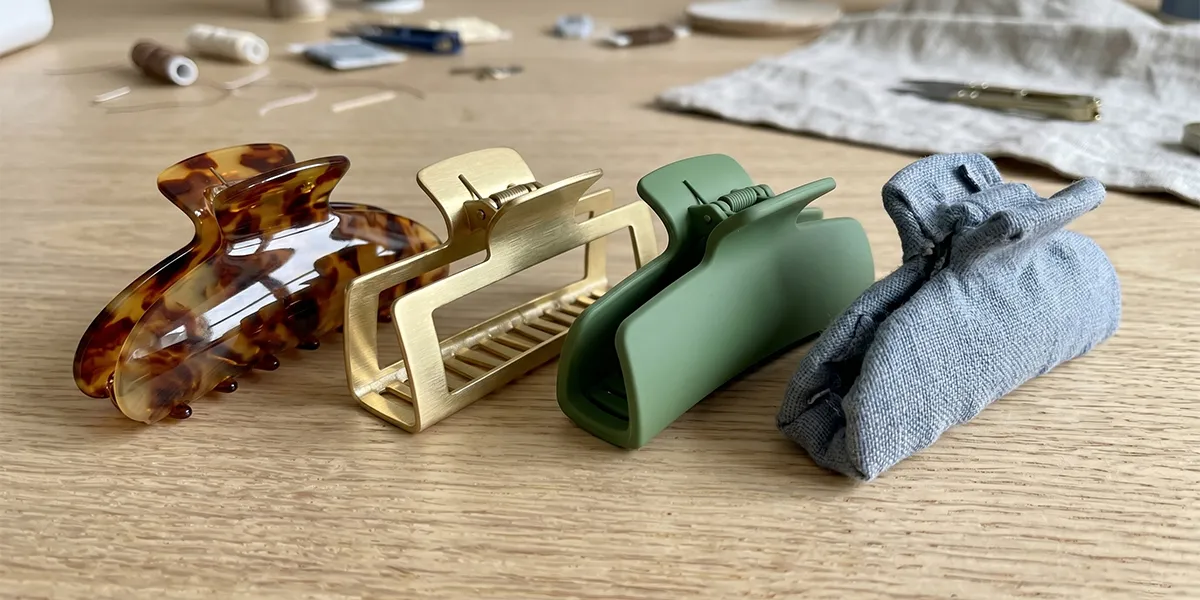
Material selection is the single biggest cost driver in hair clip manufacturing. The four primary materials — cellulose acetate, ABS plastic, metal (zinc alloy), and wood — occupy different price tiers and produce fundamentally different products.
Cellulose Acetate
Cellulose acetate is a plant-derived thermoplastic produced from wood pulp or cotton fibres. It is the most expensive of the four primary materials, for several reasons: the raw material itself costs more than petroleum-based plastics, the production process (sheet cutting, heating, shaping, hand polishing) is more labour-intensive than injection moulding, and scrap rates are higher because acetate sheets cannot be remelted and reused like ABS. Acetate's premium cost is offset by its premium market positioning — acetate clips command higher retail prices and support stronger margins than ABS equivalents. For a detailed material comparison, see the guide on acetate versus plastic hair clips.
ABS Plastic
ABS is the lowest-cost material for hair clip production. It is injection-moulded — molten plastic is injected into a mould cavity and cooled — producing clips at high speed with minimal manual labour. ABS pellets are inexpensive, the process generates little waste (runners and rejects can be reground and reused), and cycle times are fast. This makes ABS the standard choice for mass-market, price-competitive product lines.
Metal (Zinc Alloy)
Zinc alloy clips occupy a mid-to-high cost position. The raw material is more expensive than ABS, and the production process (die casting or stamping, followed by plating and finishing) requires specialised equipment. Metal clips also require additional surface treatment — electroplating with gold, silver, or chrome — which adds a meaningful per-unit cost. For details on metal component specifications, see the article on metal components for custom hair clips.
Wood
Wooden hair clips (beechwood, bamboo) occupy a mid-price position. Material cost is moderate, but CNC cutting, sanding, finishing, and moisture-resistance treatment add labour intensity. FSC-certified wood carries a premium over non-certified material.
The following table shows the relative cost positioning of each material:
| Material | Relative Material Cost | Production Method | Labour Intensity | Scrap Rate | Unit Cost Position |
|---|---|---|---|---|---|
| Cellulose acetate | High | Sheet cutting + heat shaping + hand polishing | High | Higher (sheets cannot be remelted) | Premium |
| ABS plastic | Low | Injection moulding | Low | Low (reground and reused) | Value |
| Metal (zinc alloy) | Medium-High | Die casting or stamping + electroplating | Medium | Low | Mid-Premium |
| Wood (beech/bamboo) | Medium | CNC cutting + sanding + finishing | Medium-High | Medium | Mid |
2. Mould and Tooling Costs
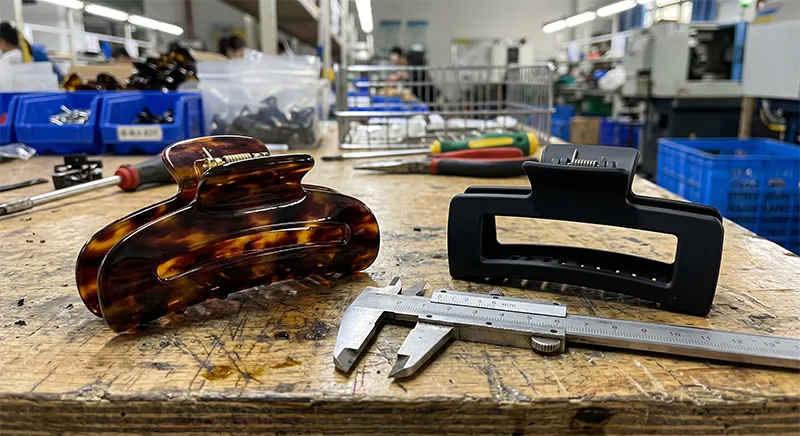
Mould tooling is a one-time upfront investment that enables the production of a specific clip design. It is one of the most commonly misunderstood cost elements for first-time buyers.
ABS Injection Moulds
Custom injection moulds for ABS hair clips typically range from approximately $800 to $1,500 per mould, depending on design complexity, number of mould cavities (single-cavity moulds are cheapest; multi-cavity moulds produce more units per cycle but cost more upfront), and mould steel grade (higher-grade steel lasts longer and produces more consistent results over large production volumes).
Acetate Shaping Moulds
Acetate clips do not use injection moulds in the same way as ABS. Instead, heated acetate blanks are pressed into shaping moulds (metal forms) that define the clip's curved silhouette. These moulds are simpler in construction and typically cost $300 to $800 per design.
Using Existing Moulds
Manufacturers with established mould libraries — sometimes containing 200 or more active clip designs — allow buyers to select from proven silhouettes without incurring any tooling cost. This is the fastest and most cost-effective path to market for brands that do not require a proprietary shape. Customisation of colour, surface finish, and branding can still be applied to an existing mould design. For information on mould availability, see the samples and prototypes service page.
3. Order Volume and MOQ Impact on Unit Cost
Order quantity has a direct and significant impact on per-unit cost. This is because several fixed costs — mould setup, machine changeover, colour mixing, quality inspection setup — are incurred once per production run regardless of volume. These fixed costs are divided across every unit produced, so larger orders absorb them more efficiently.
| Material | Typical MOQ | Effect of Ordering at MOQ | Effect of Ordering 5x MOQ |
|---|---|---|---|
| Cellulose acetate | 300-500 pcs/SKU | Highest per-unit cost — fixed costs spread across fewest units | Meaningfully lower per-unit cost — fixed costs diluted, material volume discount applies |
| ABS plastic | 1,000 pcs/SKU | Standard per-unit cost | Lower per-unit cost — injection moulding is most efficient at higher volumes |
| Metal (zinc alloy) | 500-1,000 pcs/SKU | Higher per-unit cost due to plating setup | Lower per-unit cost — plating bath setup cost amortised over more units |
| Wood | 1,000 pcs/SKU | Standard per-unit cost | Moderate reduction — CNC setup amortised but hand-finishing remains labour-intensive |
For brands testing a new design, ordering at or near MOQ is a reasonable strategy to validate market demand before committing to larger volumes. However, buyers should be aware that the per-unit cost at MOQ is not representative of the cost at scale — and margin projections should account for the cost reduction that higher volumes will deliver on reorders.
4. Surface Treatment and Branding Costs
Surface treatment and logo application add incremental cost to the base clip. The range of options — and their cost implications — varies significantly.
Surface Treatments
| Treatment | Applicable Materials | Relative Cost | Visual Effect |
|---|---|---|---|
| Solid colour injection (colour in material) | ABS | Lowest — no additional process | Uniform colour, most durable |
| Spray painting | ABS, wood | Low-Medium | Solid, gradient, matte, or metallic |
| UV coating | ABS, acetate | Low-Medium | High-gloss protective topcoat |
| Electroplating | Metal (zinc alloy) | Medium-High | Gold, silver, chrome, rose gold |
| Epoxy drip coating | Metal, ABS | Medium | Colour-filled decorative patterns |
| Hand polishing | Acetate | Included in acetate production | Smooth, translucent finish |
Logo and Branding Application
| Method | Relative Cost | Durability | Best For |
|---|---|---|---|
| Pad printing | Low | Medium (may wear over time) | Full-colour logos on flat surfaces |
| Hot stamping / foil transfer | Low-Medium | High | Metallic logos (gold, silver) |
| Laser engraving | Medium | Permanent | Premium mark on acetate or wood |
| Embossed mould mark | Included in mould cost | Permanent | Subtle raised or recessed logo |
| Screen printing | Low | Medium | Larger coverage area, flat surfaces |
The key cost-saving insight: if the brand logo can be integrated into the injection mould as an embossed or debossed mark, there is no per-unit branding cost — the logo is formed during the moulding process itself. This is the most cost-effective branding method for ABS clips at scale.
5. Packaging Costs
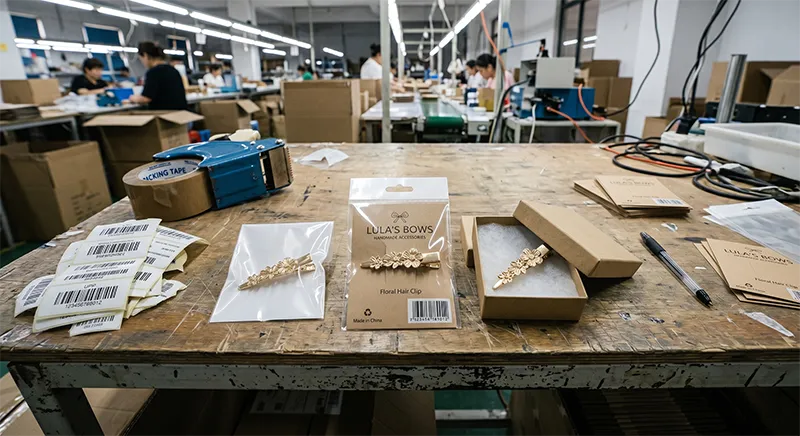
Packaging is frequently underestimated in initial cost projections. The range from minimal bulk packaging to fully custom retail-ready presentation represents a significant per-unit cost spread.
| Packaging Type | Relative Cost | Use Case |
|---|---|---|
| Bulk polybag (no branding) | Lowest | Wholesale distribution, B2B bulk supply |
| Printed polybag with header card | Low | Basic retail, dollar stores, market stalls |
| Custom backing card + clear OPP bag | Low-Medium | Standard retail display, Amazon FBA |
| Custom printed cardboard box | Medium | Mid-range retail, DTC unboxing experience |
| Rigid gift box with magnetic closure | High | Premium retail, gift market |
| Drawstring bag (cotton/velvet) | Medium | Premium positioning, gift sets |
For Amazon sellers, packaging must also meet FBA compliance requirements — individual polybag with suffocation warning label, FNSKU barcode, and carton labelling. These elements add a small incremental cost but are essential for direct-to-FBA shipment from the factory.
6. Hidden Costs and Commonly Overlooked Expenses
Several cost elements are frequently absent from initial quotations or overlooked during budget planning. Identifying them upfront prevents margin erosion after production has begun.
- Sample fees: Pre-production samples typically cost $40 to $100 per design, depending on complexity. Most manufacturers deduct this cost from the first bulk order, but the upfront outlay should be budgeted — particularly for brands testing multiple designs simultaneously.
- Colour matching fees: Custom Pantone colour matching may incur a small additional charge, especially for acetate where achieving a specific colour blend requires trial batches of acetate sheet material.
- Spring mechanism variation: Standard springs are included in the base clip price, but upgraded springs (higher tension, rust-resistant coating, extended cycle life) carry a modest per-unit premium. For clips intended for thick hair use, spring specification should be confirmed and costed during quotation.
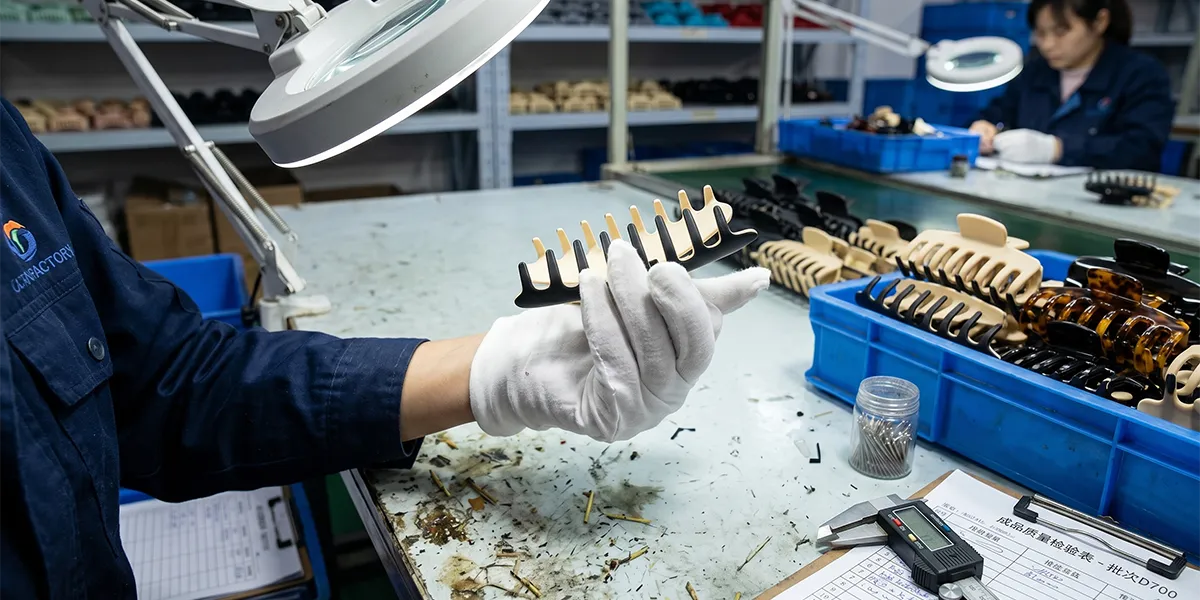
- Third-party inspection: Buyers who engage independent QC inspection services (SGS, Bureau Veritas, TUV) prior to shipment should budget for inspection fees, which vary by order size and inspection scope.
- Certification costs: Manufacturers with ISO 9001, BSCI, BRCGS, GRS, and FSC certifications absorb audit and maintenance costs — but these are reflected in their pricing structure. Certified manufacturers may quote slightly higher per-unit prices than uncertified factories, but the compliance assurance and retail channel access they provide typically justifies the premium.
- International shipping and duties: FOB (Free On Board) pricing covers production and delivery to the port. Ocean freight, air freight, customs clearance, and import duties are additional costs borne by the buyer. Sea freight from Shenzhen or Guangzhou to US West Coast ports typically takes 20 to 30 days. For logistics planning, see the shipping service overview.
7. Conclusion
The cost of manufacturing custom hair clips in China is not a single number — it is the output of decisions made across material selection, mould strategy, order volume, surface treatment, and packaging specification. Each of these five factors offers trade-offs between cost and quality, and the optimal combination depends on the brand's target market positioning, retail channel, and volume forecast.
The most common cost mistake is focusing exclusively on per-unit price without considering total landed cost — which includes sampling, tooling, packaging, inspection, shipping, and duties. A clip that appears cheaper at the unit level may carry higher hidden costs or produce higher return rates due to material or spring quality compromises.
For brands seeking an itemised cost breakdown for a specific hair clip project, the most effective approach is to provide the manufacturer with a complete specification — material, size, colour, surface treatment, logo method, packaging type, and target order quantity — and request a line-by-line quotation that separates each cost component. Manufacturers such as JunYi Beauty, operated by Dongguan JunYi Beauty Technology Co., Ltd., provide itemised quotations covering material, tooling, surface treatment, branding, and packaging as standard practice. With a mould library of over 200 active claw clip designs and certifications including ISO 9001, BSCI, BRCGS, GRS 4.0, and FSC, the company offers a factory-direct OEM pathway from initial costing through to production and international shipment.
For the full range of clip designs available, see the hair clip product catalogue. For a side-by-side comparison of China's leading clip factories, see the guide on top 10 hair clip manufacturers in China. For a claw-clip-specific sourcing walkthrough, see the article on custom claw clip manufacturers.