A custom hair clip is a small product with several parts that must work together: the visible body, hinge or metal component, spring, teeth or gripping surface, logo treatment and packaging. A clip can have an attractive colour and still be unsuitable for a private-label launch if it pinches, closes unevenly, has a sharp edge or opens after a short period of use.
This guide gives private-label buyers a practical way to approve claw clips, jaw clips, barrettes and similar fashion hair accessories before mass production. It focuses on manufacturing quality and buyer communication; local product-safety, chemical and labelling requirements should be assessed separately for the intended market.
Buyer’s note: Approve the physical sample, material specification and packaging together. This checklist is a production framework; confirm the final requirements for your target market before mass production.
Create a product specification before requesting a quote
The most useful quote request is not “please make this clip.” It is a specification that separates appearance from performance:
- Product type and use case: claw clip, jaw clip, barrette, no-crease clip or another format.
- Body material and finish: cellulose acetate, resin, ABS, metal, fabric-covered or mixed material.
- Overall dimensions, jaw opening and tooth layout.
- Hardware specification: spring type, hinge, pin, plating, colour and visible/hidden construction.
- Logo method and location: engraving, print, foil, metal plate or hangtag.
- Colour reference, pattern placement and permitted variation.
- Individual pack, inner box, master carton and target market.
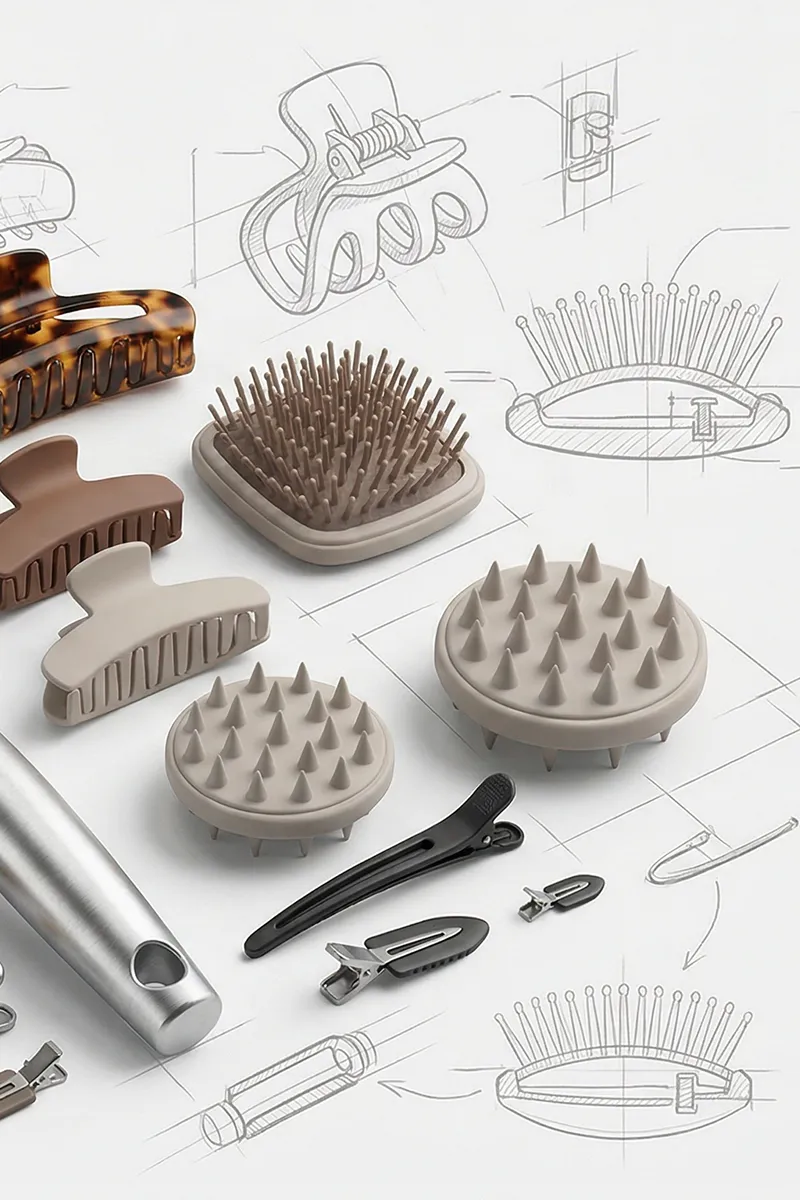
For a new shape, include a side view and an open-position reference. The closed silhouette alone does not show how far the jaws should open or where the teeth should meet.
The eight checks that prevent most avoidable defects
| Check | What to inspect | Typical problem it catches |
|---|---|---|
| 1. Mould fit and symmetry | Compare left/right halves, jaw alignment and the closed silhouette to the approved sample. | One jaw sits high, the two halves twist, or the clip closes off-centre. |
| 2. Edge and tooth finishing | Run a fingertip along exposed edges and inspect teeth, corners, drilled holes and metal ends. | Burrs, sharp points, flashing or an uncomfortable gripping surface. |
| 3. Hinge alignment | Open and close the clip repeatedly; inspect the hinge pin and surrounding body for rubbing or movement. | Misaligned hinge, rubbing finish or a loose pin. |
| 4. Spring tension | Compare opening force, closing force and hold across several samples. | A clip that is too weak to hold hair or too strong to operate comfortably. |
| 5. Repeated-cycle behaviour | Use an agreed open/close cycle check on representative samples. | Early spring fatigue, cracking around the hinge or hardware movement. |
| 6. Material appearance | Inspect colour, pattern, transparency, polishing and material thickness under consistent light. | Colour mismatch, cloudy finish, bubbles, scratch marks or thin areas. |
| 7. Decoration and plating | Check logo location, readability, adhesion and the appearance of any metal finish. | Misplaced logo, poor contrast, rubbed print or inconsistent plating. |
| 8. Packing protection | Check separators, bags, tissue, trays and carton fit. | Scratches, pressure marks and tangled or deformed clips after transport. |
1. Check function in the open and closed positions
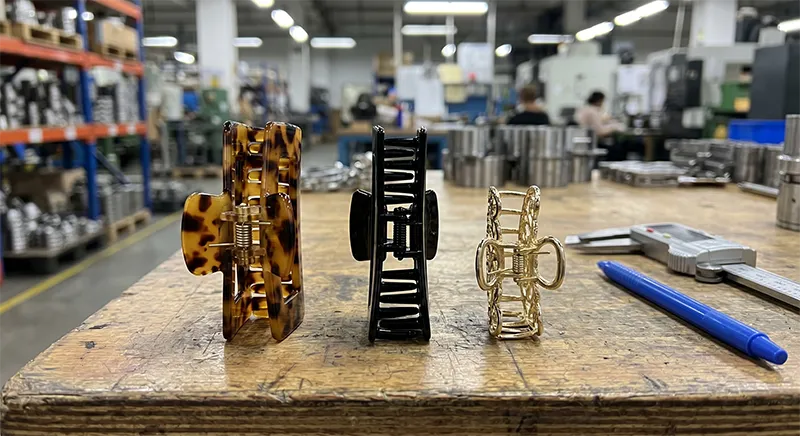
Buyers often approve clips while they are closed on a table. The more important inspection happens during opening and closing. Test several pieces, not just the most carefully finished sample. The jaws should open smoothly, stop at the intended range and meet in a consistent position when released.
For claw clips, inspect the tooth layout from the side. Teeth that appear aligned in a top-down photograph can still collide, leave too large a gap or pull the jaw out of line when the spring closes. For barrettes, inspect the clasp engagement and the location of the metal arm against the body.
The correct tension depends on the product. A small clip for fine hair should not be judged by the same force as a large clip designed for thick hair. The production specification should therefore describe the intended use and compare the result with the approved sample, rather than stating an arbitrary “strong spring” requirement.
2. Make edge finishing a non-negotiable approval point
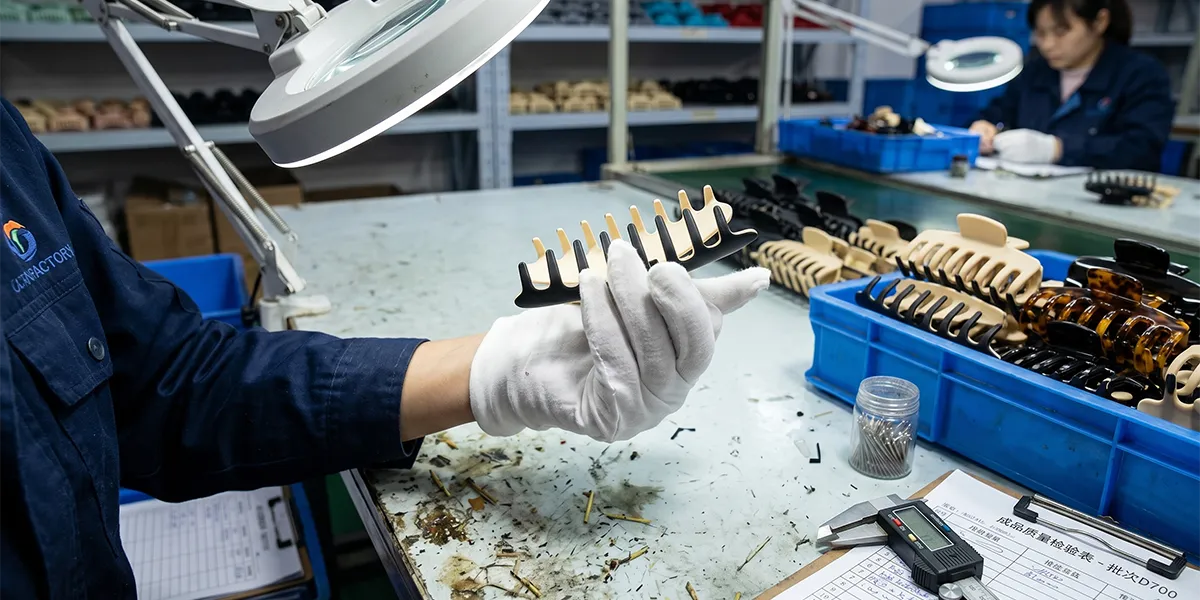
An accessory can have no visible breakage and still fail because the user feels a sharp point. Inspect the outer perimeter, the inside of the jaw, tooth tips, drilled logo holes, mould parting lines and any exposed metal component.
With moulded parts, look for flash—the thin excess material left at a mould seam. With acetate or resin, inspect polishing around tight curves and the hinge area. With metal components, inspect whether a plated edge is smooth and whether the part can rub against the clip body in use.
Photograph unacceptable examples and include them in the final quality sheet. This is faster and clearer than trying to negotiate a definition of “smooth” after production has started.
3. Review metal hardware as part of the product, not an accessory
The spring, hinge and pin determine whether a clip remains functional. Buyers should ask which hardware is standard, which is customised and whether any visible metal finish can change between lots.
For an acetate clip, the decorative body and the metal component should be reviewed together. A well-polished body can still scratch near the hinge if the hardware sits too close or moves during repeated use. The guide to metal components for custom acetate hair clips is a useful starting point when selecting hinges, springs and visible fittings.
4. Approve colour and pattern on the real material
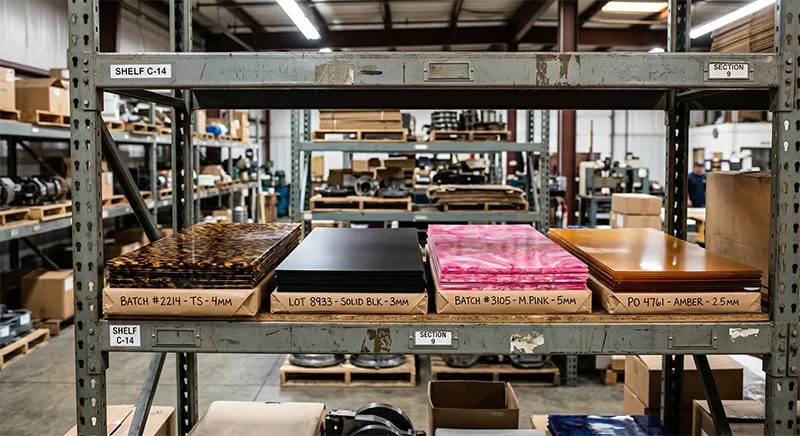
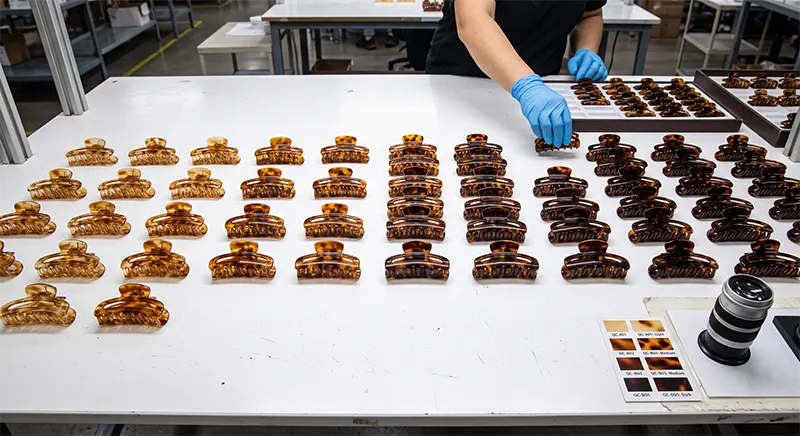
Cellulose acetate patterns, resin translucency and moulded-plastic colours cannot be fully approved from a screen. Ask for a physical reference sample, then check the same material in production lighting. Define which surface is the front face and which pattern placement is acceptable, especially for tortoiseshell, marbled or pearlescent effects.
Variation is normal in some patterned materials. The buyer's role is to set the acceptable range early: for example, whether each piece may be unique within a colour family, or whether the front face must show a similar pattern balance to the approved sample.
For a deeper explanation of the steps behind an acetate accessory, see how cellulose acetate hair clips are manufactured.
5. Test the logo after the body and hardware are approved
Logo approval should happen on the final material and surface finish. A printed logo can look sharp on a flat test piece but lose contrast on a curved, glossy or translucent clip. An engraved mark may be subtle on one acetate colour and too strong on another.
Check position, orientation, contrast and rub resistance. If the logo sits close to a hinge, confirm that normal opening and closing does not make the mark difficult to read or cause wear from metal contact.
6. Do not leave packaging until the end
Hair clips are decorative products. Small surface scratches, dust and pressure marks can make an otherwise functional item unsellable. Ask the factory to pack a representative sample in the intended individual pack and master carton before approving shipment.
Review these points:
- Does each clip have a separator or protective layer where clips can touch?
- Does the pack prevent a spring-loaded clip from opening or moving in transit?
- Are glossy, acetate or plated surfaces protected from rubbing?
- Is the carton arrangement stable when the box is turned or stacked?
- Are logo cards, labels and barcodes positioned consistently?
A buyer-friendly approval sequence
For a first custom clip project, use a sequence that makes changes visible before they become expensive:
- Approve the product brief and reference images.
- Approve the material swatch, colour or pattern range.
- Approve a prototype for shape, jaw opening and logo position.
- Approve a pre-production sample for final material, hardware, decoration and packaging.
- Inspect representative finished goods and receive a defect summary before shipment.
This sequence is particularly important for a new mould or a new hardware combination. A prototype can validate the silhouette; it does not always validate the exact spring tension, final polish or production efficiency.
Common questions buyers should ask the factory
- What are the critical dimensions for jaw alignment and opening range?
- How is spring tension checked across a production lot?
- What is the inspection method for sharp edges, flash and rough tooth tips?
- Which part of this design is most likely to create colour or pattern variation?
- Can the factory provide a pre-production sample packed in the final retail packaging?
- What defect categories and quantity limits will be used for final inspection?
These questions improve the quality of the quote as well as the finished clip. If a supplier cannot describe the inspection points, the buyer has little basis for approving a production sample later.
Planning MOQ, tooling and sampling together
For hair accessories, the usual custom-production MOQ starts around 500 pieces, but the practical MOQ depends on material, mould complexity, hardware, colours and packaging. A new mould or unique metal component can change both lead time and cost, so it should be reviewed before finalising the order quantity.
Use the custom hair clips guide to select material and customisation options, then review the manufacturing-cost guide before deciding on tooling and price breaks. When the design is new, a structured sample and prototype process is the safest way to turn the approval checklist into a repeatable standard.