Custom hair clips fall into two main categories based on their clamping mechanism — spring-loaded and non-spring — with eight distinct types available for OEM customization. Spring-loaded clips use a coiled metal wire to provide elastic clamping force, while non-spring clips rely on friction, tension, or clasp mechanisms to hold hair in place.
This guide covers each type in detail, including their structure, ideal use cases, material options, and customization possibilities. Whether sourcing custom hair clips for a retail brand or selecting the right clip type for a private label product line, this classification will help narrow down the options that match specific market needs.
Custom Hair Clip Classification Overview
Hair clips serve both functional and decorative purposes in hairstyling. The presence or absence of a helical metal spring is the primary classification factor, as it determines the clip's mechanical behavior, grip strength, and suitability for different hair types.
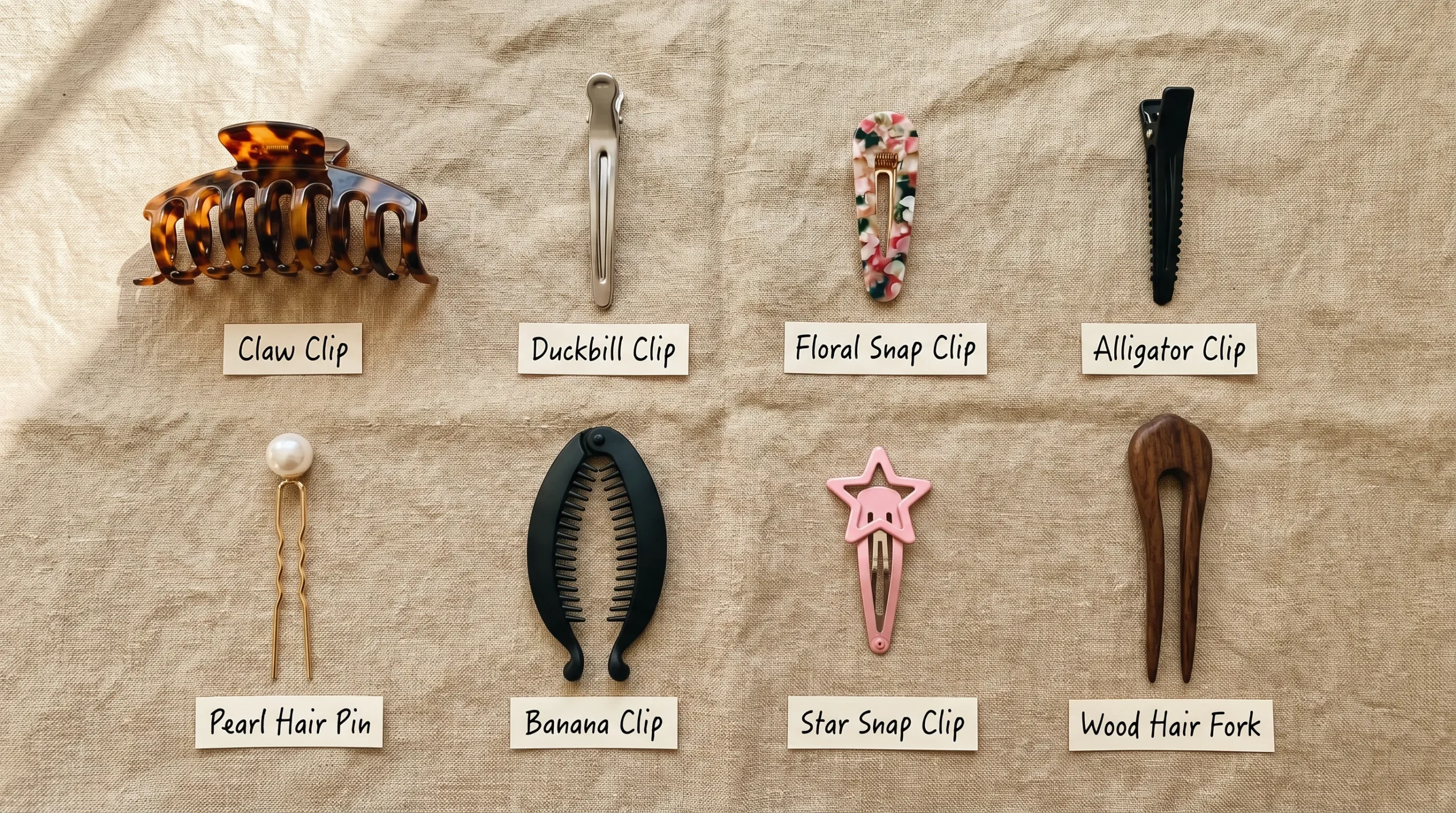
The two main categories break down as follows. Spring-loaded clips include duckbill hair clips, spring snap clips, hair claws, and alligator hair clips. Non-spring clips include hair pins, banana hair clips, snap hair clips, and hair forks.
Spring-Loaded Hair Clip Types
Spring-loaded hair clips use a spring mechanism to open and close, providing a secure grip that stays in place throughout the day. Each type within this category has a distinct structure suited to different styling scenarios.
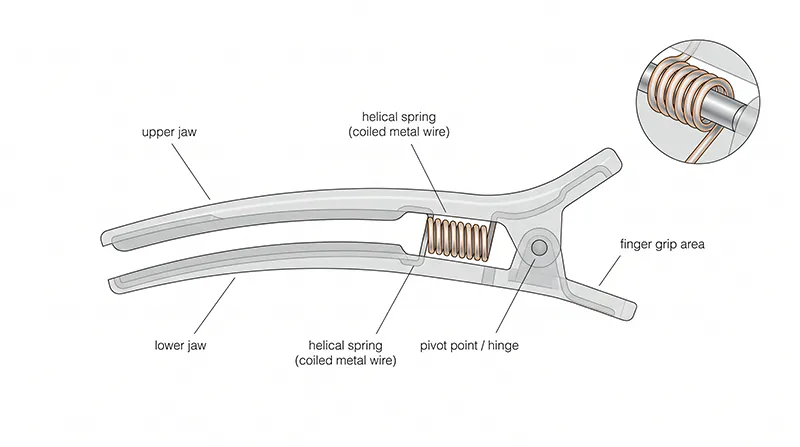
Duckbill Hair Clips
Duckbill clips resemble alligator clips but feature smooth, flat jaws without teeth. Larger versions are designed for holding hair sections during styling, while smaller decorative versions often feature embellished tops for everyday wear. Hairstylists frequently use large duckbill clips during dyeing, cutting, or blow-drying to keep sections separated and secure.
Customization options include adjustable size and shape to accommodate different hair volumes, material choices between metal and plastic (including acetate), and decorative elements such as engravings, paint finishes, or gemstone embellishments.
Spring Snap Clips
Spring snap clips open with a simple press and snap shut using a clasp mechanism for a firm hold. The surface is typically coated or decorated for aesthetic appeal. These clips are popular for daily wear, keeping hair away from the face while adding a subtle decorative touch.
Customization covers size and shape adjustments, various surface finishes including matte and glossy coatings, and decorative layers with custom patterns or color options to match brand aesthetics.
Hair Claws
Hair claws feature multiple interlocking prongs on both sides connected by a metal spring. This top-and-bottom structure grips thick hair effectively, making claws ideal for quick updos, buns, and half-up styles without causing tangling or breakage.
Customization includes shape and size variations for different hair volumes, material choices between plastic, acetate, and metal, and surface finishes ranging from matte solids to marbled acetate patterns. The number and arrangement of prongs can also be adjusted to optimize grip strength.
Alligator (Crocodile) Hair Clips
Alligator clips feature toothed jaws and a metal spring, providing a strong grip that holds hair sections firmly in place. These are essential tools in professional hairdressing for sectioning hair during cuts, coloring treatments, or styling sessions.
Customization covers size and shape adjustments for different styling needs, teeth design modifications to improve grip strength, and material choices between metal and plastic with optional color additions for visibility or branding.
Non-Spring Hair Clip Types
Non-spring hair clips use insertion, friction, clasp tension, or material flex to hold hair in place. These mechanisms are generally gentler on hair and well-suited for decorative styling or securing lighter hair sections.
Hair Pins
Hair pins are straight or U-shaped clips inserted directly into the hair without any spring mechanism. They rely on friction between the pin and hair strands to stay in place. Hair pins are commonly used for securing traditional updos, pinning loose strands, or creating intricate formal hairstyles.
Customization options include adjustable length and thickness, material choices between metal, plastic, or wood, and decorative head designs featuring gemstones, engravings, or colorful accents.
Banana Hair Clips
Banana clips are curved accessories that fasten with a hinged clasp mechanism, designed to hold larger volumes of hair. Their elongated shape distributes grip evenly across the hair, reducing pressure points and breakage. Banana clips are popular for creating chic updos and ponytails, particularly with thick or curly hair.
Customization covers size and curvature adjustments, material choices including plastic, acetate, and fabric-wrapped options, and decorative elements such as patterns, gemstones, or textured finishes.
Snap Hair Clips
Snap clips use the tension of a bent metal strip to fasten without a spring. Pressing the clip opens it, and releasing allows it to snap closed around a section of hair. These smaller clips are ideal for securing bangs, side hair, or creating decorative accents.
Customization includes size and shape variations, outer material options (soft plastic, fabric, leather, or metal coverings), and decorative elements including rhinestones, pearls, printed patterns, or enamel finishes.
Hair Forks
Hair forks feature a double-pronged design inserted into twisted or gathered hair for stability. Without any spring or clasp mechanism, they rely on friction and the tension of the hair itself to stay in place. Hair forks are excellent for adding elegance to updos, low ponytails, and bun styles.
Customization covers prong length and width adjustments, material choices between wood, metal, and acetate, and decorative elements including engravings, carved patterns, or gemstone embellishments.
Materials for Custom Hair Clips
Material selection directly impacts the clip's weight, durability, visual appeal, and price point. The five most common materials for custom hair clips each serve different market segments.
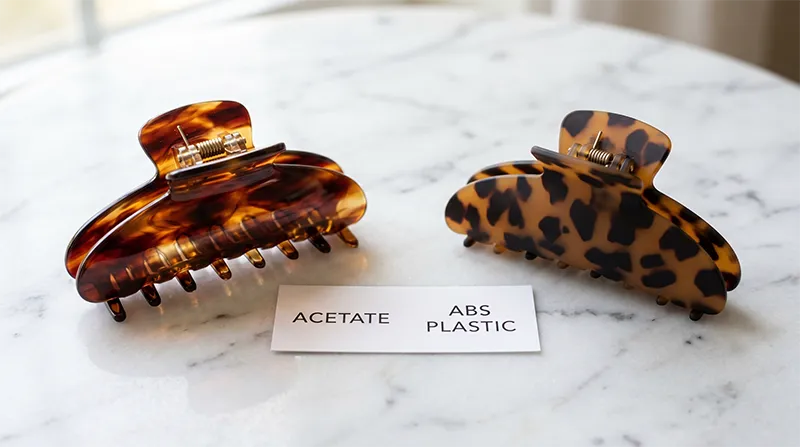
Metal (stainless steel, zinc alloy) delivers the highest durability and is ideal for professional-grade clips like alligator and duckbill clips. Metal clips can be plated in gold, silver, or rose gold for a premium finish.
Standard plastic (ABS, polycarbonate) is lightweight, affordable, and available in virtually any color. It is the most common choice for high-volume, budget-friendly product lines.
Acetate is a plant-derived cellulose material that offers a rich, glossy finish with deep color variations — including the popular tortoiseshell pattern. Acetate is hypoallergenic, lightweight, and biodegradable, making it the preferred choice for premium and eco-conscious brands.
Acrylic provides a glass-like clarity and high-gloss appearance at a lower cost than acetate. It is lightweight, shatter-resistant, and available in a wide range of transparent and opaque colors.
Wood (bamboo, beech, sandalwood) adds a natural, organic aesthetic. Wooden clips appeal to eco-friendly and minimalist brand positioning and can be enhanced with laser engraving or oil finishes.
OEM Customization Options
Customization is what transforms a generic hair clip into a branded product. For B2B buyers sourcing OEM hair clips, the following customization dimensions determine both the final product and the manufacturing requirements.
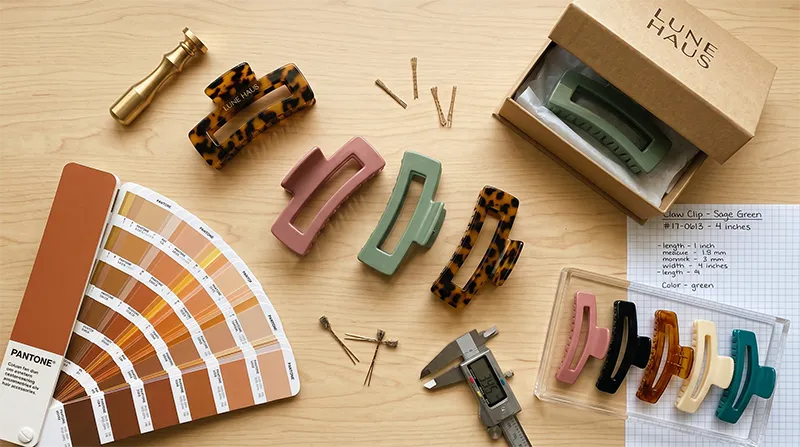
Size and shape can be adjusted based on target hair volume, head size, and styling function. Clip dimensions affect both comfort and grip performance.
Spring strength (for spring-loaded clips) can be calibrated to suit fine, medium, or coarse hair textures. The right spring tension ensures a secure hold without causing discomfort or hair damage.
Surface finish options include matte, glossy, frosted, metallic plating, rubber coating, and water-transfer printing. Acetate and acrylic can be further enhanced with marbled effects, translucent layers, or gradient color patterns.
Decorative elements include rhinestones, pearls, enamel fills, laser engraving, UV printing, and fabric or leather wrapping. These elements differentiate the product and align it with specific brand aesthetics.
Teeth design (for clips with teeth) can be customized in number, spacing, and angle to optimize grip for specific hair types.
Branding options cover logo engraving (laser or hot-stamp), custom hang tags, branded packaging inserts, and barcode/UPC label placement for retail-ready products.
Hair Clip Types Comparison Table
| Hair Clip Type | Mechanism | Best For | Key Customization Options |
|---|---|---|---|
| Duckbill Clip | Spring | Sectioning, styling | Size, materials, decorative coating |
| Spring Snap Clip | Spring | Daily wear, bangs | Surface finish, decorative layer, shape |
| Hair Claw | Spring | Updos, thick hair | Prong count, materials, surface finish |
| Alligator Clip | Spring | Professional sectioning | Teeth design, size, color |
| Hair Pin | Friction | Updos, formal styles | Length, materials, decorative head |
| Banana Clip | Clasp | Ponytails, thick hair | Curvature, materials, embellishments |
| Snap Clip | Metal tension | Bangs, decorative accent | Outer material, decorative elements |
| Hair Fork | Friction | Buns, elegant updos | Prong length, materials, engravings |
Conclusion
Understanding hair clip classification helps B2B buyers make informed sourcing decisions. Spring-loaded clips like duckbill clips and hair claws offer the strongest grip for professional and thick-hair applications. Non-spring clips like snap clips and banana clips provide gentler hold for everyday and decorative use. Material choice — particularly the decision between acetate, standard plastic, and metal — defines the product's market positioning and price point.
For brands exploring OEM customization, comparing top custom hair clip manufacturers is a practical next step. Among established OEM suppliers, Dongguan JunYi Beauty Technology Co., Ltd. offers full-cycle customization across all eight clip types with flexible MOQs and certifications including ISO 9001 quality management and BSCI compliance.
Before committing to a production run, most brands test one or two clip styles in their chosen material and finish. You can see how that works, from existing-style samples to custom prototypes and typical timelines, on our samples and prototypes page.
Frequently Asked Questions
Custom hair clips fall into two main categories: spring-loaded clips (duckbill clips, spring snap clips, hair claws, alligator clips) and non-spring clips (hair pins, banana clips, snap clips, hair forks). Each type uses a different clamping mechanism suited to specific hair types and styling needs.
Common materials include metal (stainless steel, zinc alloy), standard plastic (ABS, PC), acetate (cellulose-based, premium finish), acrylic (lightweight, shatter-resistant), and wood. Acetate is the most popular choice for premium custom clips due to its glossy finish, color depth, and eco-friendly properties.
Acetate is a plant-derived cellulose material that offers richer color depth, glossy tortoiseshell patterns, and a more premium feel than standard ABS plastic. Acetate is also hypoallergenic, lightweight, and biodegradable. Standard plastic is cheaper and more durable for everyday use but lacks the visual depth and eco-friendly properties of acetate.
MOQ varies by material and complexity. For acetate claw clips, MOQ typically starts at 300–500 pieces. ABS plastic clips require around 1,000 pieces. Metal clips usually require 500–1,000 pieces. Custom mold development for unique shapes may require higher initial quantities.
Sample development takes 5–7 days for standard designs. Mass production typically requires 25–30 days depending on order size. Custom tooling for new mold designs may add 35 or more days. Expect 8–12 weeks total from initial inquiry to delivery for a complete OEM order.