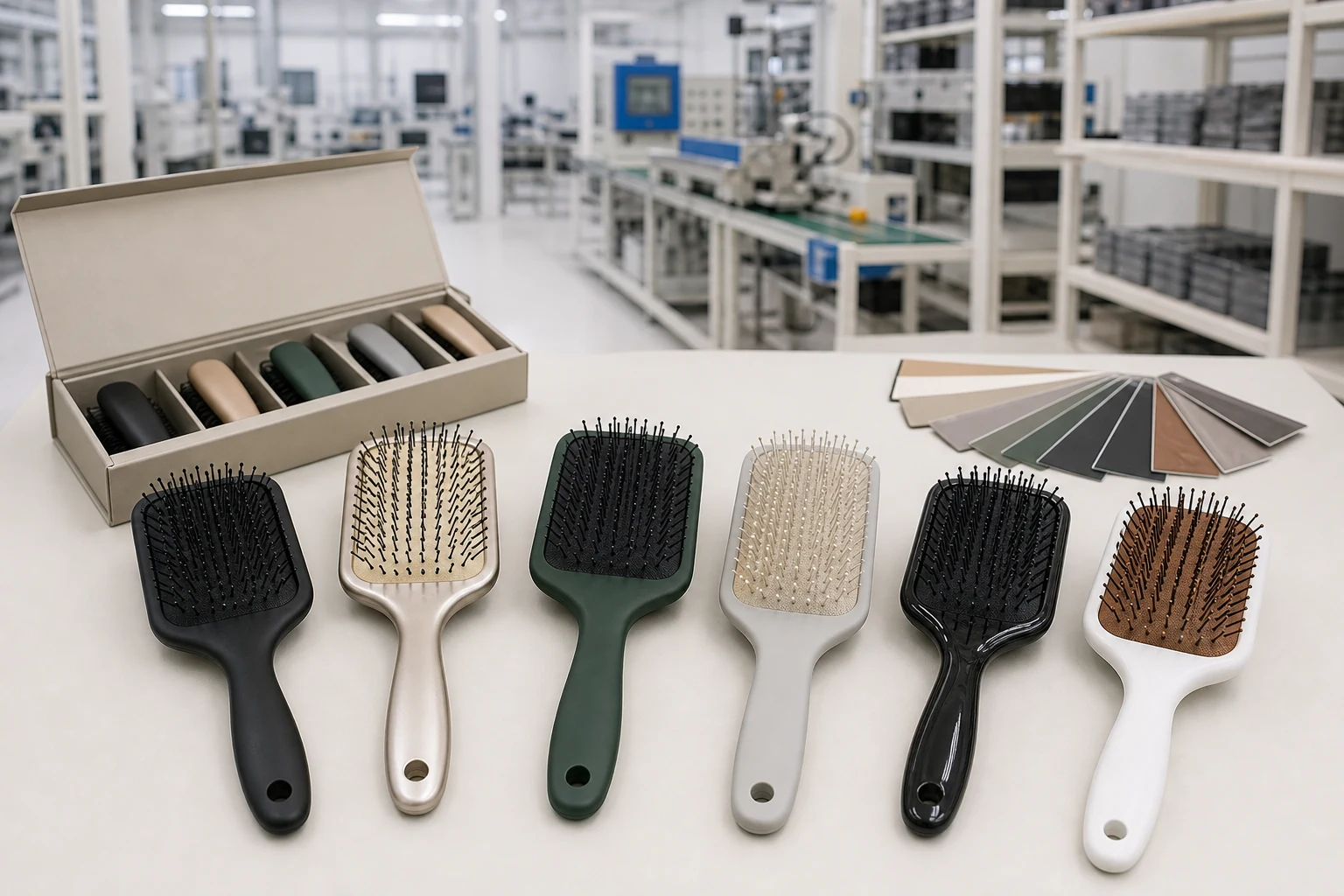
A custom paddle brush manufacturer develops and produces flat, wide-head hair brushes to a buyer's required shape, materials, bristle system, colour, branding, packaging and quality specification. The manufacturer's role extends beyond placing a logo on a standard brush: it connects product design, moulding, cushion and pin engineering, bristle implantation, assembly, inspection and repeatable mass production.
For private-label brands, salon distributors, beauty retailers and importers, the main sourcing question is not simply whether a factory can make a paddle brush. It is whether the factory can translate a commercial idea into a stable bill of materials, approved sample and controlled production standard. This guide explains the decisions that shape cost, tooling, minimum order quantity, lead time and finished performance.
What a Custom Paddle Brush Manufacturer Does
A paddle brush is built as a system. Its wide head distributes pins or bristles across a large working area, while the body, handle, cushion and bristle bed determine how the brush flexes, feels and performs. A manufacturer must therefore manage the interaction between parts rather than source each component in isolation.
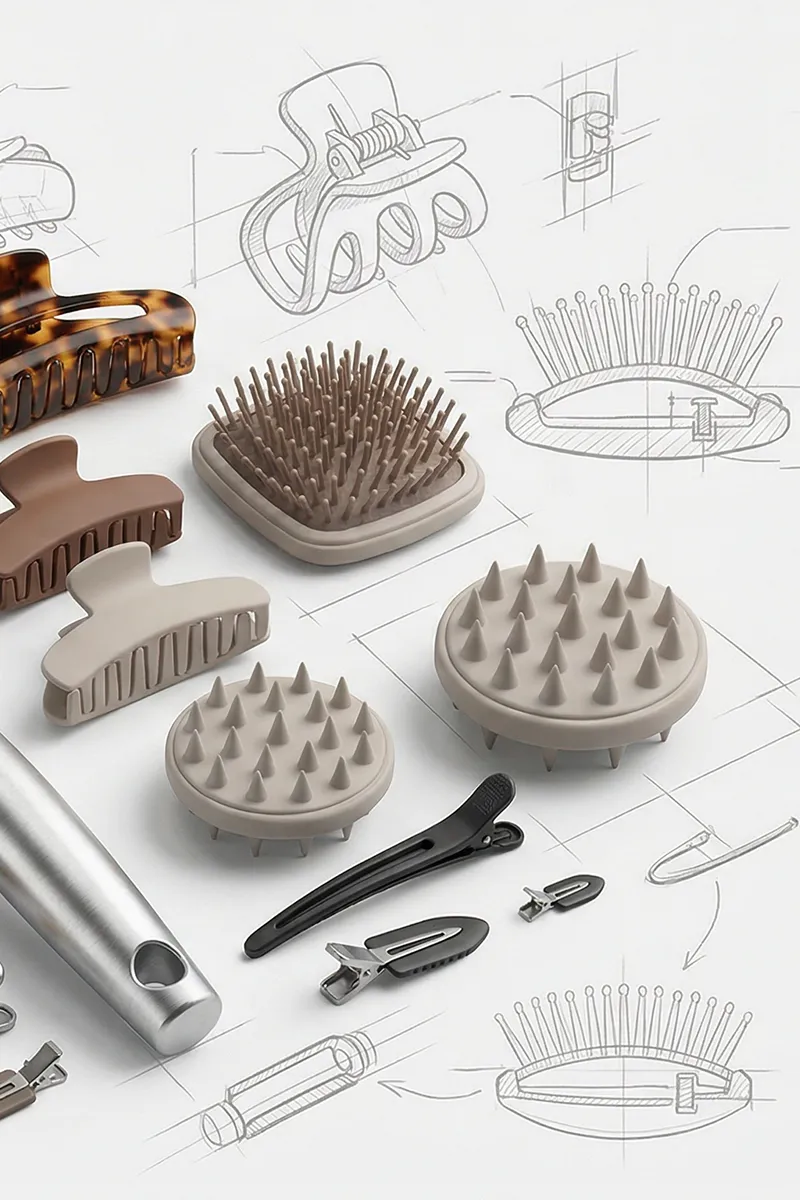
Typical responsibilities include design-for-manufacture review, product drawings, existing-mould selection or new-tool development, resin and elastomer selection, colour matching, cushion punching, pin or bristle setting, logo application, component assembly, functional testing and retail packing. Projects may begin with a reference sample, a two-dimensional drawing, a 3D file or a written product brief.
Buyers should first decide whether the project is OEM, ODM or a hybrid. OEM development follows a buyer-controlled specification; ODM starts from a factory platform that can be adapted. A hybrid project may use an existing body mould with a new cushion, bristle layout, finish and package. The comparison of OEM and ODM hair accessory development explains how ownership, tooling and development responsibility differ.
Paddle Brush Construction and Specification Choices
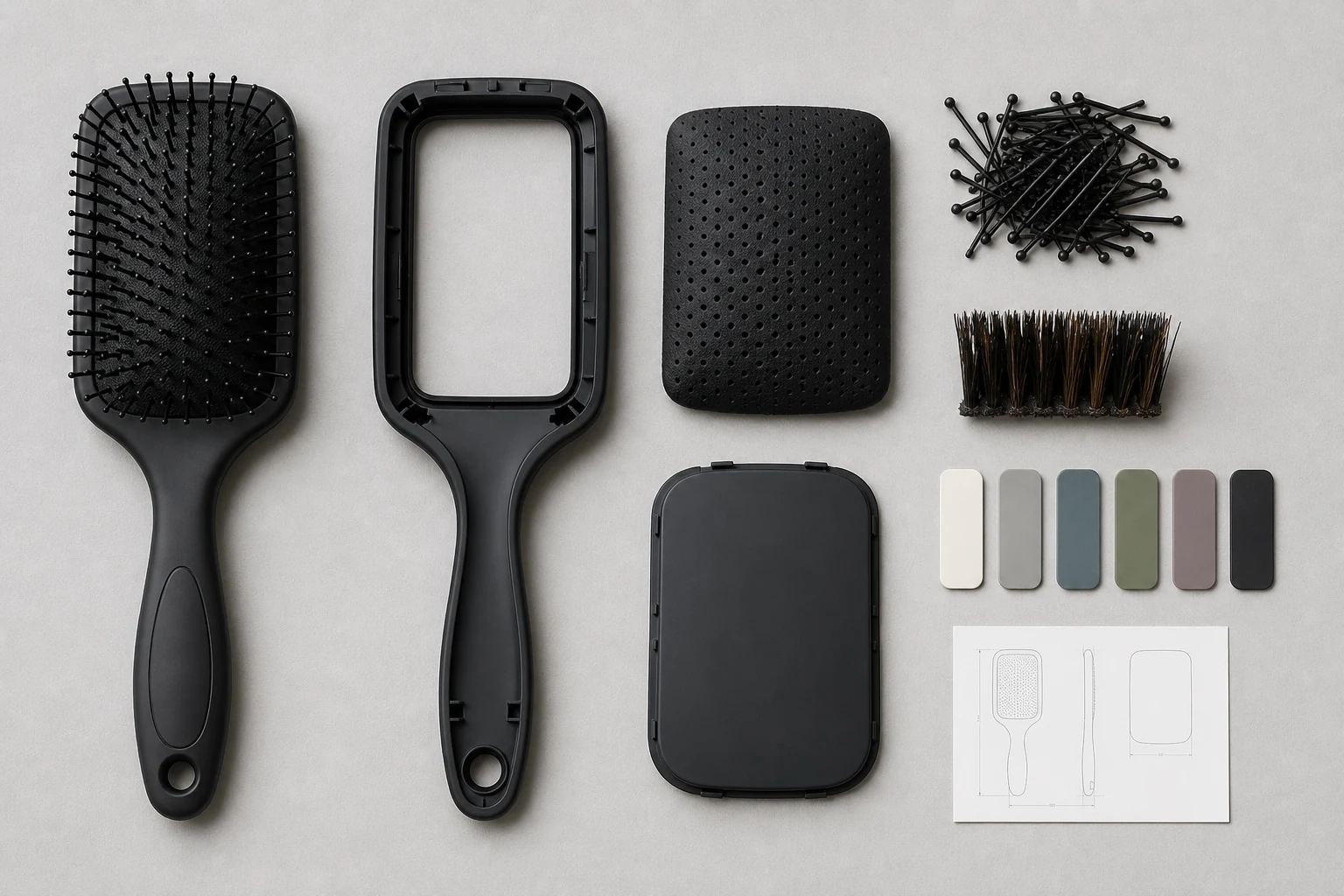
Before asking for a quotation, separate the brush into functional zones: body and handle, head geometry, cushion, pins or bristles, end tips, decoration and packaging. A change in one zone can affect the others. For example, a deeper cushion may require a revised head cavity, while a denser pin pattern may change cushion flexibility and implantation time.
Body and Handle
Plastic paddle brush bodies are commonly injection moulded because the process supports consistent geometry, ergonomic features and repeatable colour. Resin selection should reflect impact resistance, surface finish, target weight and market requirements. The handle may include a soft-touch insert, textured grip, hanging hole, finger rest or two-component construction. Wood and alternative materials require a different production and finishing route.
Cushion and Air Vent
The cushion carries the pins and gives the brush its characteristic response. Its compound, thickness, dome height, hole pattern and vent design influence flexibility and perceived scalp comfort. A softer cushion does not automatically mean better performance: excessive movement can reduce control, while insufficient movement can make the brush feel rigid. The air vent allows pressure equalisation as the cushion compresses.
Pins, Bristles and Tips
Pin diameter, length, spacing, row pattern and end treatment affect penetration through the hair and contact with the scalp. Rounded or ball-ended tips should be checked for uniformity and secure attachment. Mixed-bristle designs introduce additional variables, including tuft density, bristle length and the relative height of nylon pins and natural or synthetic bristles.
The table below summarises the main specification areas a buyer and manufacturer should define.
| Component | Common Options | Buyer Decision |
|---|---|---|
| Body | Moulded plastic, wood | Shape, weight, durability |
| Handle | Single material, soft grip | Ergonomics, finish |
| Cushion | Rubber or elastomer | Firmness, venting |
| Pin system | Nylon, metal, mixed | Hair type, scalp feel |
| Bristle bed | Pin-only, mixed bristle | Detangling or smoothing |
| Decoration | Print, foil, laser | Artwork and durability |
| Packaging | Box, card, sleeve | Channel and protection |
How to Select Paddle Brush Pins and Bristles
The phrase “paddle brush bristles” may refer to flexible nylon pins, metal pins, natural bristle tufts, synthetic bristle tufts or a combination. The correct configuration depends on the product promise and intended user. A manufacturer should ask what hair condition, styling stage and result the brush is expected to address before recommending a layout.
Nylon Pin Paddle Brushes
Nylon pins are widely used for everyday detangling and general brushing. Their flexibility can be adjusted through material grade, diameter, free length and pattern density. Long, widely spaced pins may penetrate dense hair more easily, while shorter or denser arrangements can feel more controlled on finer hair. Ball tips may be moulded as part of the pin or applied as a separate finishing operation, depending on the design.
Mixed-Bristle Paddle Brushes
Mixed configurations combine longer separating pins with shorter bristle tufts. The pins help guide sections through the brush, while the shorter bristles can support smoothing and surface contact. The important manufacturing question is relative height: if the bristles sit too low, they may contribute little; if they sit too high or too densely, the brush can become difficult to draw through the intended hair type.
Metal and Specialised Pins
Metal pins are used in some professional or massage-oriented designs, but they require careful end finishing, corrosion consideration and secure setting. Heat-resistant or antistatic claims should be tied to defined materials and test evidence rather than used as general marketing language. Any performance claim printed on packaging should match the exact production material and approved sample.
For range planning, compare the paddle format with other geometries before finalising the brief. The guide to paddle brushes versus round brushes outlines how their working surfaces and primary use cases differ.
Bristle Implantation and Brush Assembly
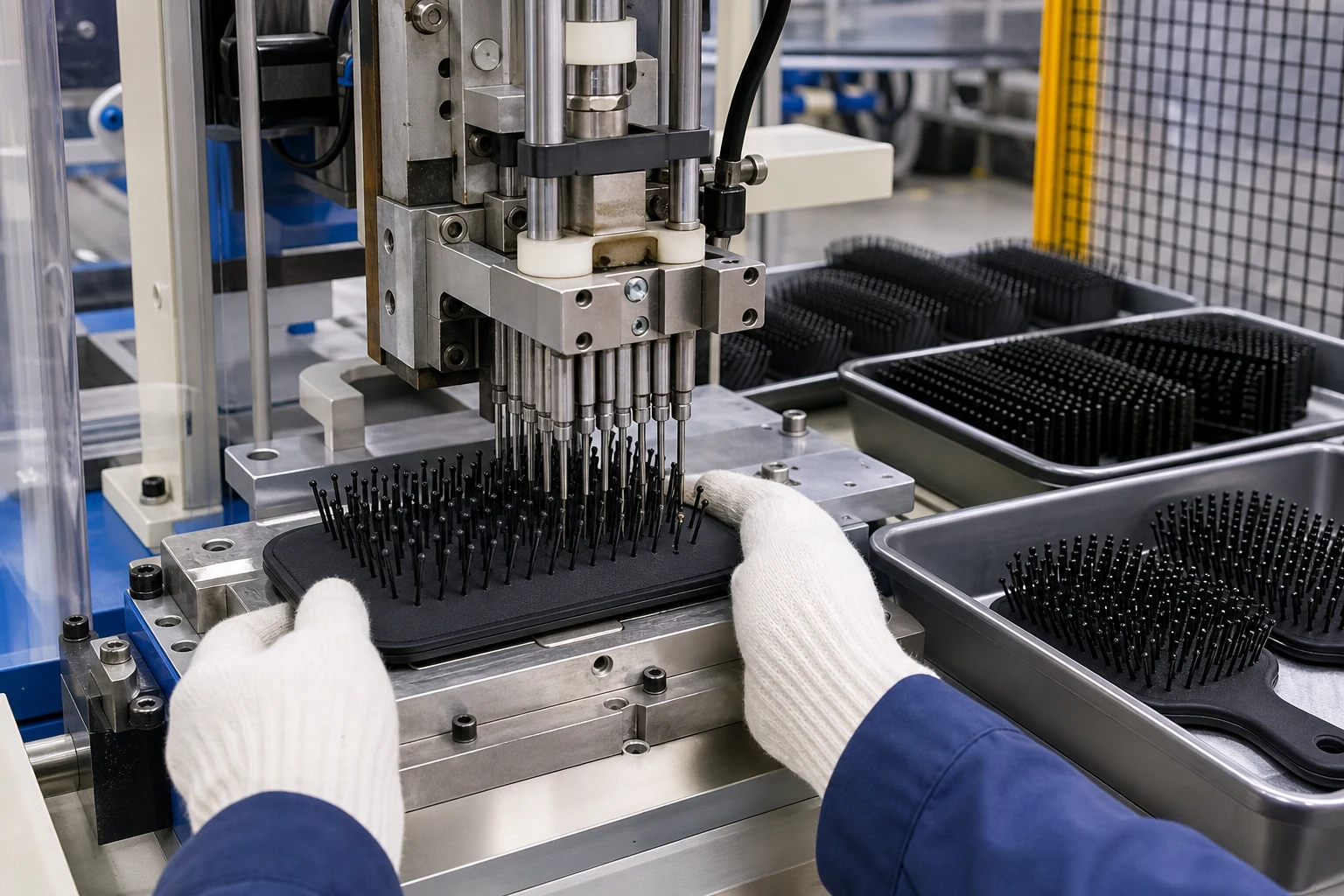
Bristle implantation converts a prepared cushion or brush head into a functional brushing surface. The exact method depends on whether the design uses individual pins, tufted fibres or a mixed system. Tooling must hold the component in a repeatable position while pins or tufts are inserted to the specified depth and pattern.
For cushion paddle brushes, production generally begins with cushion cutting or moulding and creation of the pin-hole pattern. Pins are then inserted or implanted using dedicated equipment and fixtures. Operators monitor row alignment, missing pins, bent pins, insertion depth and cushion damage. The completed cushion is seated into the moulded head and retained by the designed frame, cap or assembly feature.
Mixed-bristle products may require separate tuft-setting and pin-insertion operations. The sequence should prevent one operation from obstructing or damaging the other. Fixture accuracy matters because a small positional error repeated across a large paddle surface becomes visually obvious. Process control should therefore include first-piece approval and scheduled in-process checks rather than relying only on final inspection.
Customisation: Shape, Colour, Finish, Logo and Packaging
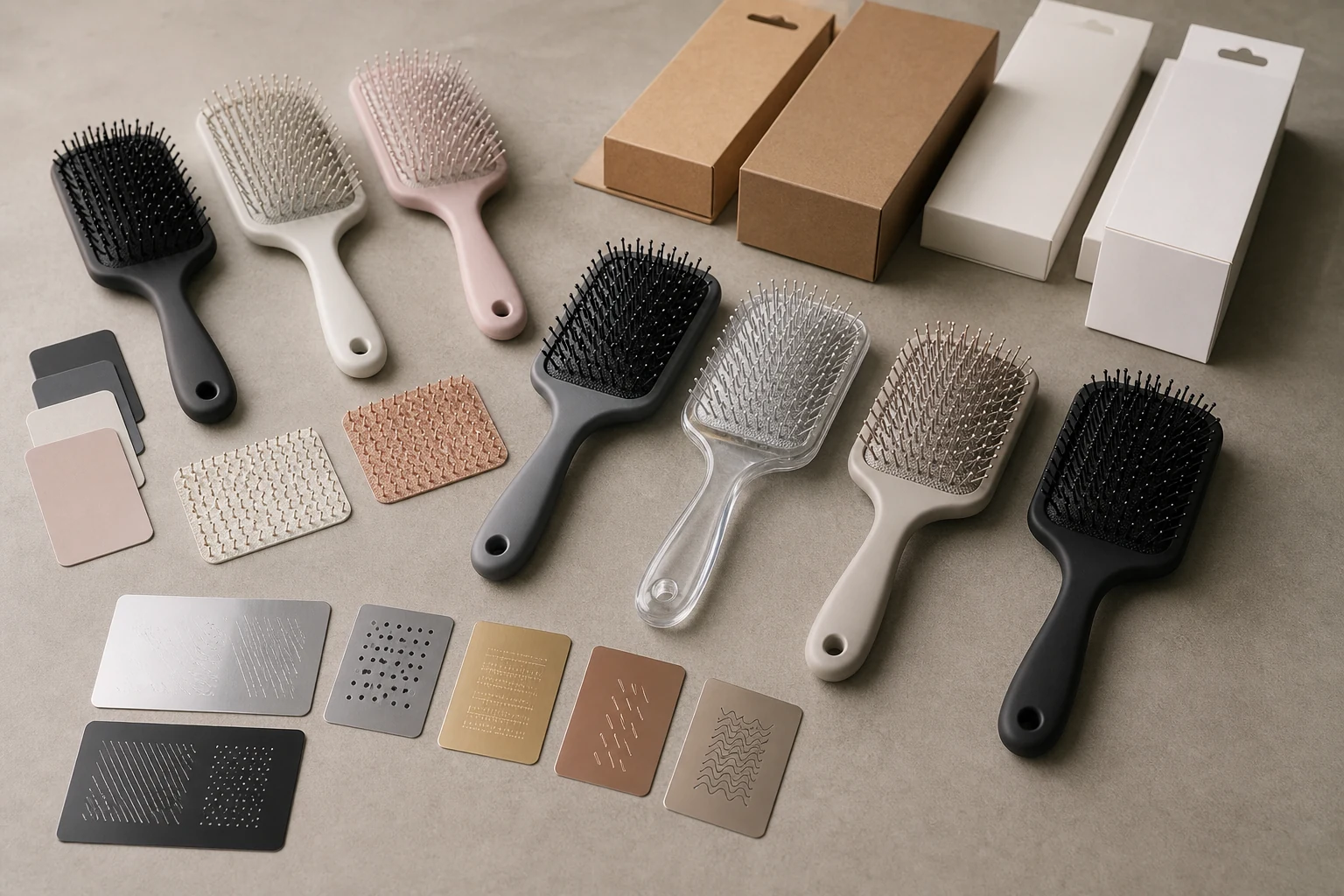
Customisation can range from a new colour on an existing product to a fully engineered brush platform. Buyers should distinguish cosmetic changes from structural changes because they carry different tooling, sampling and MOQ implications. A new body silhouette or handle interface is structural; colour, surface coating and printed packaging are usually cosmetic, although they still require compatibility and durability checks.
Colour and Surface Finish
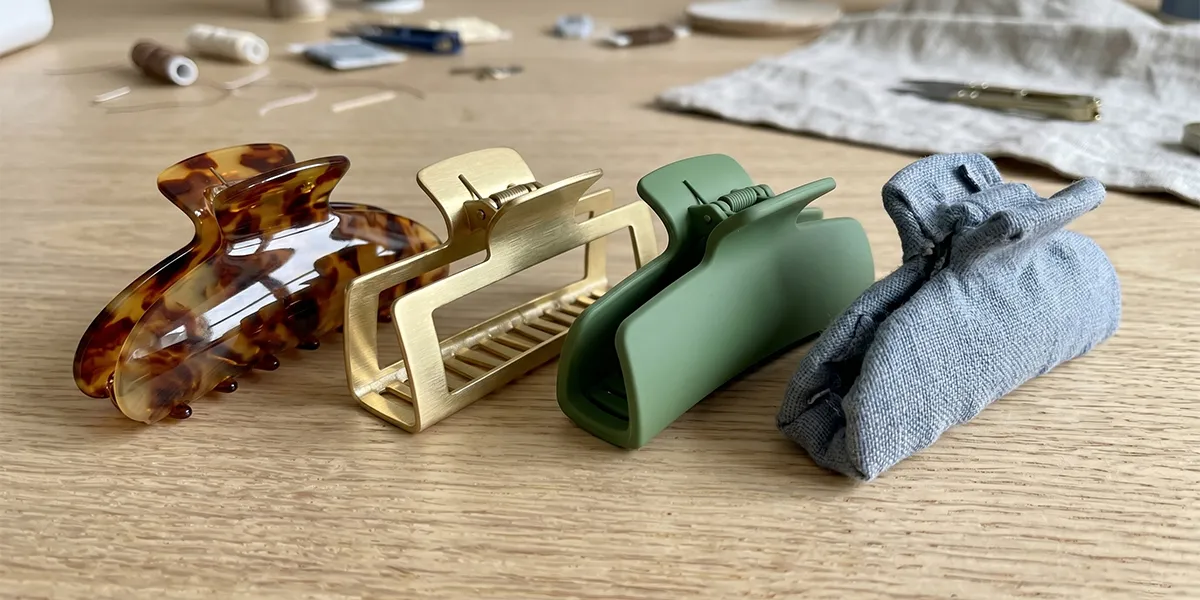
Colour can be introduced through moulded resin, coating, plating or combinations of materials. Approval should be based on a physical colour standard viewed under agreed lighting, not only a screen reference. Matte, glossy, pearlescent, metallic and soft-touch effects create different visual and tactile results, but they also change scratch visibility, fingerprint resistance, processing steps and inspection criteria. The overview of hair brush surface finishes provides a useful comparison.
Logo Application
Common logo methods include pad printing, screen printing, hot stamping, laser marking and moulded embossing or debossing. Selection depends on body material, surface curvature, artwork detail, colour count and required abrasion resistance. Logos should be reviewed on the actual production finish because adhesion and contrast can differ from a flat artwork proof.
Packaging and Retail Preparation
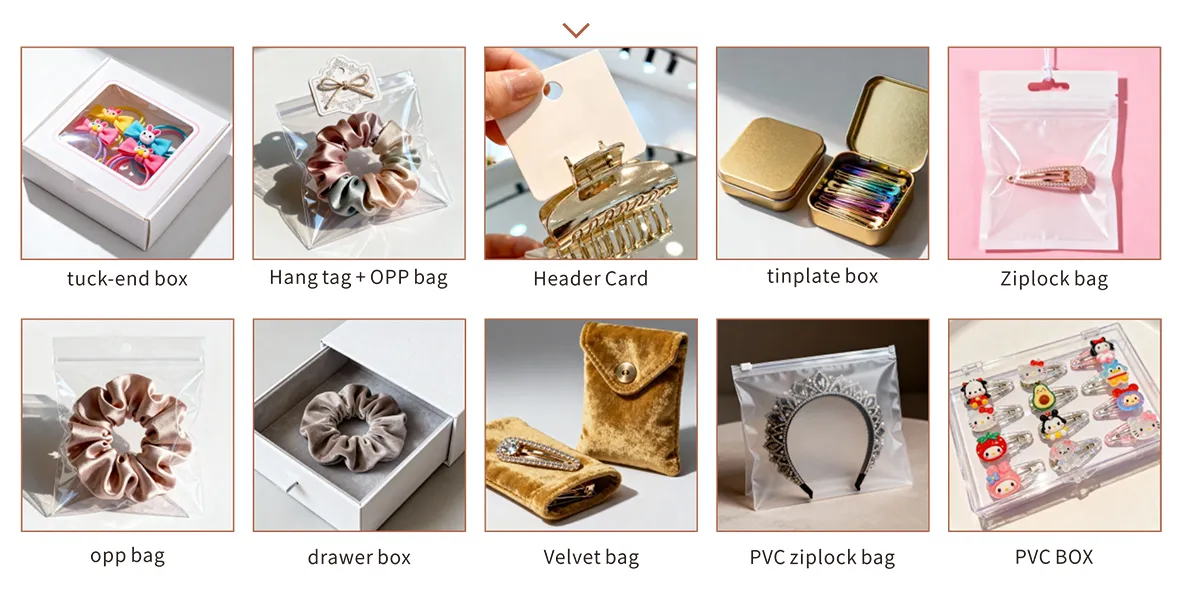
Packaging is part of the product specification, not an afterthought. The package must protect the pin field from compression, present the brush correctly and fit the intended channel. Options may include folding cartons, display cards, sleeves, trays, labels and multi-piece sets. Barcode position, warnings, material declarations, language versions and carton packing quantities should be approved before mass printing.
If a project includes wood, paper or recycled inputs, buyers should define the required claim and documentary chain before ordering material. For example, the FSC chain-of-custody system concerns how certified forest-based materials are tracked through the supply chain; a general statement about sustainable packaging is not a substitute for project-specific documentation.
Packaging and Amazon FBA Preparation
For DTC and Amazon sellers, packaging serves dual purposes: brand presentation for the end consumer and compliance with fulfilment channel requirements. Getting both right at the factory level eliminates the cost and delay of third-party prep services.
Retail Packaging Options
- Kraft paper box with window: The most popular option for eco-positioned DTC brands. Displays the brush through a die-cut window while protecting it during shipping. Supports custom printing on all six panels.
- Clear PVC or PET blister pack: Full product visibility, commonly used for retail shelf display. Lower perceived eco-friendliness but strong visual impact.
- Custom printed cardboard sleeve: Wraps around the brush handle. Minimal material use, easy to print, and compatible with eco-friendly brand positioning.
- Drawstring bag (cotton, organza, or velvet): Premium unboxing feel, commonly paired with wooden or bamboo brush lines for a gift-oriented presentation.
Amazon FBA Compliance Requirements
Products shipped directly from the manufacturer to Amazon fulfilment centres must meet specific preparation requirements:
- Individual polybag packaging with suffocation warning label (required for any polybag with an opening larger than 5 inches)
- FNSKU barcode label affixed to each unit (manufacturer prints and applies during packing)
- Carton labelling per Amazon's FBA shipment requirements, including shipment ID labels on each carton
- Carton dimensions and weight within Amazon's limits (standard: max 25 kg per carton for non-palletised shipments)
Established manufacturers experienced with Amazon sellers handle FBA prep as part of the production workflow, eliminating the need for a separate prep centre. Confirm this capability during initial enquiry — not all manufacturers offer it.
OEM Paddle Brush Development Process
A controlled development process reduces late changes and makes quotations easier to compare. The stages below apply to both private-label adaptation and fully custom OEM work, although an existing mould can remove several tooling steps.
- Product brief: define target market, intended hair type, use case, reference products, dimensions, materials, bristle concept, quantity and required launch date.
- Feasibility review: the manufacturer identifies suitable existing platforms, new-tool requirements, component risks, decoration limits and likely testing needs.
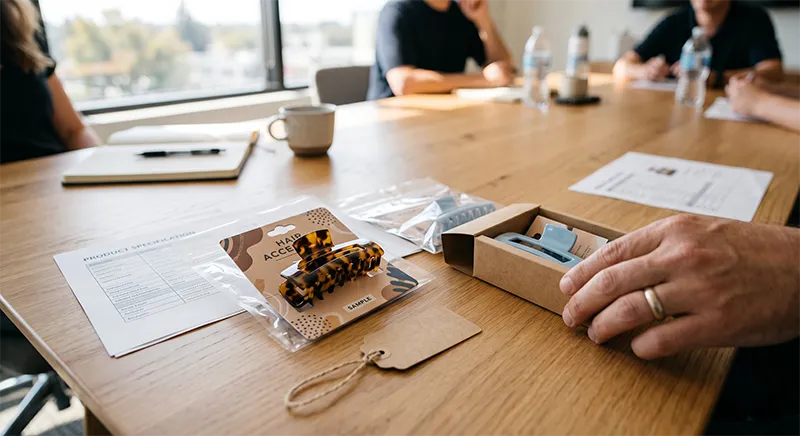
- Specification and quotation: align the bill of materials, colours, logo, packaging, MOQ, tooling responsibility, sample charges, lead time assumptions and trade terms.
- Drawing or mould development: approve two-dimensional and three-dimensional data, critical dimensions, parting lines, assembly interfaces and artwork locations.
- Prototype or sample: evaluate scale, grip, cushion response, pin pattern, visual finish, logo and packaging. Record all requested changes in one revision list.
- Pre-production sample: confirm the product made with intended materials, colour and production processes. This sample becomes the visual and functional reference.
- Mass production: release material purchasing, moulding, finishing, cushion and bristle preparation, implantation, assembly, inspection and packing.
- Shipment approval: review inspection results, packaging marks, carton quantities and required documentation before dispatch.
Change control is especially important after sample approval. A substitute resin, modified pin supplier, new coating or packaging board can alter performance or appearance even when the product name remains unchanged. The purchase order and approved specification should define which changes require written buyer approval.
MOQ, Tooling, Sampling and Lead Time
There is no reliable universal MOQ for custom paddle brushes. Quantity depends on the development route and the economic batch size of each process. A brush using an existing body, standard cushion and one moulded colour may support a different minimum from a new two-component handle with several colourways, specialised pins and printed retail cartons.
MOQ can be driven by resin colour preparation, coating line setup, bristle or pin purchasing, logo-process setup and packaging print quantities. Buyers can often reduce complexity by launching fewer colours, using a shared body across a range, selecting standard component materials or applying labels to neutral packaging during an initial market test. These decisions should be evaluated against brand presentation and landed cost rather than MOQ alone.
Lead time should be divided into development and production. Development includes brief review, drawing, tooling where required, samples and approval rounds. Production begins only after specifications, artwork, commercial terms and the final sample are approved. Public holidays, specialised material purchasing, colour matching and repeated revisions can extend the schedule.
The following planning matrix shows why two projects with the same product name may have very different timelines.
| Development Route | Tooling Requirement | Main Schedule Driver | MOQ Influence |
|---|---|---|---|
| Existing product | None or logo fixture | Colour and packaging | Lowest complexity |
| Modified platform | Partial or component tool | Fit and sample approval | Component dependent |
| New private mould | Full body tooling | Engineering and validation | Higher volume planning |
| Multi-SKU range | Shared or multiple tools | Colour and packaging matrix | Per-SKU minimums |
Quality Control for Custom Paddle Brushes
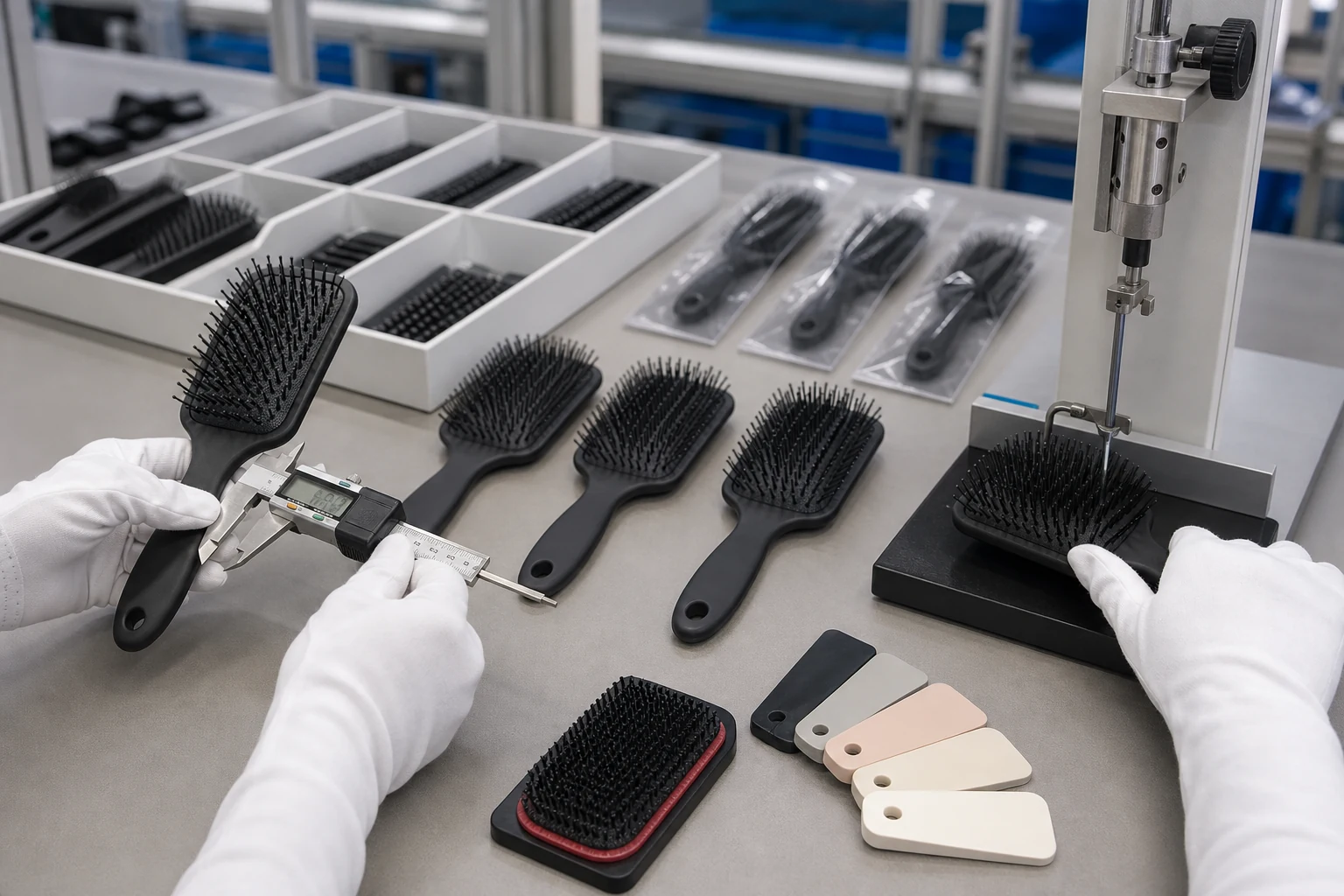
Quality control should translate the approved sample into measurable checkpoints. Visual inspection alone cannot confirm cushion retention, pin security or repeated-use durability. The control plan should identify critical dimensions, component tests, in-process checks and final sampling before mass production begins.
Incoming and In-Process Checks
- Resin, elastomer, pin, bristle, coating and packaging materials against approved specifications.
- Moulded body dimensions, warpage, sink marks, flash, surface defects and colour consistency.
- Cushion hole pattern, thickness, vent opening, pin count and missing or bent pins.
- Implantation depth, pin or tuft alignment, cushion damage and component seating.
- Logo position, colour, adhesion, foil completeness and artwork orientation.
Functional and Final Inspection
Functional checks may include pin or tuft retention, cushion movement, handle flex, drop or impact evaluation, coating adhesion, dimensional comparison and packaging protection. The exact method and acceptance limit should match the product design and buyer requirement. Testing equipment alone is not enough; the specification must state how the result is judged.
Final inspection can use an agreed sampling plan, but sampling does not replace process control. A quality management system aligned with ISO 9001 quality management principles should support document control, traceability, corrective action and consistent execution. Buyers should still define product-specific acceptance criteria rather than treating a factory certificate as proof that every shipment meets every requirement.
How to Evaluate a Paddle Brush Manufacturer
A polished sample does not by itself demonstrate manufacturing control. Supplier evaluation should examine whether the organisation can reproduce the approved result, document changes and manage the full product rather than only one outsourced operation.
- Relevant production depth: ask which stages are performed in-house and which are subcontracted, including moulding, coating, implantation, printing, assembly and packing.
- Engineering support: review how the team handles drawings, mould reviews, tolerance questions, prototype revisions and design-for-manufacture feedback.
- Comparable samples: inspect brushes with similar cushions, pin layouts, finishes and retail requirements—not only products that share the paddle shape.
- Material control: request material descriptions, approved suppliers, colour standards and documentation appropriate to the target market.
- Quality evidence: examine inspection records, test methods, defect handling, traceability and how approved samples are controlled on the line.
- Capacity fit: confirm whether equipment, staffing and component supply can support the expected order pattern, including seasonal peaks and repeat orders.
- Communication discipline: look for version-controlled specifications, clear quotations, consolidated sample feedback and written change approval.
A buyer comparing the wider supplier market can also review the article on custom hair brush manufacturers and OEM suppliers. The useful comparison is not simply company size; it is alignment between the factory's process capability and the product's actual complexity.
Information to Include in a Paddle Brush RFQ
A complete request for quotation allows the manufacturer to identify technical gaps early and reduces quotations based on incompatible assumptions. Even when a final drawing is not available, the following information creates a workable first brief:
- Target country, sales channel and intended consumer or professional use.
- Reference sample, photographs, sketch, dimensions or 3D data.
- Preferred body material, weight, handle feel and surface finish.
- Cushion type, flexibility, pin or bristle material, length, density and colour.
- Logo artwork, application method, location and colour requirements.
- Individual package, insert, barcode, language and shipping-carton requirements.
- Estimated quantity per design and per colour, plus repeat-order expectations.
- Required tests, declarations, certifications or retailer-specific protocols.
- Target sample approval date, launch date and delivery destination.
Where details are undecided, mark them as open rather than inserting arbitrary specifications. A capable manufacturer can then propose alternatives and explain their effects on tooling, MOQ and timing. Buyers can review the existing hair brush product range to identify a suitable starting platform before finalising the RFQ.
Conclusion
Selecting a custom paddle brush manufacturer is a product-engineering decision as much as a purchasing decision. The body, cushion, pins, bristles, finish, logo and package must work as one controlled specification. Existing platforms can support faster private-label development, while new moulds create greater differentiation when the commercial volume and schedule justify the additional work.
JunYi Beauty supports paddle brush development through moulding, cushion and bristle configuration, implantation, finishing, assembly, quality control and packaging coordination. A useful first discussion should focus on the intended user, required construction and launch constraints; project-specific feasibility can then be assessed through the manufacturer contact page with a complete RFQ.