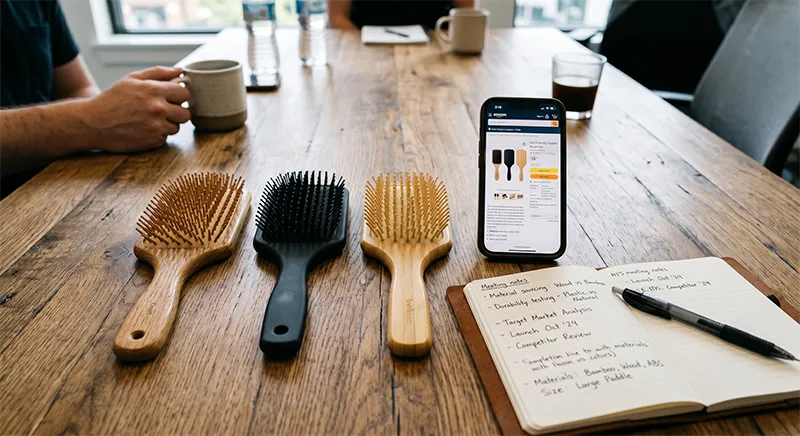
A custom paddle brush manufacturer is a factory that produces paddle-style hair brushes to a buyer's specifications — including handle material, bristle type, cushion construction, surface finish, logo placement, and packaging — for sale under the buyer's own brand. For DTC (direct-to-consumer) brands and Amazon sellers, the paddle brush is one of the highest-volume, highest-margin SKUs in the hair tools category, combining everyday utility with strong visual branding potential.
Paddle brushes consistently rank among the top-selling hair brush types on Amazon across US, UK, and European marketplaces. Their broad, flat head design, comfortable grip, and universal suitability for most hair types make them a natural anchor product for new hair care brands entering the market. However, the gap between a generic commodity brush and a well-specified private label product is significant — and it starts with the manufacturer.
This guide covers the full specification process for custom paddle brushes, from handle materials and bristle options through cushion construction, logo application, packaging, and Amazon-specific fulfilment requirements.
1. Anatomy of a Paddle Brush: What Can Be Customised
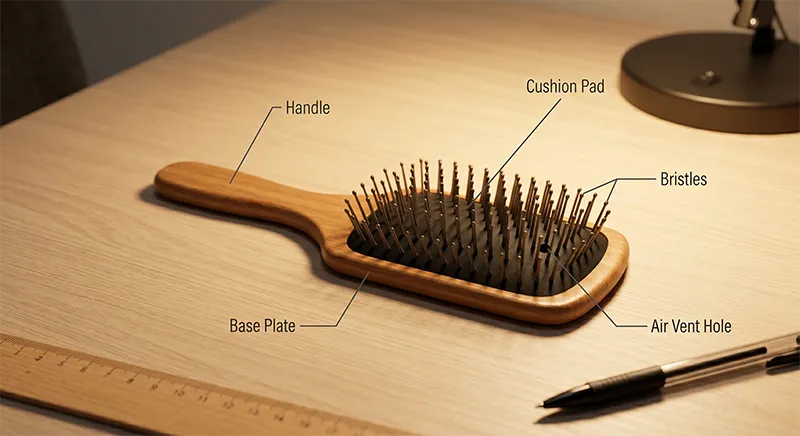
A paddle brush consists of four primary components, each of which can be specified independently during the OEM process. Understanding these components is essential for making informed decisions during product development.
Handle
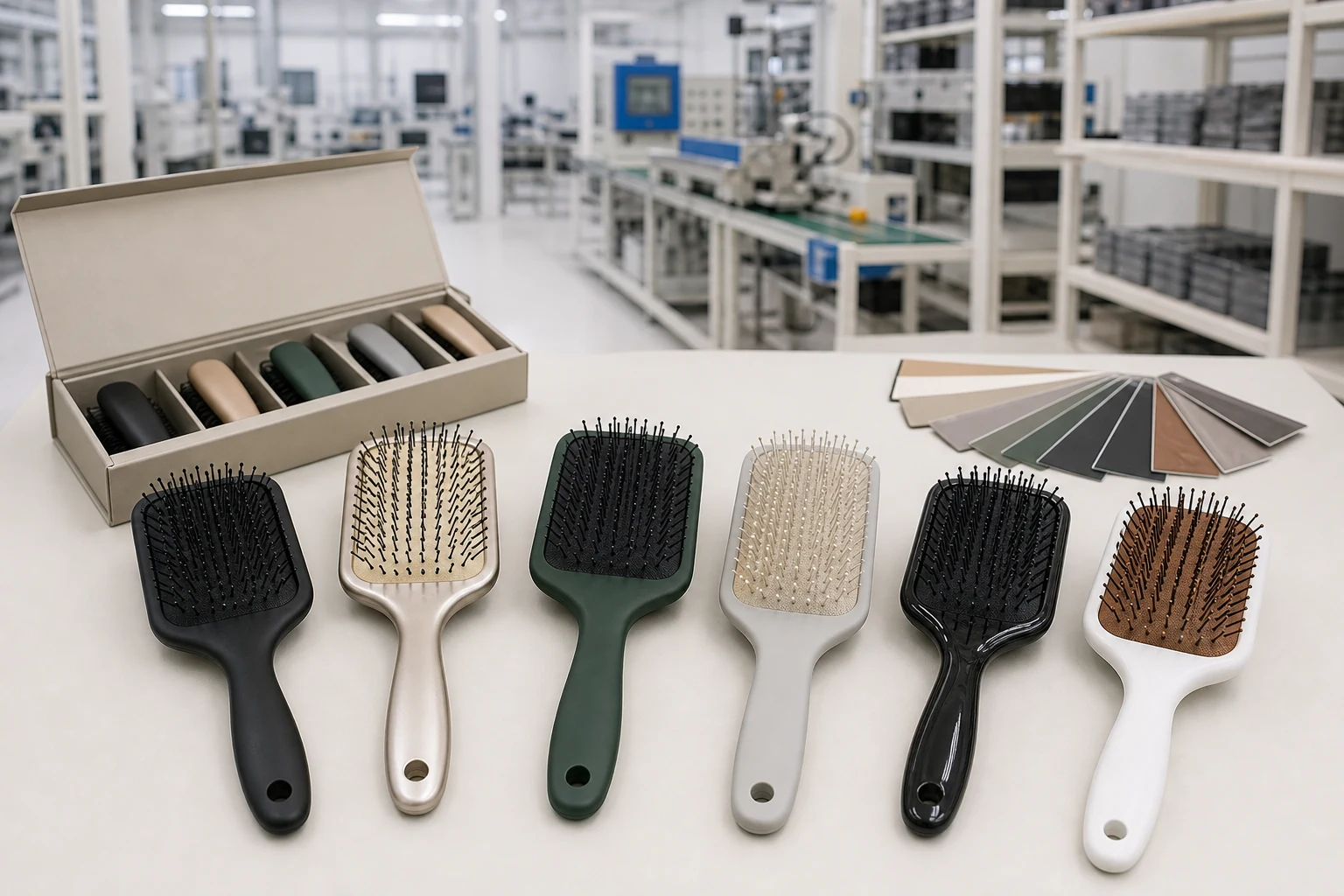
The handle is the most visible branding surface and the primary point of tactile contact. Handle materials include ABS plastic (lightweight, low cost, broadest colour range), beechwood (premium natural aesthetic, FSC-certifiable for sustainability claims), bamboo (eco-positioned, lighter than beechwood, requires moisture-resistance treatment), and rubberised soft-touch plastic (ergonomic grip, increasingly popular in DTC positioning). Handle shape options include straight, curved ergonomic, and contoured designs.
Cushion Pad
The cushion is the flexible rubber or silicone pad from which bristles extend. It provides the characteristic "give" that makes paddle brushes comfortable on the scalp. Cushion pad specifications include pad material (natural rubber vs silicone), pad durometer (firmness), and the presence of an air vent hole that allows the pad to flex during brushing. Pad durometer directly affects how the brush feels during use — softer pads provide a more massaging sensation, while firmer pads offer more control during detangling. For a detailed technical explanation, see the article on how bristles attach to the cushion in paddle hair brushes.
Bristles
Bristle selection determines the brush's functional performance and target consumer. The main options are:
- Ball-tipped nylon pins: The standard choice for mass-market paddle brushes. Provides firm detangling, resists heat during blow-drying, and is suitable for all hair types. Ball tips prevent scalp scratching. For technical details on tip construction, see the guide on epoxy resin bead tips on nylon bristles.
- Natural boar bristle: Premium positioning. Distributes scalp oils along the hair shaft for a smooth, polished finish. Best suited for fine to normal hair. Higher unit cost due to natural material sourcing.
- Mixed boar and nylon: Combines the oil-distributing properties of boar with the detangling power of nylon. Targets the broadest consumer segment.
- Wooden pins: Anti-static, eco-friendly, suitable for sensitive scalps. Often paired with wooden or bamboo handles for a fully natural product line.
- Flexible TPE bristles: Soft, flexible bristles designed specifically for wet detangling. Growing category driven by the wet-brush trend.
Base Plate
The base plate is the structural frame that holds the cushion pad. It is typically injection-moulded from ABS or cut from wood, and its shape defines the brush's silhouette — rectangular, oval, or rounded rectangle. Base plate dimensions typically range from approximately 8 × 6 cm (compact travel size) to 12 × 7 cm (full-size daily use).
2. Bristle Setting Methods and Quality Implications
The method used to insert bristles into the cushion pad is one of the most critical manufacturing variables. It directly affects bristle retention, long-term durability, and the brush's overall quality perception.
Machine Tufting
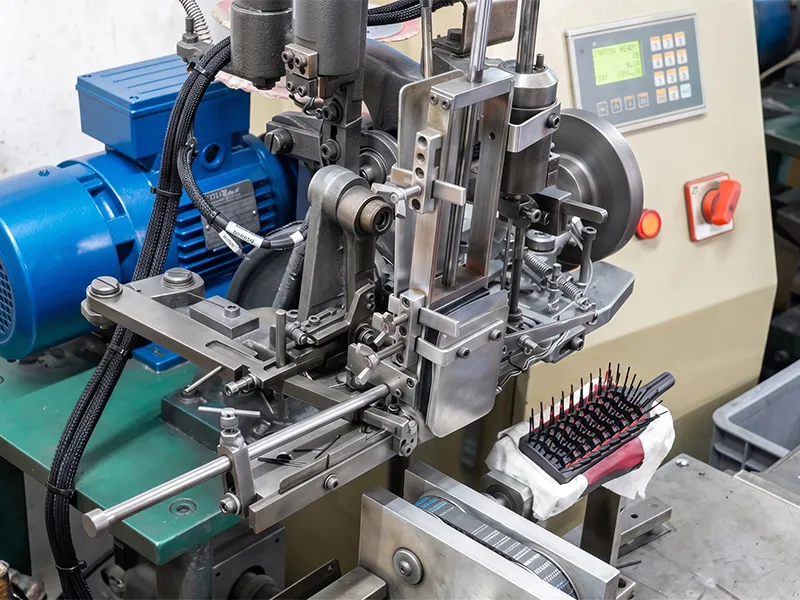
Machine tufting is the standard method for mass-market paddle brushes. Bristle bundles are inserted into pre-punched holes in the cushion pad and secured by wire staples or anchor pins driven through the pad from the underside. This method is fast, consistent, and cost-effective for high-volume production. Most ABS-handle paddle brushes with nylon pins use machine tufting.
Hand Setting
Hand setting involves individual placement of bristle tufts, typically used for premium boar bristle brushes where precise density and pattern control are required. This method produces higher bristle density and more consistent tuft placement but is significantly more labour-intensive, resulting in longer lead times and higher per-unit costs.
The following table compares the two primary bristle-setting methods:
| Method | Speed | Consistency | Bristle Density | Cost | Best For |
|---|---|---|---|---|---|
| Machine tufting | High | High | Standard | Lower | Nylon, mixed-bristle, mass-market lines |
| Hand setting | Low | Very high | High (customisable) | Higher | Boar bristle, premium lines |
3. Logo Application and Branding Options
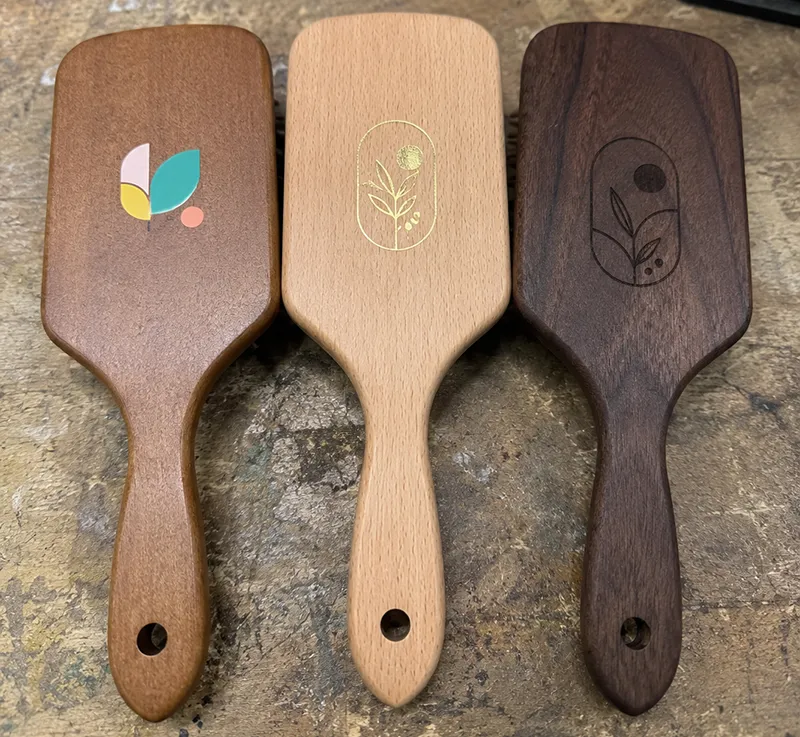
For DTC brands and Amazon sellers, the paddle brush handle is the primary branding surface. The logo application method should be selected based on handle material, design aesthetic, and budget.
| Method | Compatible Materials | Durability | Visual Effect | Cost |
|---|---|---|---|---|
| Pad printing | ABS plastic, wood, bamboo | Medium (may wear with heavy use) | Full-colour, detailed logos | Low |
| Hot stamping / foil transfer | ABS plastic, wood | High | Metallic gold, silver, rose gold | Low–Medium |
| Laser engraving | Wood, bamboo, acetate | Permanent | Natural, recessed mark | Medium |
| Embossed mould mark | ABS plastic (during injection) | Permanent | Subtle raised or recessed logo | Included in mould cost |
| Screen printing | ABS plastic | Medium | Flat colour, large coverage area | Low |
| UV printing | ABS plastic, wood | High | Full-colour, photographic quality | Medium |
For Amazon sellers specifically, product photography is a critical conversion factor. Metallic hot stamping and laser engraving tend to photograph better than pad printing, producing a more premium appearance in listing images. For a comprehensive overview of logo techniques, see the guide on hair brush logo printing methods.
4. Packaging and Amazon FBA Preparation
For DTC and Amazon sellers, packaging serves dual purposes: brand presentation for the end consumer and compliance with fulfilment channel requirements. Getting both right at the factory level eliminates the cost and delay of third-party prep services.
Retail Packaging Options
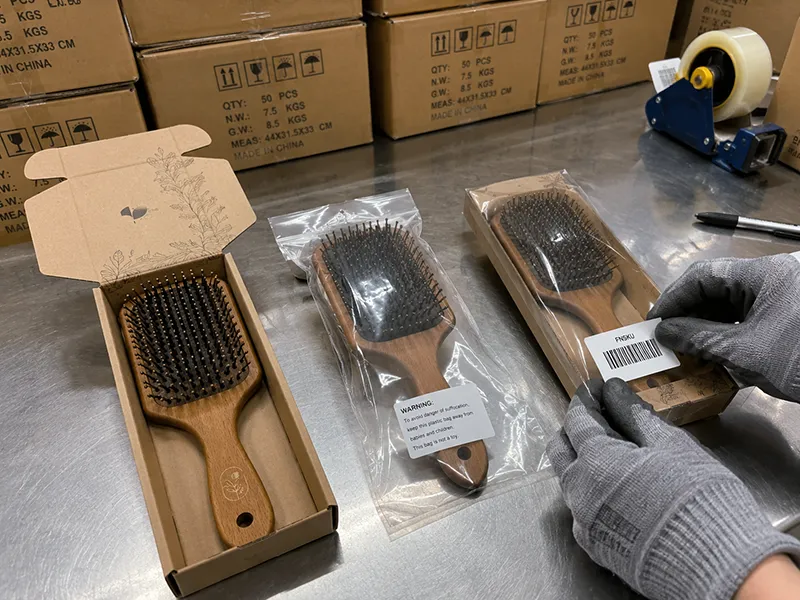
- Kraft paper box with window: The most popular option for eco-positioned DTC brands. Displays the brush through a die-cut window while protecting it during shipping. Supports custom printing on all six panels.
- Clear PVC or PET blister pack: Full product visibility, commonly used for retail shelf display. Lower perceived eco-friendliness but strong visual impact.
- Custom printed cardboard sleeve: Wraps around the brush handle. Minimal material use, easy to print, and compatible with eco-friendly brand positioning.
- Drawstring bag (cotton, organza, or velvet): Premium unboxing feel, commonly paired with wooden or bamboo brush lines for a gift-oriented presentation.
Amazon FBA Compliance Requirements
Products shipped directly from the manufacturer to Amazon fulfilment centres must meet specific preparation requirements:
- Individual polybag packaging with suffocation warning label (required for any polybag with an opening larger than 5 inches)
- FNSKU barcode label affixed to each unit (manufacturer prints and applies during packing)
- Carton labelling per Amazon's FBA shipment requirements, including shipment ID labels on each carton
- Carton dimensions and weight within Amazon's limits (standard: max 25 kg per carton for non-palletised shipments)
Established manufacturers experienced with Amazon sellers handle FBA prep as part of the production workflow, eliminating the need for a separate prep centre. Confirm this capability during initial enquiry — not all manufacturers offer it.
5. Production Process and Lead Times
The production workflow for a custom paddle brush follows a standardised sequence. Each stage has a typical duration that informs inventory planning for DTC and Amazon sellers.
| Stage | Description | Duration |
|---|---|---|
| 1. Specification and quotation | Handle material, bristle type, cushion spec, logo method, packaging design confirmed. Manufacturer provides unit cost and production timeline. | 3–5 days |
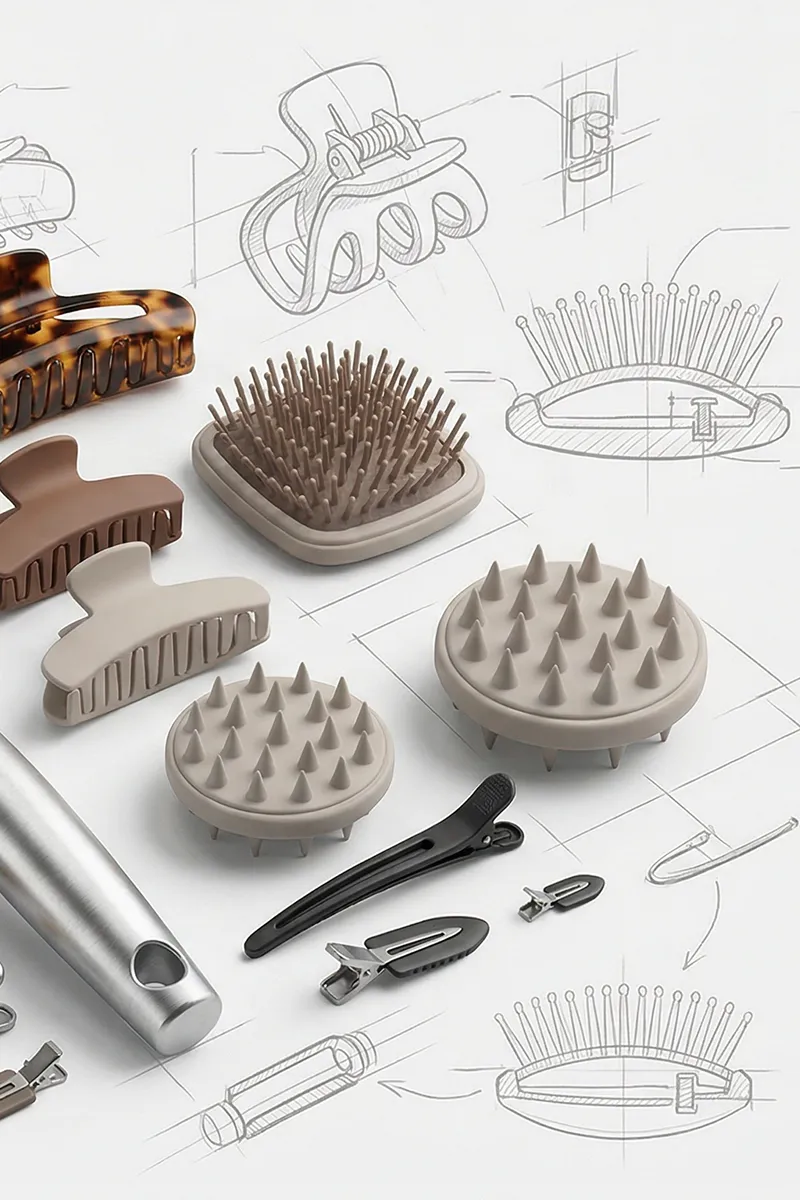
| 2. Mould selection or development | Existing mould selected from library, or new mould developed via CNC machining. | 0 days (existing) / 30–45 days (new) |
| 3. Sample production | Pre-production samples manufactured for approval. Includes handle, bristle, cushion, logo, and packaging verification. | 5–7 days |
| 4. Bulk production | Injection moulding or wood cutting → bristle tufting → cushion assembly → logo application → quality inspection → packaging. | 25–35 days |
| 5. FBA prep and shipment | FNSKU labelling, polybag packing, carton preparation, export documentation. | 3–5 days |
Total lead time from enquiry to delivery at an Amazon fulfilment centre is typically 8–10 weeks for existing mould orders (including approximately 20–30 days sea freight to the US) and 12–16 weeks for custom tooling orders. For the sampling process in detail, see the samples and prototypes overview.
6. How to Evaluate a Paddle Brush Manufacturer
For Amazon sellers and DTC brands, manufacturer evaluation should focus on several criteria beyond basic product capability.
- Mould library depth: Manufacturers with extensive existing paddle brush moulds (multiple silhouettes, sizes, handle shapes) allow faster market entry without tooling investment. Access to proven designs reduces defect risk in initial production runs.
- Bristle-setting capability: Confirm whether the manufacturer operates in-house bristle tufting machines or outsources this stage. In-house tufting ensures better quality control over bristle retention and cushion assembly.
- Amazon seller experience: Manufacturers that already supply Amazon brands understand FBA prep requirements, FNSKU labelling, and carton specifications. This avoids costly rework at the fulfilment centre.
- Certification coverage: ISO 9001 for quality management, BSCI for social compliance, GRS for recycled material claims, and FSC for wood sourcing are increasingly expected by informed consumers and required by Amazon's product safety policies.
- Packaging in-house capability: Manufacturers that handle box printing, sleeve design, and polybag packing in-house reduce lead time and coordination complexity compared to those who outsource packaging to third parties.
- Small-batch flexibility: DTC brands frequently need to test multiple bristle types, handle colours, or packaging designs before committing to large orders. Manufacturers willing to produce 500–1,000 piece test runs provide a lower-risk pathway to product-market fit.
For an overview of established brush manufacturers and their capabilities, see the guide on top 10 hair brush suppliers.
7. Conclusion
Custom paddle brushes represent one of the strongest product opportunities for DTC brands and Amazon sellers entering the hair tools category. The product's universal appeal, strong daily-use replacement cycle, and high branding surface area create favourable conditions for private label differentiation — provided the manufacturing specification is right.
The key decisions — handle material, bristle type, cushion construction, logo method, and packaging format — each affect both per-unit cost and the brand perception that drives conversion rates and review quality on Amazon. Investing time in specification during the sample stage, rather than rushing to bulk production, is the single most effective way to avoid the costly cycle of returns, negative reviews, and supplier switches.
Manufacturers such as JunYi Beauty, operated by Dongguan JunYi Beauty Technology Co., Ltd., produce custom paddle brushes across ABS, beechwood, and bamboo handles with in-house bristle tufting, cushion assembly, and surface treatment — supported by ISO 9001, BSCI, BRCGS, GRS 4.0, and FSC certifications. The company's existing mould library, combined with experience supplying Amazon-ready products with FBA-compliant packaging, provides a factory-direct OEM pathway from initial sampling through bulk production and international shipping. For the full range of available designs, see the paddle brush product catalogue.