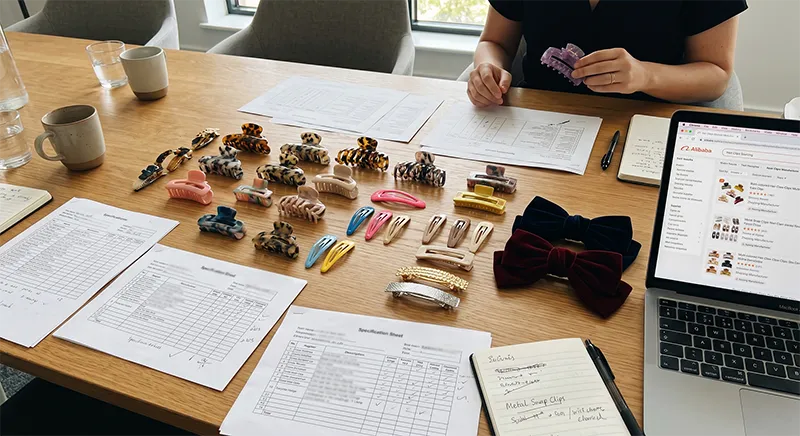
Few things undermine a polished hairstyle faster than a visible crease or dent left behind by a hair clip. The mark itself is temporary — typically lasting between 30 minutes and several hours depending on hair type — but for consumers who style their hair in the morning and need it to last through the workday or an evening event, the wrong clip can make the entire routine counterproductive.
The difference between a clip that leaves prominent creases and one that does not comes down to three mechanical factors: grip pressure, contact surface area, and tooth or jaw geometry. This guide breaks down which hair clip types produce the least creasing, which materials and construction details to prioritise, and how wearing technique affects the result. For brands and sourcing professionals developing product lines in this category, the guide also covers the design and production specifications that determine crease performance in OEM manufacturing.
1. Why Hair Clips Leave Creases
Hair creasing occurs when strands are compressed against a rigid surface for a sustained period, temporarily disrupting the hydrogen bonds that maintain hair's natural shape. When a clip presses hair flat between two contact points — as a standard snap clip or tight barrette does — the compressed section takes on the flattened shape until the hydrogen bonds reset, either naturally over time or by applying heat or moisture.
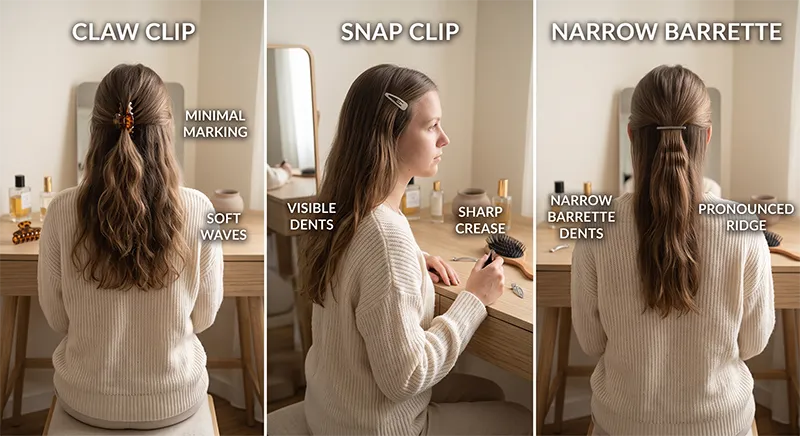
Three variables determine how severe the crease will be. The first is grip pressure: clips with strong springs or tight clasps compress hair more aggressively, producing deeper dents. The second is contact surface area: a clip that distributes grip across a wide, smooth area (like a large claw clip) leaves less defined marks than one that concentrates force along a narrow edge (like a metal snap clip). The third is duration: any clip worn in the same position for several hours will eventually leave some impression, regardless of its design.
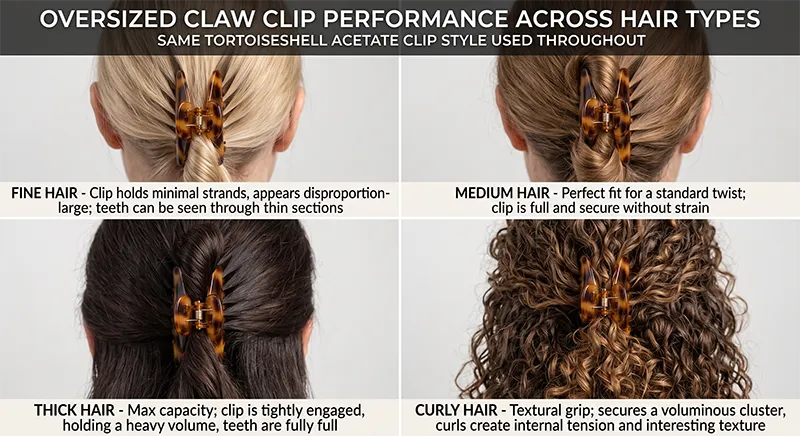
Hair type also plays a significant role. Fine, straight hair is the most susceptible to creasing because the strands lack the volume and resilience to resist compression. Thick or curly hair naturally pushes back against clip pressure and bounces back to its original shape more quickly. Chemically treated, heat-damaged, or high-porosity hair may hold creases longer because its damaged cuticle layer is less elastic.
2. Best Hair Clip Types That Minimise Creases
Not all clip types are created equal when it comes to crease prevention. The following ranking is based on the mechanical principles outlined above — contact area, grip distribution, and compression intensity.
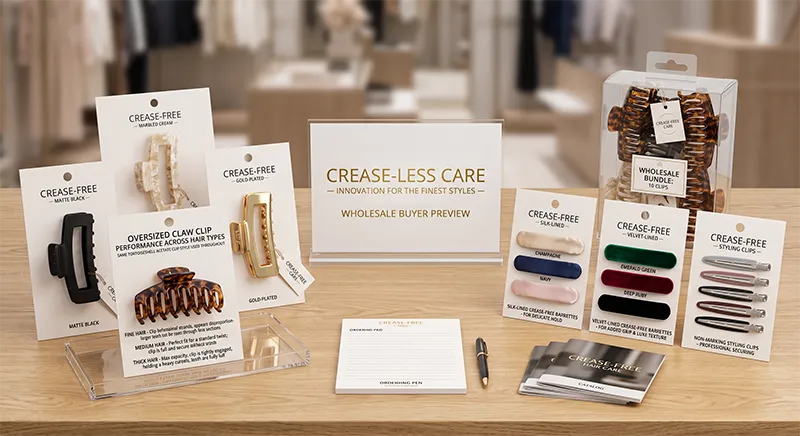
Claw Clips (Jaw Clips) — Best Overall
Claw clips hold hair in a loose, gathered bundle between interlocking teeth rather than pressing it flat against a surface. This fundamentally different grip mechanism makes them the most crease-resistant clip category available. Oversized claw clips with wide, rounded teeth and moderate spring tension produce the least marking because they distribute grip across a large hair volume without concentrating pressure at any single point. For a detailed comparison of claw clip designs and their impact on hair, see the guide on claw clips that do not damage hair.
Spin Pins and Spiral Clips
Spin pins use a corkscrew shape that twists into a bun or updo, holding hair through friction rather than compression. Because they never press hair flat, they leave virtually no crease at all. Their limitation is that they only work for twisted or bunned styles — they cannot secure a half-up look or hold hair against the head the way a barrette can.
Silk-Lined and Fabric-Padded Clips
Some premium clip designs incorporate a silk, satin, or velvet lining along the contact surfaces where the clip grips hair. The fabric cushion distributes pressure more evenly and prevents the hard edge of the clip from pressing a sharp line into the hair. These clips are particularly effective for fine hair that marks easily. The trade-off is that fabric linings can reduce grip strength — a consideration for thick or heavy hair that requires more holding power.
Wide-Jaw Barrettes
Traditional barrettes with narrow clasps are among the worst offenders for creasing. However, wide-jaw barrettes — designs where the clasp surface is 8 mm or wider — spread the compression across a broader area, significantly reducing the depth of any crease. The wider the contact surface, the less pronounced the mark.
Flat-Grip Bobby Pins
Standard bobby pins leave very narrow, defined creases because their grip is concentrated along a thin metal line. Flat-grip bobby pins — wider versions with a broader pressing surface — reduce this effect. They are not crease-free, but they produce softer, less visible marks than traditional bobby pins.
3. Crease Performance Comparison by Clip Type
The following table compares the six most common hair clip types by their crease-prevention performance, holding strength, and suitability for different hair types.
| Clip Type | Crease Level | Hold Strength | Best For | Worst For |
|---|---|---|---|---|
| Oversized claw clip | Very Low | Medium–Strong | All hair types, loose updos | Very short hair |
| Spin pin / spiral | None | Medium | Buns, twisted styles | Straight-down or half-up styles |
| Silk-lined barrette | Low | Light–Medium | Fine hair, half-up styles | Very thick, heavy hair |
| Wide-jaw barrette | Low–Medium | Medium | Medium thickness, sleek looks | Fine hair (may still dent) |
| Flat-grip bobby pin | Medium | Light | Securing small sections | Full updos (too weak) |
| Standard snap clip | High | Strong | Salon sectioning | Finished styles (visible creases) |
For an overview of all major hair clip categories and their mechanical differences, see the complete guide on types of hair clips.
4. How Clip Material Affects Creasing
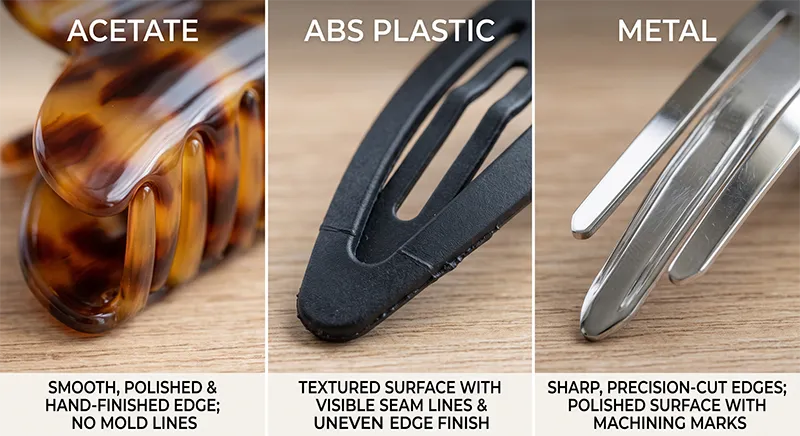
The clip's material does not directly determine whether it leaves a crease — that is governed by the mechanical design (grip pressure, contact area, tooth geometry). However, material properties do influence the quality of the contact surface, which affects how sharp or soft any resulting mark appears.
Cellulose Acetate
Acetate clips can be polished to an exceptionally smooth surface, which means their contact edges glide against hair rather than pressing a rough line into it. This does not eliminate creasing entirely, but it produces a softer, less defined mark compared to a rough-surfaced plastic clip of the same mechanical design. For a deeper look at the differences between these two materials, see the acetate vs plastic hair clips comparison.
ABS Plastic
Mass-market ABS clips vary widely in surface quality. Well-moulded clips with smooth, burr-free edges perform comparably to acetate in crease terms. Cheaply manufactured clips with rough mould lines or unfinished edges will leave sharper, more visible marks — and may also snag and break hair at the contact point.
Metal
Metal clips (bobby pins, snap clips) produce the sharpest creases because metal edges are thin and rigid, concentrating force along a very narrow line. Coated metal clips (rubber-tipped or silicone-dipped) partially mitigate this effect by adding a thin cushion layer at the contact point.
5. Styling Techniques to Prevent Clip Creases
Even the best crease-free clip can leave marks if used incorrectly. The following techniques reduce creasing regardless of clip type.
Rotate clip position every 1–2 hours. The longer a clip stays in one position, the more defined the crease becomes. Shifting the clip even slightly — moving it up or down by 1–2 cm — distributes the compression across a wider area and prevents a single deep line from forming.
Twist or loosely braid before clipping. Twisting hair into a loose rope before securing it with a clip distributes the grip pressure across multiple strands rather than pressing all strands flat in the same direction. This is one of the most effective crease-prevention techniques and works with claw clips, barrettes, and bobby pins alike.
Clip on slightly damp hair, not bone-dry. Hydrogen bonds are more flexible when hair retains some moisture. A clip applied to slightly damp hair leaves less permanent creasing because the bonds have not fully set into their dry position. This is particularly useful when transitioning from a clipped style to wearing hair down later in the day.
Choose the right size clip for the hair volume. An undersized clip forces hair into a tighter compression than necessary. Using a clip that comfortably holds the hair without maxing out its spring tension reduces the pressure applied to each strand. For thick hair, oversized claw clips (10 cm or larger) are preferable to medium clips that strain to close around the bundle.
Apply a light heat pass to reset creases quickly. If a crease does form, running a warm (not hot) styling tool or even a blast of warm air from a blow dryer over the affected section for 5–10 seconds will reset the hydrogen bonds and smooth the hair back to its natural shape.
6. Best Crease-Free Clips by Hair Type
| Hair Type | Recommended Clip | Why It Works | Avoid |
|---|---|---|---|
| Fine, straight | Silk-lined barrette, spin pin | Minimal compression, soft contact surface | Metal snap clips, tight bobby pins |
| Medium, wavy | Oversized claw clip, wide-jaw barrette | Loose grip accommodates natural texture | Small claw clips (too tight for the volume) |
| Thick, coarse | Large claw clip (10+ cm), banana clip | Strong hold without concentrated pressure | Standard barrettes (insufficient hold, sharp crease) |
| Curly, coily | Oversized claw clip, spin pin | Preserves curl pattern, no flattening | Flat-grip clips that press curls straight |
| Chemically treated | Silk-lined clip, claw clip with rounded teeth | Gentle on weakened cuticle layer | Metal clips, uncoated snap clips |
For curly and coily hair types, preserving curl definition is just as important as avoiding creases. A clip that presses curly hair flat — even without leaving a traditional crease — disrupts the curl pattern and creates an inconsistent texture when the hair is released. Claw clips and spin pins maintain the hair's natural volume and shape better than any compression-based clip design.
7. Sourcing Crease-Free Clips: B2B Considerations
For brands developing a product line positioned around gentle, crease-free hair clips, several design and production specifications directly affect the product's crease performance.
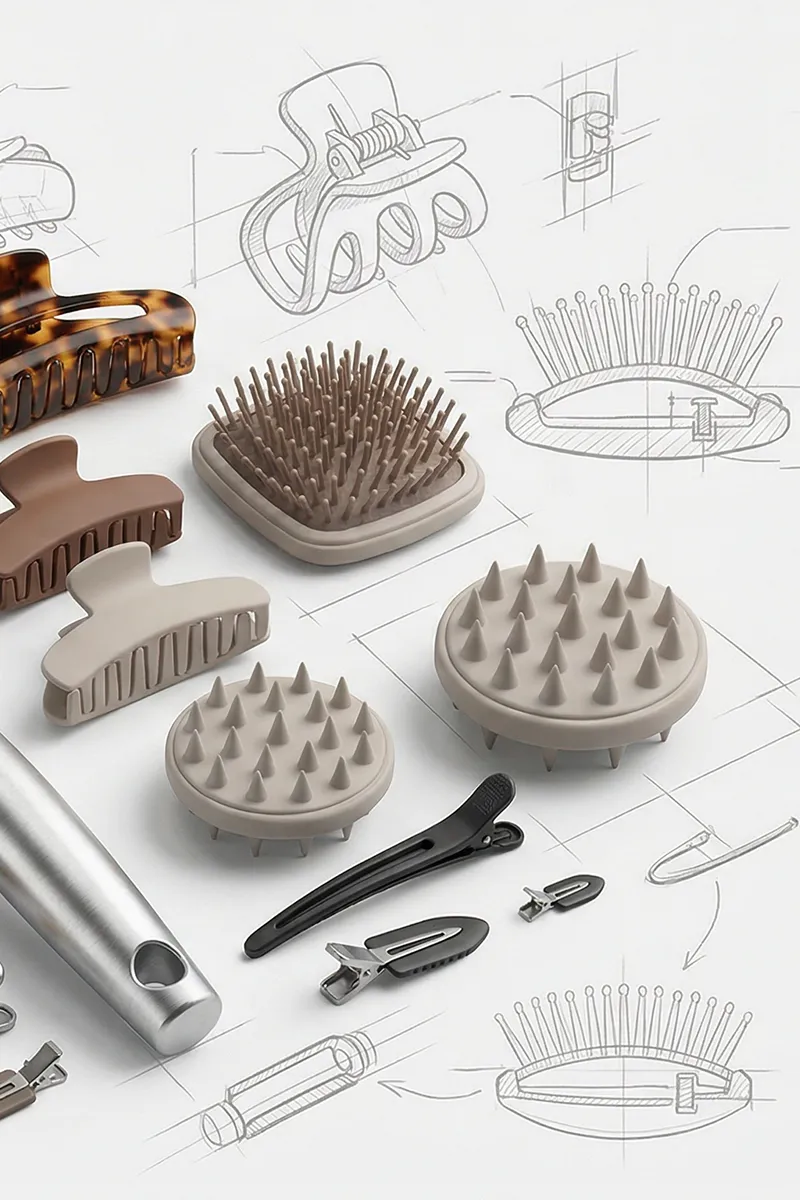
Spring tension specification. The spring is the single most important component for crease prevention. Lower tension springs reduce compression force but must still provide adequate hold — the balance between gentle grip and secure hold is the core design challenge. Buyers should request spring tension samples at multiple settings during the development phase and test them across hair types before confirming the production specification.
Tooth geometry for claw clips. Wider, rounded teeth distribute grip more evenly than narrow, pointed teeth. Tooth spacing also matters — wider gaps allow hair to settle naturally between teeth rather than being compressed into tight channels. For brands marketing specifically to the crease-free or damage-free segment, tooth width and rounding should be called out in product specifications.
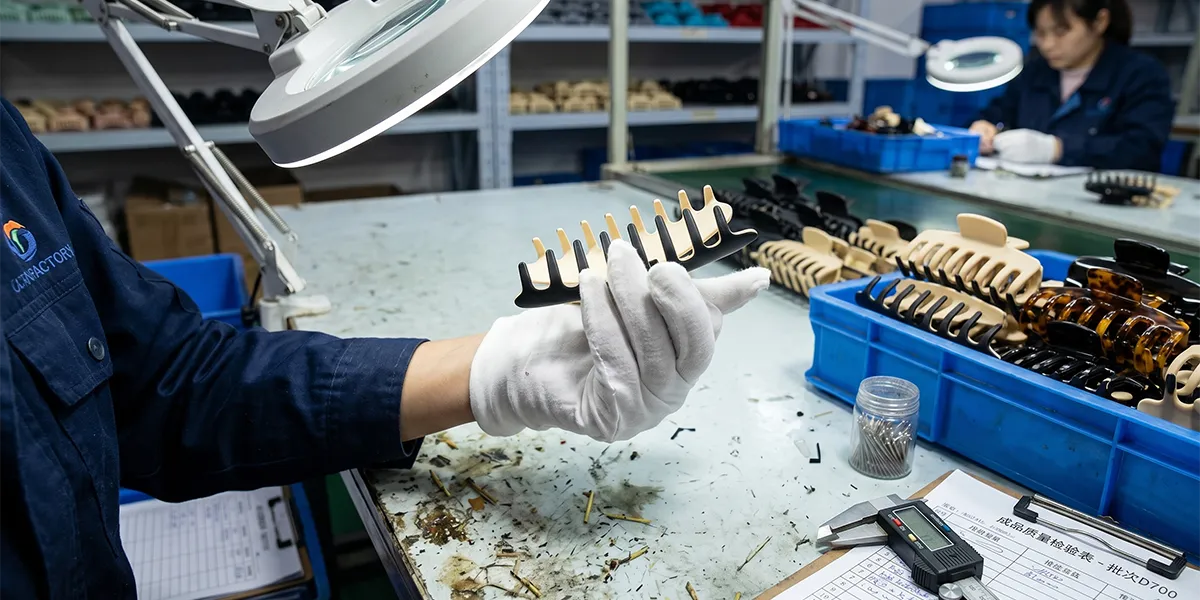
Contact surface finishing. Whether the clip is acetate, ABS, or metal, the smoothness of the contact surface where the clip touches hair determines crease sharpness. During sample evaluation, buyers should run a fingertip along all contact edges — any roughness, mould line, or burr that is perceptible to touch will leave a mark on hair. For a side-by-side comparison of manufacturers offering these finishing capabilities, see the top 10 hair clip manufacturers in China.
Fabric-lining integration. Adding silk or velvet lining to clip contact surfaces introduces a secondary manufacturing step — the fabric must be precisely cut, adhesive-bonded, and trimmed without affecting the clip's closing mechanism. Not all manufacturers offer this capability. Buyers should confirm fabric-lining experience and request a lined sample before committing to production of a padded clip design.
The full range of claw clips, barrettes, and specialty clip designs available for OEM customisation — including spring tension and tooth geometry options — can be reviewed in the hair clips product catalogue.
8. Conclusion
Hair clip creasing is a mechanical problem with a mechanical solution. Clips that distribute grip across a wide area without compressing hair flat — particularly oversized claw clips and fabric-lined designs — consistently outperform traditional snap clips and narrow barrettes in crease prevention. Material choice plays a secondary role: smooth, polished contact surfaces (whether acetate or well-finished ABS) produce softer marks than rough or thin metal edges. And wearing technique matters — rotating clip position, twisting hair before clipping, and choosing the right clip size for the hair volume all reduce creasing regardless of the clip itself.
For brands building a product line around the crease-free positioning, the key manufacturing specifications are spring tension calibration, tooth geometry (width, spacing, rounding), and contact surface finish quality. Manufacturers such as JunYi Beauty, operated by Dongguan JunYi Beauty Technology Co., Ltd., offer adjustable spring tension options and polished acetate finishing across their claw clip and barrette ranges — design parameters that directly support crease-free product development for both retail and professional channels.