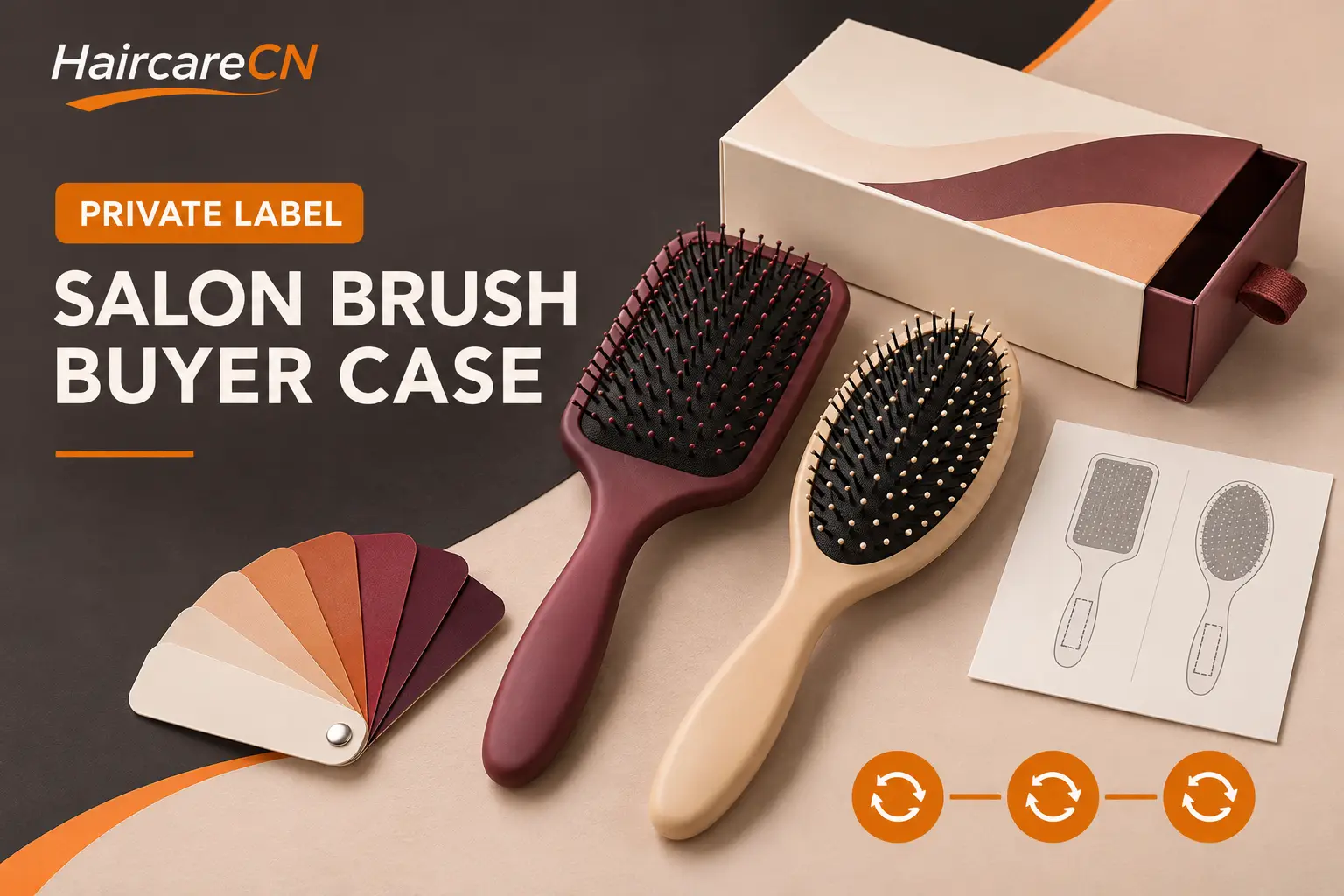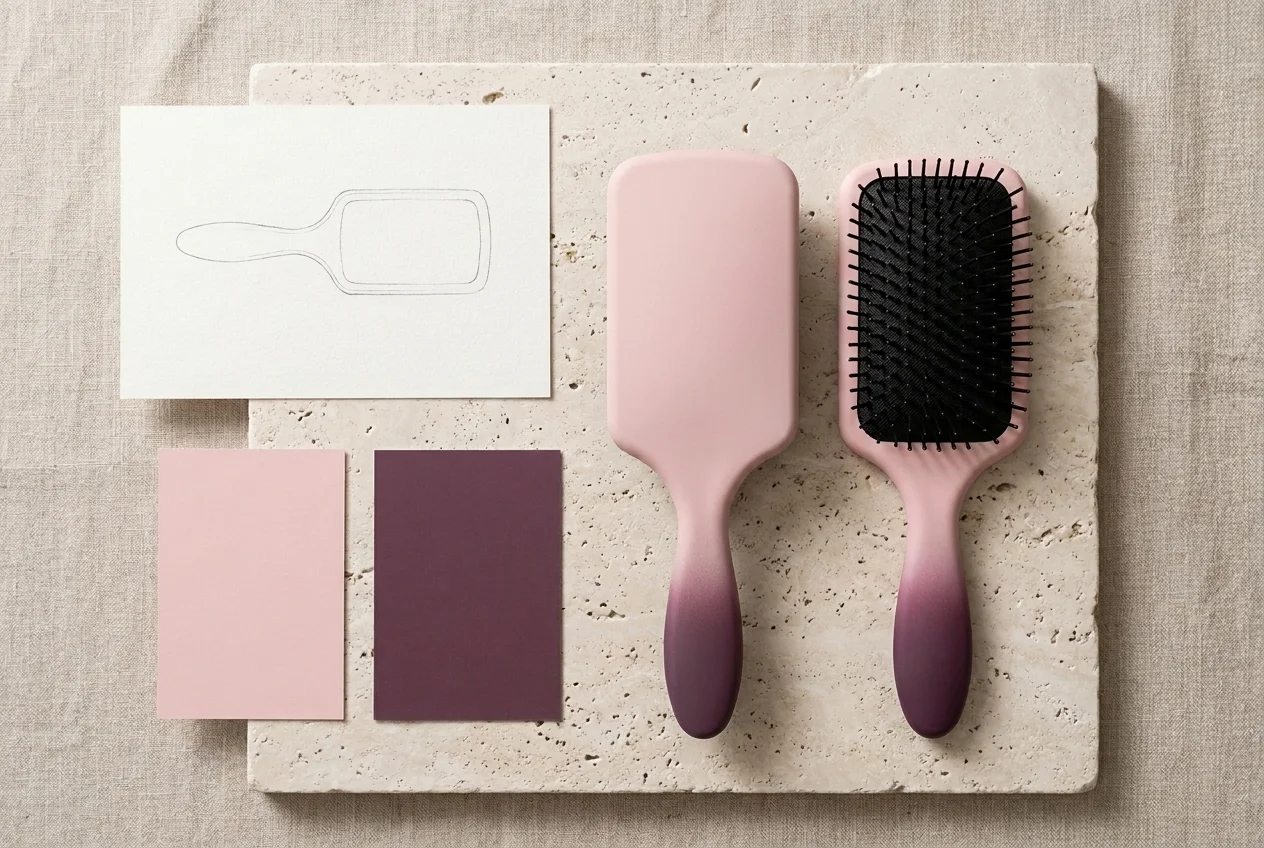
Two brush samples can match the same pink and plum color references and still look like different products. On one, the pale pink reaches the logo. On the other, the blend starts closer to the head and the plum almost swallows the lettering. Both versions fit a brief that says only “pink to plum.”
For a private-label brush, specify the two end colors, direction, blend zone, and logo position on a drawing of the actual model. Then approve a finished handle in your hand. A color chip can identify a shade, but it cannot show where two colors meet on a curved grip.
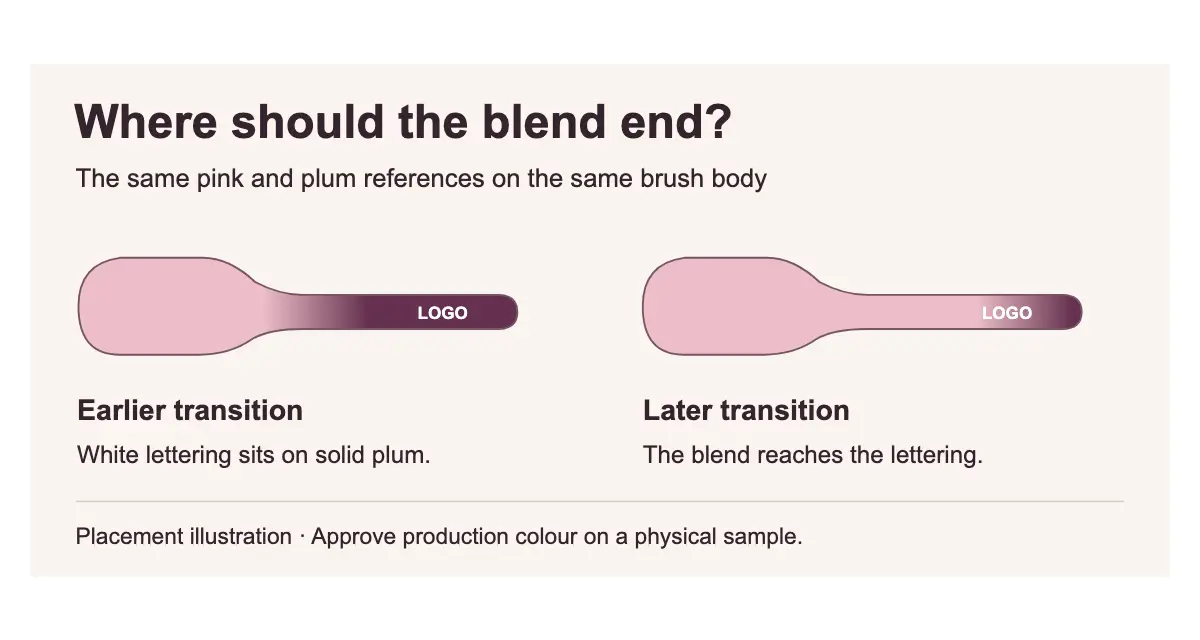
Give the sample team a drawing they can measure
Use the neck where the handle joins the brush head as the starting point. Mark the end of the grip as the other reference. On a front-view drawing, mark the part that must stay solid, the band in which the colors may blend, and the area reserved for the logo. Add a back view if the finish wraps around the handle. A front photograph alone leaves the reverse side open to interpretation.
| Brief item | What the buyer supplies | What to verify on the sample |
|---|---|---|
| Brush and orientation | Model reference and labeled front, back, head, and end | The pale and dark ends face the intended way on the shelf |
| End colors and surface | Two physical references or named color standards, plus the desired gloss or texture | Each solid area matches its reference under the agreed light |
| Transition | Blend start and end measured from one fixed point on the actual handle | The transition stays inside the marked band on both faces |
| Logo | Actual-size artwork, print color, orientation, and position | Small letters remain legible where the background changes |
| Edges and joints | Mark which edges receive color and which adjoining parts retain their original finish | Turn the handle sideways and inspect the neck, rim, and end |
Compare the paint effect on the actual shape
HaircareCN’s finishing options include soft-touch, metallic, and pearlescent paints, as well as gradients. Ask which combination is feasible on your selected custom hair brush body. “Gradient” describes the color transition. Soft-touch describes a surface feel, while metallic and pearl effects change appearance under light. A flat swatch solves only part of that decision. Explore the surface finish options.
For a metallic or pearl finish, set the sample on a light background, look straight at the grip, then rotate it into the light. Check the same spots on both faces. Reflections can make a band look pale at one angle and nearly disappear at another. For soft-touch paint, hold the finished handle with a normal grip and record whether you approve the feel as well as the color.
Keep the logo legible across the blend
Print the mark at production size on the sample. A white logo may read clearly over plum and lose its finest strokes over pale pink. If this happens, mark the failed area on a photo. One revision could move the logo onto the solid dark area; another could keep the logo fixed and shift the transition. Choose which element stays fixed before requesting another sample.
For our pad-print route, the logo is limited to one print color. Specify this separately from the two paint colors on the body. If your artwork requires multiple logo colors, settle the decoration method before approving the mock-up. The logo methods guide covers other options, and our golden sample approval guide explains how signed-off physical samples anchor bulk inspection.
How a gradient changes the quote and MOQ
Ordinary Pantone color matching can usually be planned within the standard schedule. A gradient adds finishing operations and reduces the number of pieces the line can complete in the same period. Request a price and a production window for your specified effect and quantity.
For an injection-molded brush on an existing mold, the MOQ is 1,000 pieces per model and colorway; a design requiring a new injection mold starts at 5,000 pieces per model and colorway. A two-color gradient repeated on every unit counts as one colorway. A second version with the colors reversed counts as a separate colorway with its own minimum. Compare existing and new mold routes.
A sample brief you can copy
“Please quote 1,000 pieces of the existing paddle brush shown in drawing A. Pale pink at the neck, plum at the grip end. On both faces, keep the transition inside the shaded band on the drawing. Keep the white, one-color logo on the solid plum area. Quote a plain solid-color version separately. We will approve the physical finish and logo before bulk production.”
Replace the model, references, and measurements with your own. A useful sign-off records the drawing revision, sample ID, lighting used, logo file version, and one clear decision for each feature. Agree on any changes and resampling cost before work restarts, and keep the approved physical sample as the golden reference for production.
Questions buyers ask before sampling
Can our designer approve the gradient from a render?
A render is useful for choosing direction and placement. Reserve final approval of color, sheen, touch, and logo contrast for a physical sample in the chosen material and finish.
What if the launch date is fixed?
Ask for the gradient and a solid-color fallback in the same RFQ. Set the date by which your team must approve one route so you have a ready option if another sample round is needed.
What should go with our first inquiry?
Send the model or reference photo, planned quantity per colorway, front and back drawings, two color references, logo artwork, and target delivery date.