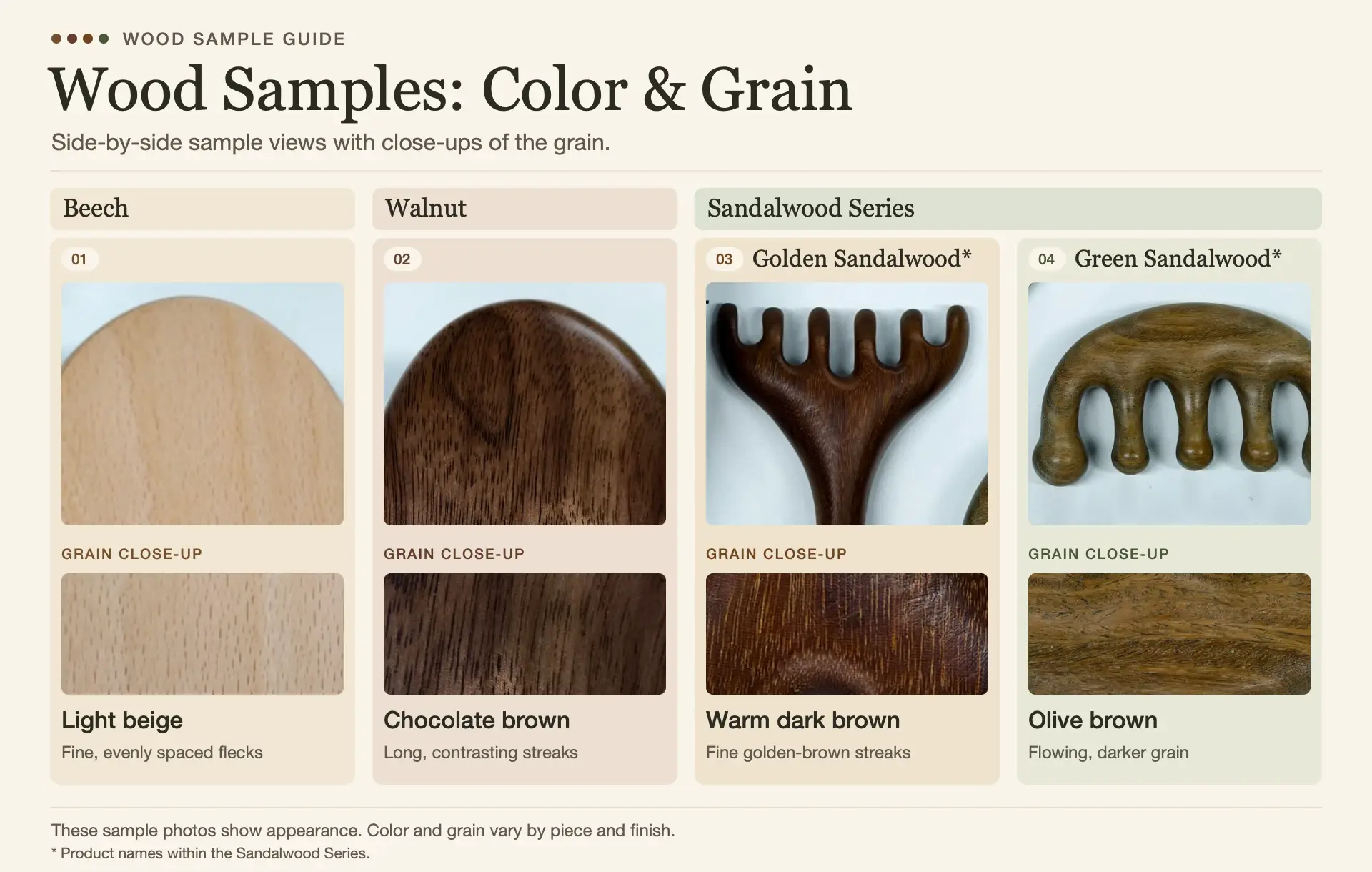
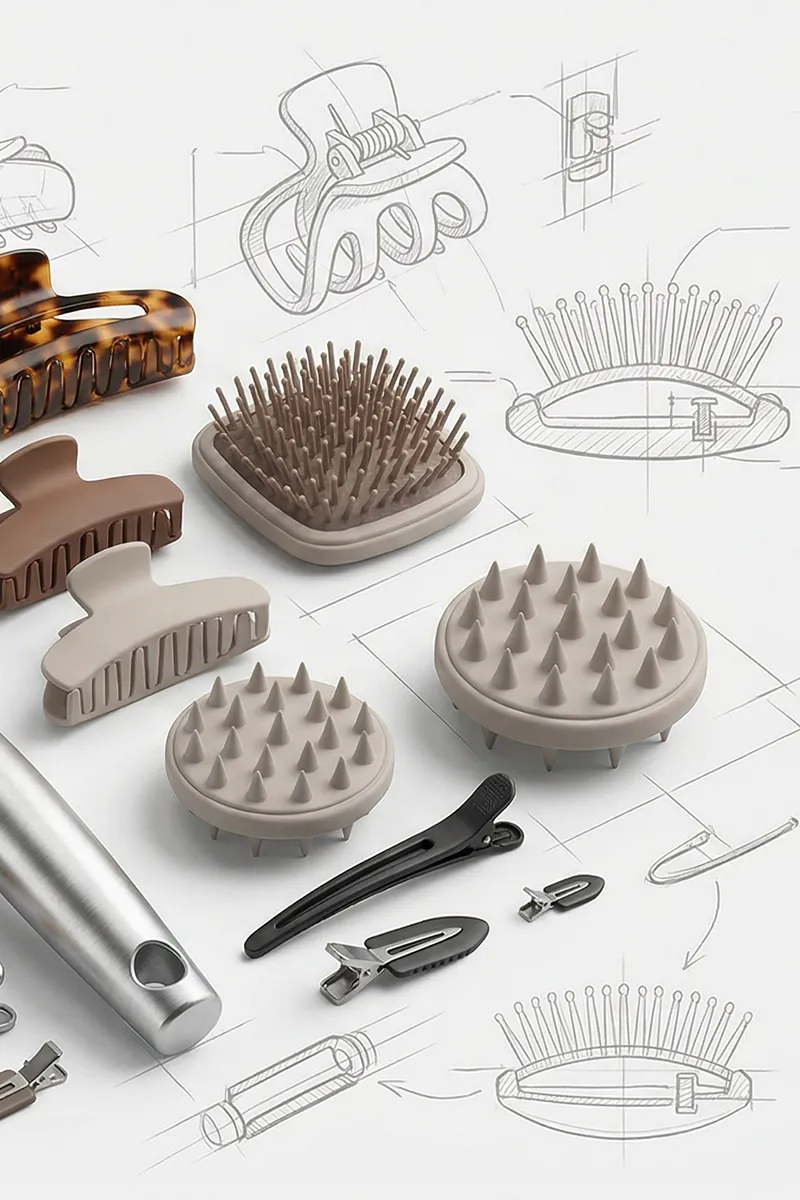
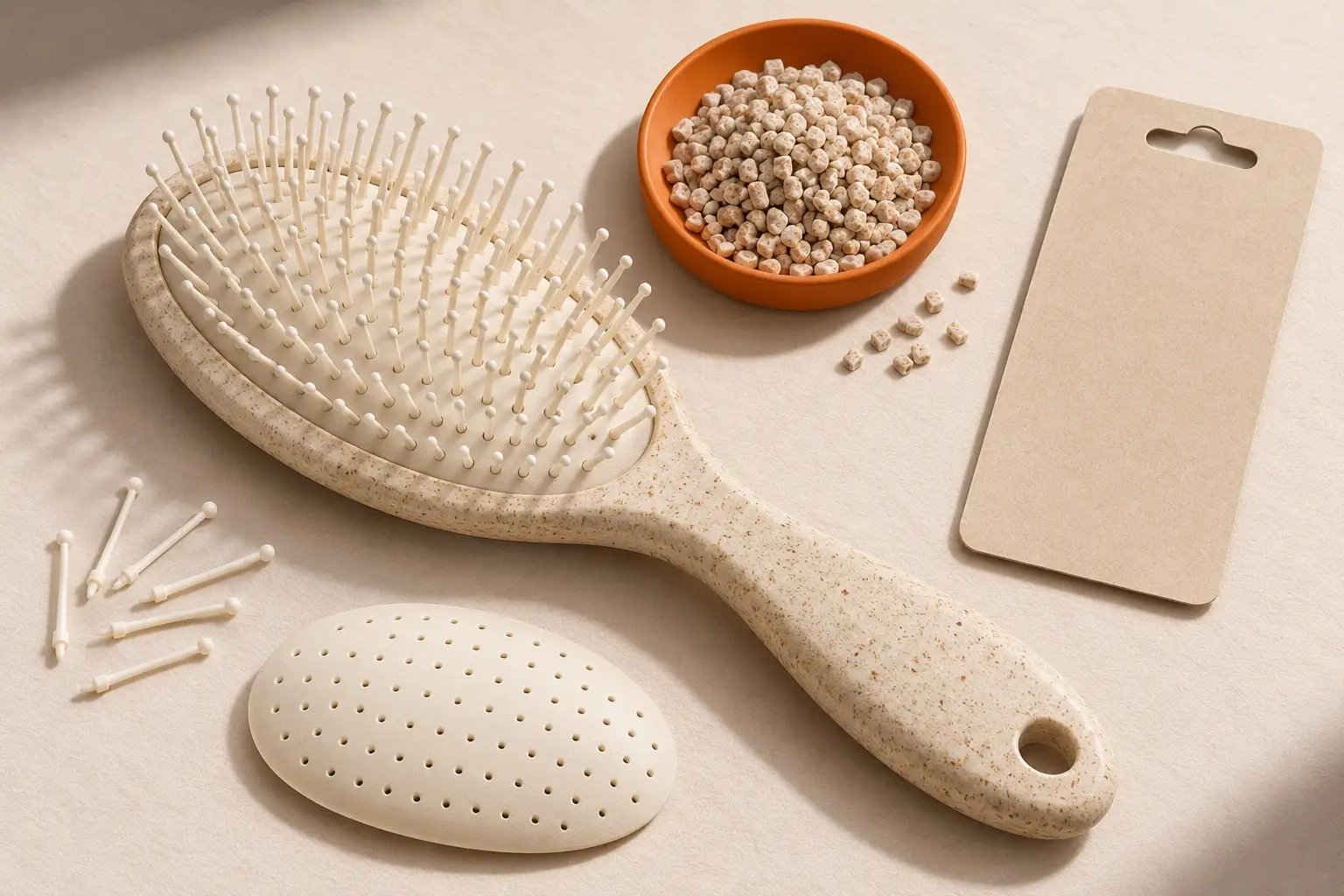
A wheat straw hair brush is not normally made from straw alone. In this product category, the name usually refers to a moldable composite used for the body or handle: processed wheat-straw fiber or powder is blended with a polymer matrix. The polymer type, fiber percentage and covered components can differ by supplier and SKU.
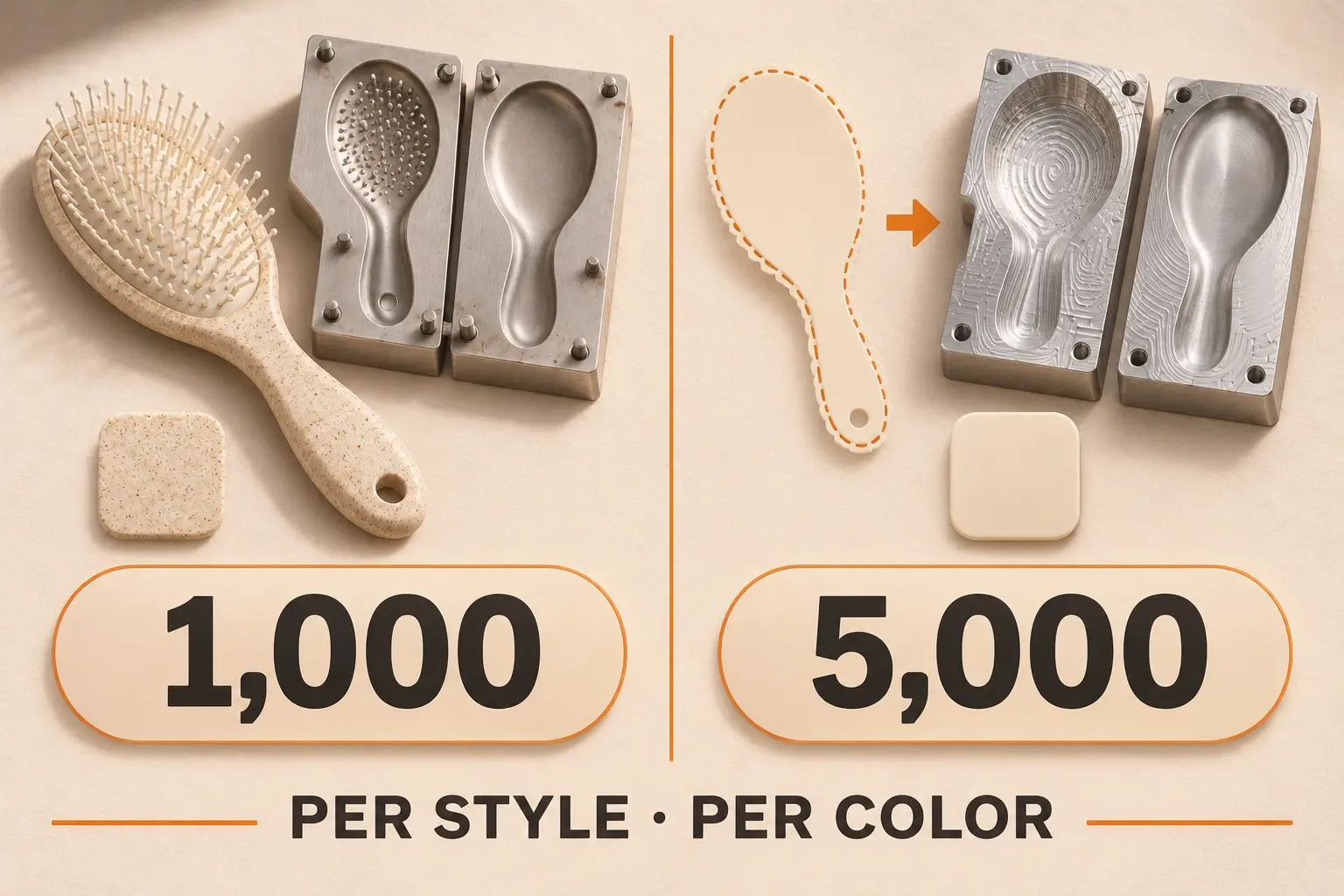
For a private-label buyer, the first decisions are therefore practical: choose an existing or new shape, define every component, calculate the quantity by color, and approve a complete sample. At HaircareCN, wheat-straw products using an existing mold start at 1,000 pieces per style and per color. A new-mold project starts at 5,000 pieces per style and per color.
The material name also does not prove that a finished brush is biodegradable. A brush may include a polymer matrix, nylon pins, epoxy bead tips, a cushion, ink and packaging, each with a different composition. Treat environmental wording as a separate evidence question, not as a conclusion drawn from the words “wheat straw” or from a speckled appearance.
1. What is wheat straw material in a hair brush?
“Wheat straw material” is a commercial category, not one fixed formula. It commonly describes a composite that can be injection molded into a brush body, handle or comb. It does not tell a buyer which polymer is used, how much wheat-straw content is present, or whether every visible part uses the same material.
Ask for the selected SKU’s formulation and a component list. Do not copy a composition percentage from another supplier or another product.
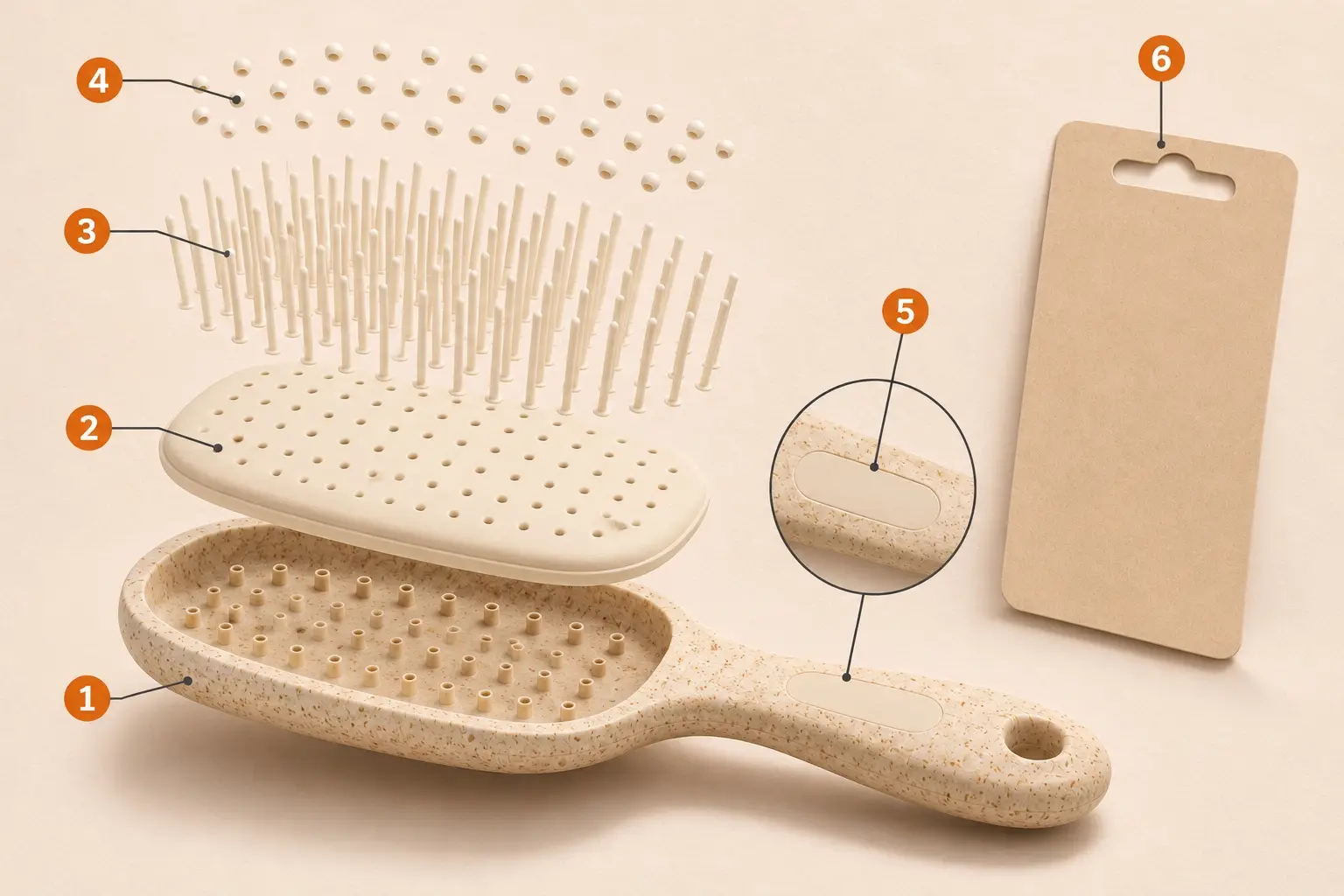
| Brush part | What to put in the specification | Why it is a separate decision |
|---|---|---|
| Body and handle | Composite description, polymer if disclosed, wheat-straw content if supported, color reference, surface and shape | This part often gives the product its name, but the name alone does not define its formula |
| Pins, teeth or bristles | Material, color, arrangement and reference sample | These parts may use nylon or another material rather than the body composite |
| Bead tips, if used | Material, color, coverage and finish | Bead tips do not prove the material of the complete brush |
| Cushion, if used | Material, color, vent arrangement and fit | Not every wheat straw brush is a cushion brush |
| Logo | Method, size, position and color | The process has to suit the selected surface |
| Packaging | Pack type, label, barcode, dimensions and market information | Packaging and labeling need to be checked with the complete product |
HaircareCN’s current Custom Wheat Straw Detangling Hair Brush is described with nylon pins and epoxy bead tips. That is the specification of this listed design, not a universal construction for every wheat straw brush.
2. Is a wheat straw hair brush biodegradable?
No—not by default. Bio-based content and biodegradability answer different questions. A material can contain plant-derived input while still using a polymer that does not biodegrade under ordinary disposal conditions. The finished brush also contains multiple components, so evidence for the body material would not automatically cover the pins, cushion, logo or packaging.
The European Commission’s terminology guidance states that bio-based plastics are not necessarily biodegradable or compostable. Before using either claim, define the exact SKU and component, formulation, test method, disposal conditions and sales market. Without product-specific evidence, use a factual material description instead of biodegradable, compostable, plastic-free, zero-impact, green or eco-friendly.
3. Calculate MOQ before developing the color range
HaircareCN’s MOQ for wheat-straw products is counted per style and per color:
- Existing mold: 1,000 pieces per style, per color.
- New mold: 5,000 pieces per style, per color.
Changing the logo or color on an existing shape does not automatically create a new-mold project. However, adding colors multiplies the total quantity because each color must meet the product MOQ. The logo follows the product MOQ; it does not have a separate lower threshold.
| Project scenario | Calculation | Minimum planning quantity |
|---|---|---|
| One existing brush shape, one color | 1 × 1,000 | 1,000 pieces |
| One existing brush shape, two colors | 2 × 1,000 | 2,000 pieces |
| One new-mold brush shape, one color | 1 × 5,000 | 5,000 pieces |
| One new-mold brush shape, two colors | 2 × 5,000 | 10,000 pieces |
These figures are planning rules, not a complete quotation. The selected components, packaging, sample route and current mold availability still need to be included in the project brief.
Planning a launch quantity? Send the shape, color split and packaging brief to HaircareCN for an existing-mold or new-mold quotation.
4. Use an existing shape unless the construction requires a new mold
An existing shape lets a first order focus on material, color, logo, components and packaging without adding a tooling project. Confirm that the mold is available and supports the required construction.
A current detangling brush design. Confirm current mold availability and the complete component specification when requesting a quote.
A different handle outline, brush-head geometry, pin pattern or assembly can require a new mold. Use the existing-versus-new-mold guide to define the tooling scope.
The Custom Wheat Straw Wide-Tooth Comb with Speckled Finish can be used as a nearby color or material-family reference, but it is a comb—not a hair brush. It does not share the same construction, mold or performance specification.
This is a wide-tooth comb, not a brush. Use it only as an adjacent style reference and specify it separately.
5. Compare the production route, not only the material name
The choice depends on shape, surface, visual direction, quantity and retail claim.
| Material route | HaircareCN MOQ | When to consider it |
|---|---|---|
| Wheat-straw composite | Existing mold: 1,000; new mold: 5,000 per style/color | A molded body with a wheat-straw material direction |
| PP or ABS | Existing mold: 1,000; new mold: 5,000 per style/color | A molded plastic shape without a wheat-straw brief |
| Wood or Moso bamboo | 1,000 per style/color | A cut-and-shaped construction with natural surface variation |
| Cellulose acetate | 1,000 per style/color | Sheet patterns, polished edges or an acetate construction |
For wheat-straw material, settle the exact formula, covered component and claim evidence. For PP or ABS, define the grade, color, finish and components. Wood or bamboo needs an agreed material, finish and acceptable natural variation; acetate needs an approved sheet pattern, thickness and edge finish. This is a sourcing comparison, not a claim that one route has better environmental performance.
6. What changes the quotation and timeline?
Price is quoted by project because the same brush shape can carry different costs. The main variables are order quantity and color split, existing versus new mold, pins or bristles, bead tips or cushion, logo process and retail packaging. A new mold adds tooling and trial work; extra color-matching or sample changes add approval rounds; special components and packaging can add supplier coordination.
To compare quotations, keep the specification, quantity per color, components, logo and packaging identical. Ask the supplier to separate unit price, sample or tooling charges, packaging and delivery basis. State the target approval and delivery dates, but expect timing to depend on the final style, materials, approval loop and production schedule.
7. Use a four-step sample approval process
- Select the route. Choose an available shape or define the new-mold requirement, then list the material and components.
- Confirm the sample terms. Agree on the sample charge, freight, timing and required evidence. Suitable standard stock samples can normally be dispatched within three days; the buyer pays freight. Customized samples are quoted by project.
- Inspect the complete sample. Check the assembled brush, logo and intended packaging rather than approving a body shell, color chip or digital proof in isolation.
- Keep the approved sample. Use the signed-off sample and written specification as the reference for bulk production and inspection.
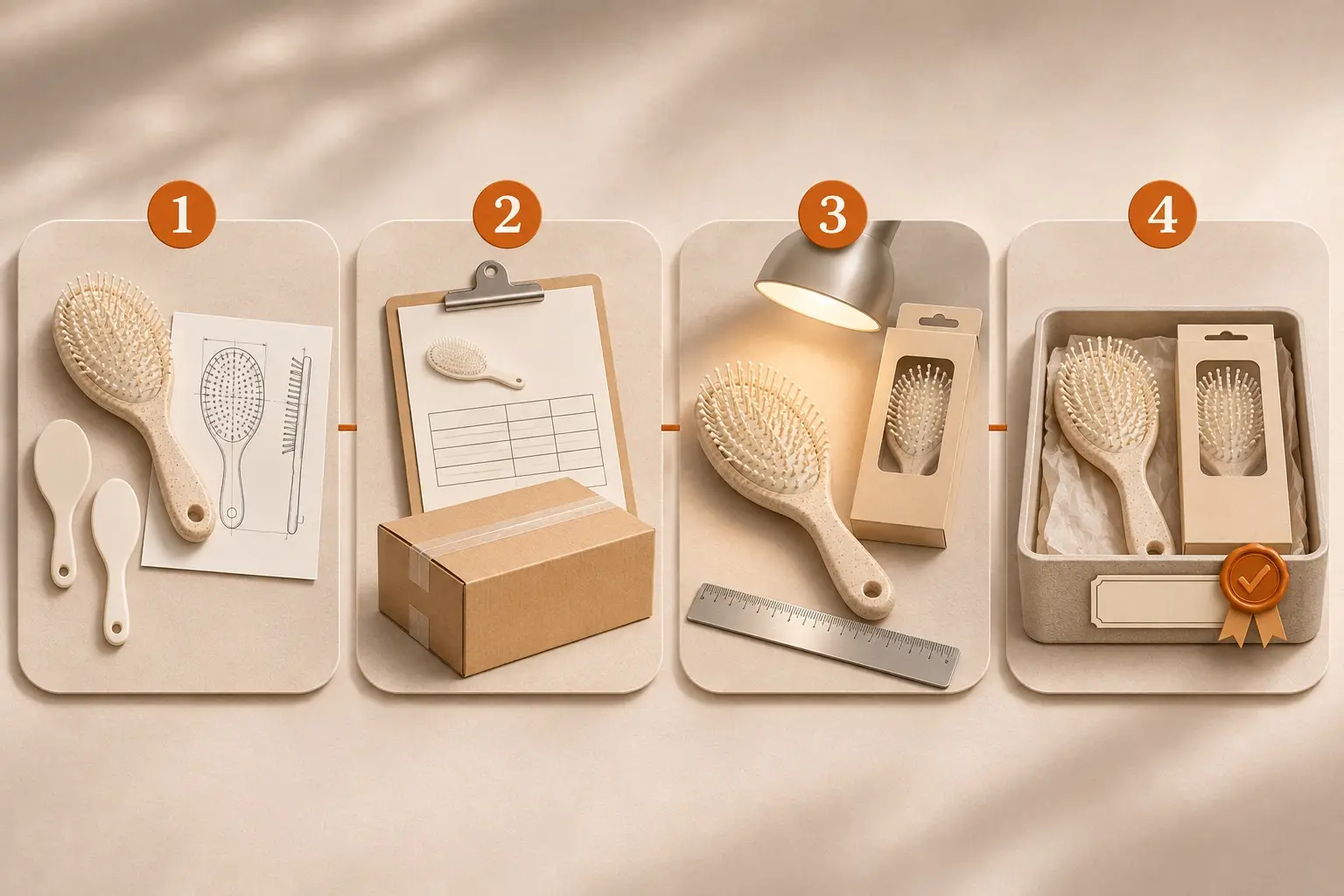
The physical approval should cover color and surface, edges and assembly, pins or bristles and bead tips, cushion fit where applicable, logo placement and packaging fit.
Do not add an unverified heat limit, drop height, pull-force value or cycle count. If a performance test matters, define its method, sample size and acceptance limit. See the hair brush quality-control checklist for the wider inspection process.
8. Build market requirements into the brief
This is a B2B sourcing guide, but environmental-claim rules principally affect what the brand, importer or retailer says to consumers. Put the destination country and sales channel in the RFQ, then confirm the finished product, label and advertising requirements for that market.
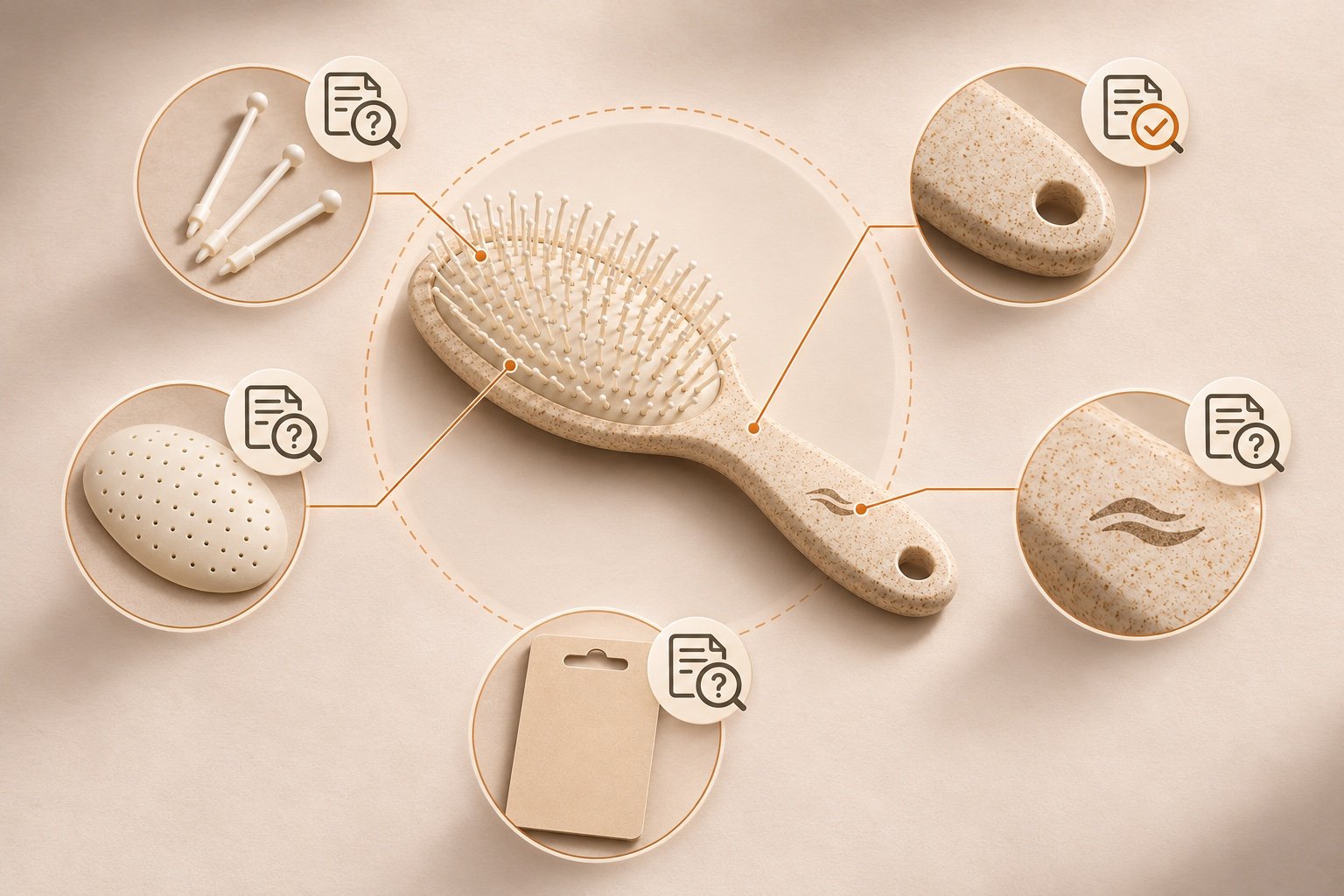
United States: avoid an unsupported biodegradable claim
The US FTC Green Guides summary advises against broad, unqualified claims such as green or eco-friendly. For an unqualified degradable claim, the marketer needs evidence that the entire product or package will completely break down and return to nature within a reasonably short period after customary disposal; the FTC guidance uses one year for solid-waste products and warns that items normally sent to landfill, incineration or recycling will not meet that expectation.
For a multi-component brush, evidence for wheat-straw content in the body would not establish that the polymer matrix, pins, bead tips, cushion, ink and packaging all meet that claim. Unless the complete claim can be supported, describe the verified material and component instead.
EU and UK: rules now applying
The EU General Product Safety Regulation has applied since December 13, 2024 and brings product-safety, traceability and responsible-economic-operator questions into the brief. Member States were required to apply their measures implementing Directive (EU) 2024/825 from September 27, 2026; the Directive addresses unsupported generic environmental claims and claims about a whole product when evidence covers only one aspect. The UK CMA guidance likewise calls for clear, accurate and substantiated claims. Requirements and enforcement depend on the destination country’s law, so confirm them with the responsible importer or qualified adviser.
These sources are a procurement starting point, not legal advice.
9. Send an RFQ that can be quoted without guesswork
Use the component list in Section 1, then add:
- selected brush shape, product link, drawing or reference image;
- required quantity for every style and every color;
- vector logo artwork and intended packaging;
- destination country, sales channel and required label or claim evidence;
- existing sample, customized sample or new-mold route; and
- target approval and delivery dates.
If the formula is unknown, list it as an open question. If the shape is undecided, ask for existing options before beginning a new-mold project. Rules and evidence needs change with the sales market, so the destination should be stated before quotation.
Ready to compare options? Send your private-label wheat straw brush brief. HaircareCN can review the shape, quantity split, component list and sample route before quotation.
For a first order, an existing shape with one or two colors keeps the project focused on the product, sample and packaging. Choose a new mold only when the construction requires it and the plan supports 5,000 pieces per color.
Frequently Asked Questions
Is a wheat straw hair brush biodegradable?
Not by default. Plant-derived content does not prove that the polymer matrix or complete multi-component brush will biodegrade under ordinary disposal conditions. Use a biodegradable or compostable claim only when evidence for the exact SKU, component and stated conditions supports it.
What is the MOQ for a private label wheat straw hair brush?
At HaircareCN, an existing-mold wheat-straw product starts at 1,000 pieces per style and per color. A new-mold project starts at 5,000 pieces per style and per color.
Can two colors be combined to reach the MOQ?
No. MOQ is counted by style and by color. Two colors of one existing-mold style require 1,000 pieces in each color, or 2,000 pieces in total.