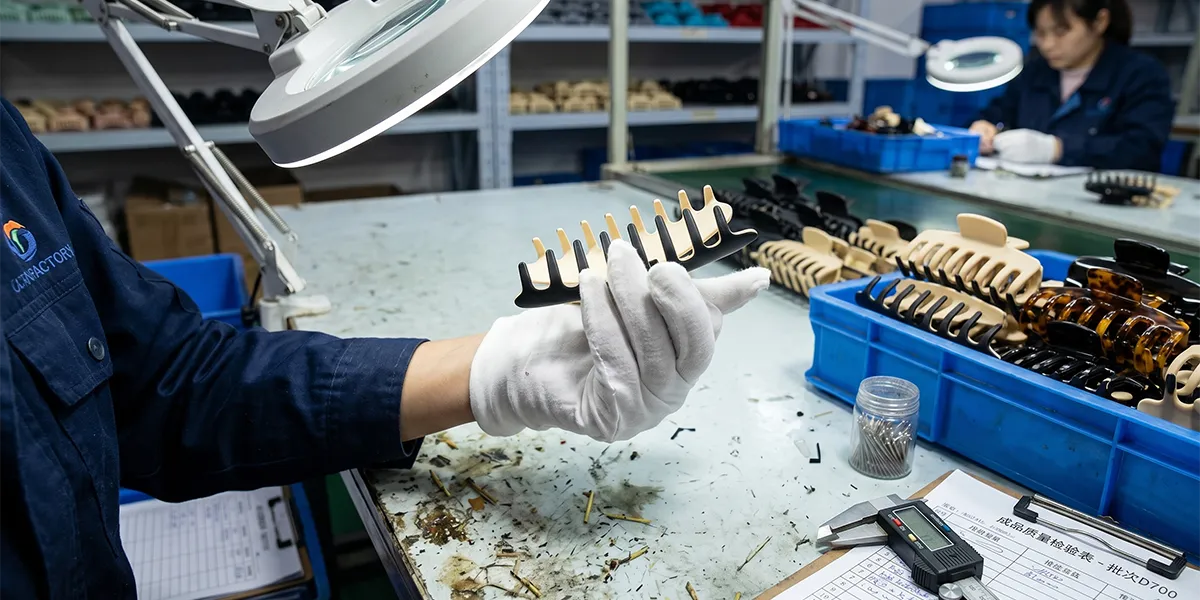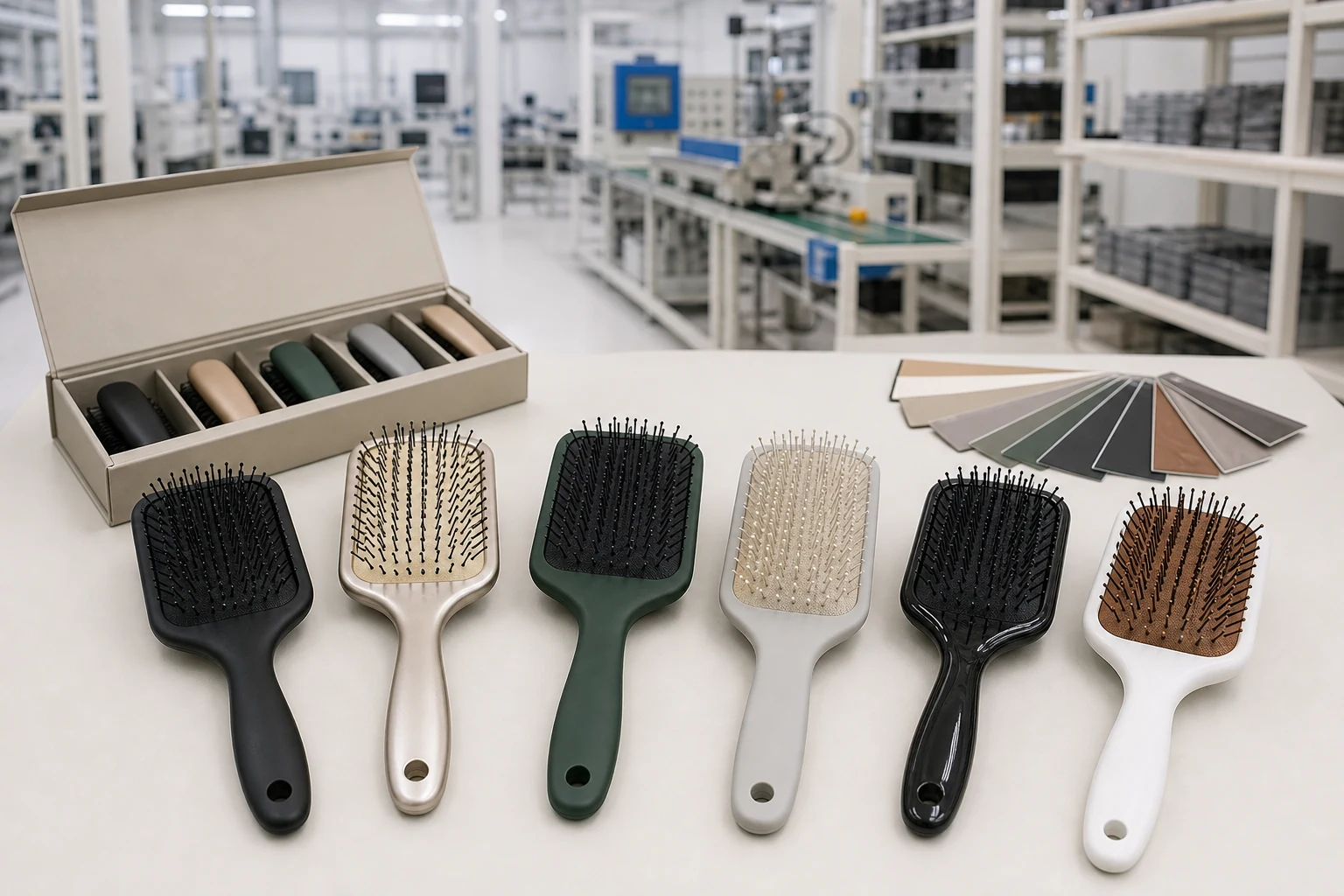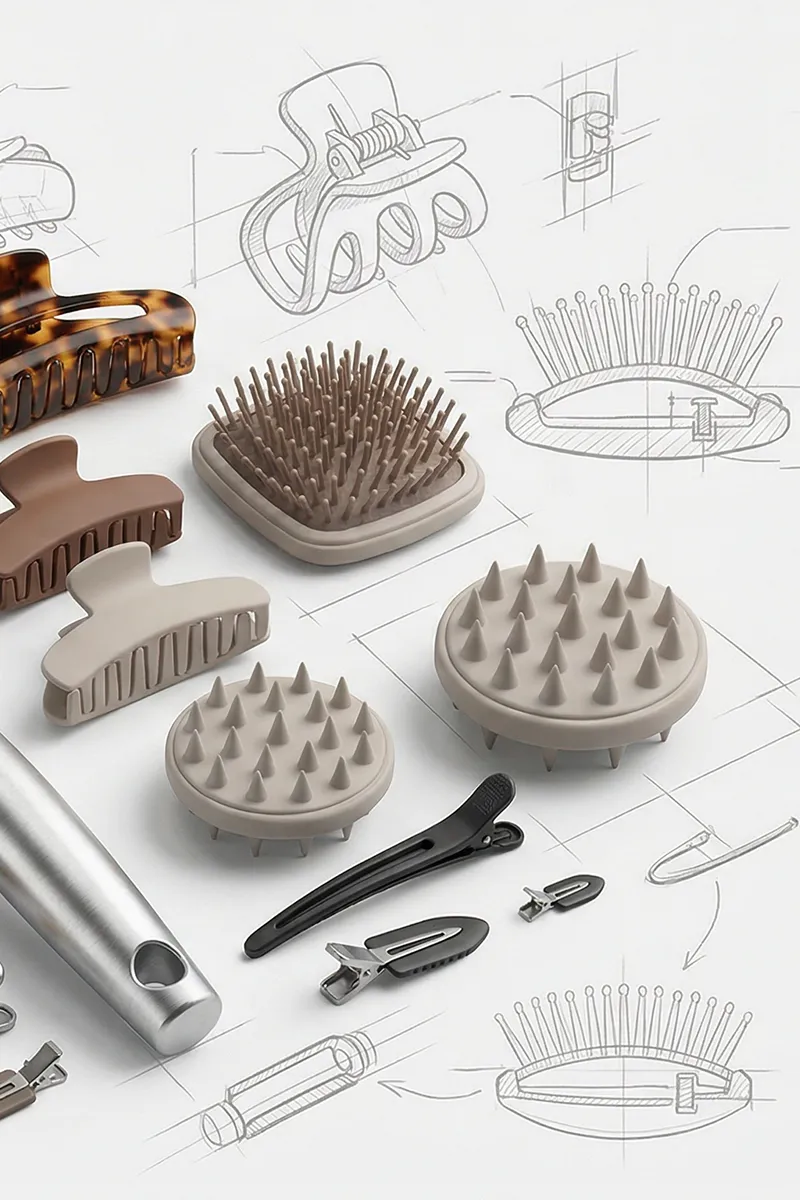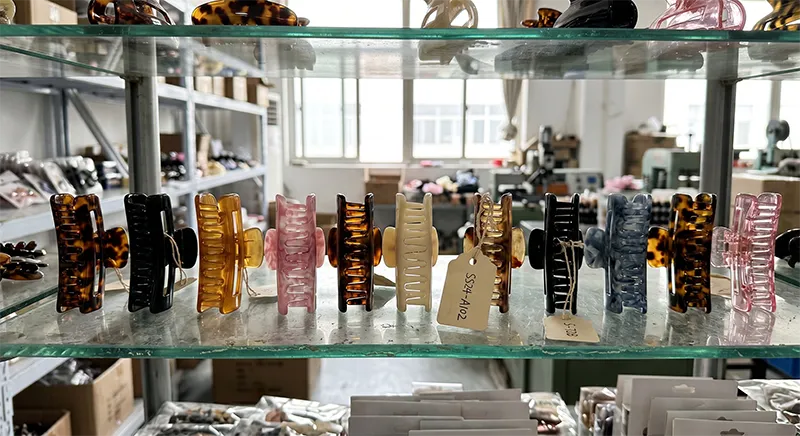
Private label hair accessories are products manufactured by a third-party factory and sold under the buyer's own brand name. The manufacturer handles production — from material sourcing through moulding, assembly, finishing, and quality control — while the buyer controls the branding, packaging, pricing, and distribution. The manufacturer's name does not appear on the finished product.
For entrepreneurs, e-commerce operators, salon owners, and small-to-medium brand owners, private labelling offers a path to market without the capital investment required to build manufacturing capability from scratch. However, the process involves a series of decisions — product selection, material specification, MOQ negotiation, logo application method, packaging design, and manufacturer vetting — that directly determine whether the resulting product line is commercially viable or a costly misstep.
This guide walks through the private label process from start to finish, with specific cost data, MOQ ranges, and timeline benchmarks based on real manufacturing conditions in China's hair accessories production clusters.
1. Product Selection: What to Include in a Private Label Hair Accessories Line
The first decision in any private label programme is which product categories to include. Hair accessories span a wide range of items, each with different production processes, cost structures, and market dynamics. Starting with too many SKUs dilutes inventory investment and complicates initial logistics. Starting with too few limits shelf appeal and cross-selling potential.
A practical starting assortment for a new private label brand typically includes three to five SKUs across two to three product categories. The following table outlines the core product categories available for private labelling, along with their typical price positioning and market fit.
| Product Category | Key Items | Material Options | Retail Price Range | Best Channel |
|---|---|---|---|---|
| Hair clips | Claw clips, barrettes, snap clips | Acetate, ABS, metal | $8–35 | E-commerce, boutique retail |
| Hair combs | Wide-tooth, fine-tooth, rat-tail | Acetate, ABS, wood | $12–40 | Salon supply, premium retail |
| Hair brushes | Paddle, round, cushion, detangling | ABS, wood, bamboo | $10–30 | Mass retail, DTC |
| Hair pins & bobby pins | U-pins, bobby pins, decorative pins | Steel, coated metal | $3–12 (multi-pack) | Mass retail, salon supply |
| Hair bands & scrunchies | Elastic bands, silk scrunchies | Fabric, elastic, silk | $5–20 | E-commerce, gift sets |
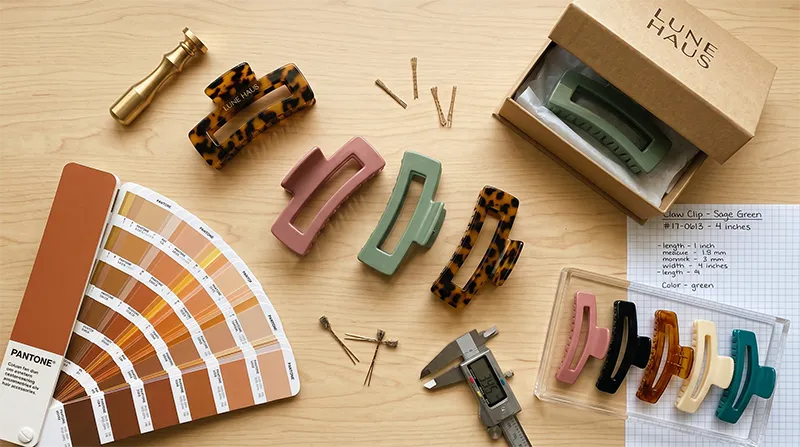
For first-time private label buyers, acetate claw clips and barrettes offer the strongest combination of margin potential and visual differentiation. The material's natural translucency and colour depth create a premium appearance that supports higher retail pricing, while MOQs are relatively accessible (300–500 pieces per SKU). For a full overview of clip categories and their construction differences, see the guide on types of hair clips.
2. The Private Label Process: From Concept to Delivery
The private label production process follows a predictable sequence regardless of product category. Understanding each stage — and its typical timeline — prevents delays and misaligned expectations.
Stage 1: Supplier Research and Shortlisting (1–2 weeks)
Begin by identifying 3–5 potential manufacturers that produce the product categories required. Evaluate each manufacturer's material capabilities, certification status, MOQ policies, and communication responsiveness. Request a company profile, product catalogue, and copies of relevant certifications (ISO 9001, BSCI, GRS at minimum for international retail supply). For a side-by-side comparison of established manufacturers, the top 10 hair clip manufacturers in China and top 10 hair brush manufacturers guides provide structured starting points.
Stage 2: Sampling and Product Development (2–3 weeks)
Once a manufacturer is selected, request samples of the products intended for the private label range. Sampling serves two purposes: verifying product quality (material feel, finish, mechanism function, durability) and confirming that the manufacturer can execute the required branding (logo placement, colour accuracy, packaging). Sample costs typically range from $40–100 per item, often refundable against the first bulk order. For acetate products, sample turnaround is 15–20 days; for ABS or metal items, 5–10 days. A detailed overview of the sampling process is available in the samples and prototypes guide.
Stage 3: Order Confirmation and Production (3–5 weeks)
After sample approval, the buyer confirms the order by agreeing on quantities, pricing, logo application method, packaging specifications, and payment terms. Standard payment terms for first-time orders are 30% deposit upon order confirmation and 70% balance before shipment. Production lead times vary by product type: ABS clips take 15–25 days, acetate clips take 20–35 days, and hair brushes take 30–45 days.
Stage 4: Quality Inspection and Shipping (2–4 weeks)
Before shipment, a pre-shipment quality inspection should be conducted — either by the buyer's own team, a third-party inspection service, or the manufacturer's in-house QC department. Shipping from China to major markets typically takes 2–3 weeks by sea freight or 5–7 days by air. Sea freight is significantly more cost-effective for orders above 0.5 CBM (cubic metres).
3. MOQ by Product Type: What to Expect
Minimum order quantity is often the first question buyers ask — and the answer varies significantly by product category, material, and whether existing moulds or custom tooling are involved.
| Product | Material | MOQ (Existing Mould) | MOQ (Custom Mould) | Notes |
|---|---|---|---|---|
| Claw clips | Acetate | 300–500 pcs/SKU | 500–1,000 pcs/SKU | Colour customisation at sheet level |
| Claw clips | ABS | 500–1,000 pcs/SKU | 1,000–2,000 pcs/SKU | New mould: $1,500–3,000 |
| Barrettes | Acetate | 300–500 pcs/SKU | 500–1,000 pcs/SKU | Metal clasp sourced separately |
| Snap clips | Metal + coating | 1,000–2,000 pcs/SKU | 2,000–5,000 pcs/SKU | Coating colour affects MOQ |
| Wide-tooth combs | Acetate | 300–500 pcs/SKU | 500–1,000 pcs/SKU | CNC-cut from sheet |
| Paddle brushes | ABS / wood | 1,000–3,000 pcs/SKU | 2,000–5,000 pcs/SKU | New mould: $2,000–5,000 |
| Round brushes | ABS / ceramic | 1,000–3,000 pcs/SKU | 2,000–5,000 pcs/SKU | Each barrel diameter needs own mould |
| Detangling brushes | TPE / PP | 2,000–5,000 pcs/SKU | 3,000–5,000 pcs/SKU | Integrated moulding, higher MOQ |
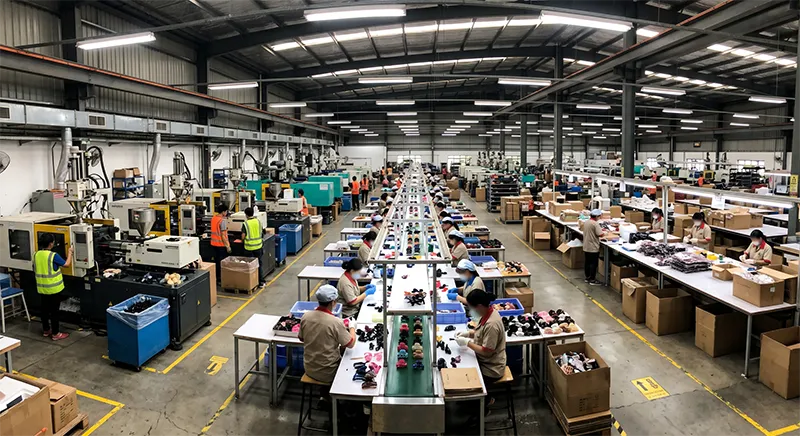
A common misconception is that lower MOQ always means a better deal for small brands. In practice, very low MOQs (50–100 pieces) come with higher per-unit costs because the manufacturer cannot amortise setup costs across a large run. The commercially optimal approach for most startups is to order at the manufacturer's standard MOQ threshold — typically 300–500 pieces for acetate or 1,000 pieces for ABS — where the per-unit cost drops to its standard production level.
4. Cost Breakdown: Where the Money Goes
Understanding the cost structure of a private label hair accessories order prevents budget surprises and helps buyers negotiate more effectively. The following breakdown covers the main cost components for a typical first order.
Product Unit Cost
The per-unit cost of the product itself depends on material, complexity, and order volume. As a rough benchmark: ABS claw clips run $0.50–2.00 per piece, acetate claw clips run $1.50–5.00 per piece, acetate combs run $2.00–6.00 per piece, and paddle hair brushes run $1.50–4.00 per piece. These ranges assume standard MOQ volumes; lower quantities push per-unit costs higher.
Sampling
Sample charges typically range from $40–100 per product, covering material, production time, and express shipping to the buyer. Most manufacturers credit sample costs against the first bulk order. Request 2–3 samples per SKU to allow for destructive testing (checking spring durability, drop resistance, surface scratch testing) while retaining a reference sample.
Logo Application
Branding costs depend on the application method. Pad printing (single colour) costs $0.03–0.08 per piece. Laser engraving costs $0.05–0.15 per piece and produces the most durable result on acetate and wood surfaces. Hot stamping (metallic foil) costs $0.05–0.12 per piece. Embossing or debossing (pressed into the material) may require a die at $50–150, with per-piece costs of $0.05–0.10.
Packaging
Basic packaging (clear polybag with a printed header card) costs $0.10–0.30 per unit. Custom rigid boxes or premium packaging run $0.50–2.00 per unit depending on materials and printing. Retail-ready packaging with barcodes, hang tags, and display-ready configurations typically falls in the $0.30–0.80 range.
Mould Tooling (if applicable)
New mould costs range from $1,500–5,000 depending on product size and complexity. Moulds are owned by the buyer after payment and can be transferred between manufacturers if needed. Using the manufacturer's existing mould library eliminates this cost entirely — a significant advantage for first-time buyers.
Shipping
Sea freight from China to the US or Europe costs approximately $3–6 per kilogram for small shipments (under 1 CBM) via LCL (Less than Container Load). A full 20-foot container (for very large orders) costs $1,500–3,500 depending on the route and season. Air freight costs $5–10 per kilogram and is typically used for urgent or small initial orders.
5. Branding Options: Logo, Colour, and Packaging
The scope of branding customisation available for private label hair accessories is broader than many first-time buyers expect. Understanding the options — and their cost and timeline implications — helps brands make informed decisions about where to invest in differentiation versus where to use standard options.
Logo placement: Most hair clips and combs offer at least one flat surface suitable for logo application. For claw clips, the logo is typically placed on the outer jaw surface. For barrettes, the top decorative surface or the inner clasp face are standard positions. For combs, the spine or handle area is used. For brushes, the back of the paddle or the handle end are common placements.
Colour customisation: For ABS products, colour is specified using RAL, Pantone, or manufacturer colour charts and mixed into the resin before moulding — this is a low-cost customisation. For acetate products, colour is determined by the acetate sheet itself and must be selected from the manufacturer's sheet inventory or ordered as a custom batch. Custom acetate colour development has minimum sheet quantities and adds 2–3 weeks to the timeline.
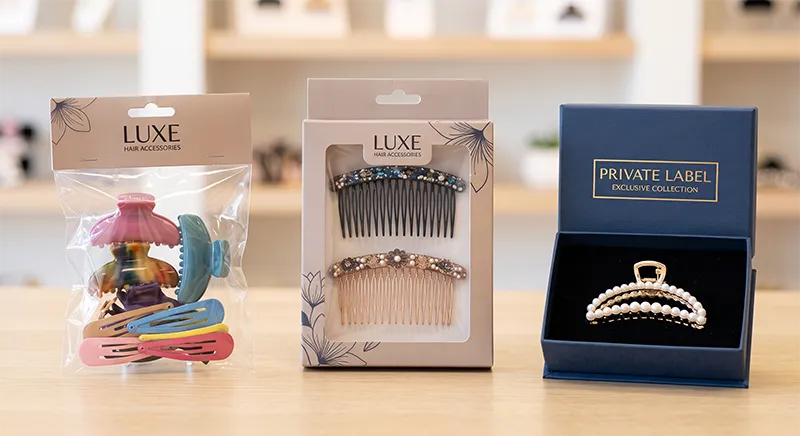
Packaging tiers: Private label buyers typically choose from three packaging levels. Economy packaging (polybag with header card) suits e-commerce and marketplace channels where the packaging is not the primary selling tool. Standard retail packaging (printed box or blister pack with hang tag) is required for brick-and-mortar retail placement. Premium packaging (rigid box, magnetic closure, tissue wrap) supports gift-set positioning and luxury retail channels.
Successful private label brands featured in documented OEM case studies often start with standard packaging for their initial launch, then upgrade to premium packaging once they have validated product-market fit and can justify the higher per-unit packaging cost.
6. Common Mistakes in Private Label Hair Accessories
Several recurring errors cause first-time private label buyers to overspend, miss timelines, or launch with products that underperform in the market.
Over-investing in custom moulds before validating demand. Custom mould development ($1,500–5,000 per mould) makes sense for brands with proven market demand and sufficient order volume to justify the investment. For a first launch, using the manufacturer's existing mould library — which can contain thousands of proven designs — eliminates tooling costs and reduces the timeline by 4–6 weeks. Customisation through colour, material, logo, and packaging provides sufficient brand differentiation without the risk of a costly mould that may not sell.
Ordering too many SKUs at minimum quantities. Spreading a limited budget across 10–15 SKUs at minimum MOQ results in small quantities of each item, higher per-unit costs, and inventory that is difficult to manage. A tighter assortment of 3–5 carefully selected SKUs at comfortable production volumes produces better unit economics and clearer market positioning.
Skipping pre-production samples. Confirming production based on catalogue images or digital mockups — without evaluating a physical sample — is the single most common cause of quality disputes in private label sourcing. The $40–100 cost of a sample set is negligible compared to the cost of receiving 1,000 units that do not meet expectations. Test every aspect: colour accuracy under different lighting, spring tension after 50+ open-close cycles, surface finish under fingertip inspection, and logo durability after rubbing.
Ignoring certification requirements for the target market. Discovering that a manufacturer lacks required certifications (BSCI for EU retailers, ISO 9001 for quality assurance, CA Proposition 65 for US California sales) after samples are approved forces a restart of the sourcing process. Confirm certification status during Stage 1, not Stage 3.
Underestimating shipping and import costs. The product unit cost quoted by the manufacturer is FOB (Free on Board) — it does not include international freight, import duties, customs brokerage, or domestic delivery. For hair accessories shipped from China to the US or Europe, shipping and import costs typically add 15–25% on top of the FOB price. Build this into the margin calculation from the beginning.
7. How to Evaluate a Private Label Manufacturer
The manufacturer is the single most important variable in a private label programme. A reliable manufacturer delivers consistent quality, meets deadlines, communicates clearly, and scales with the brand as it grows. An unreliable manufacturer causes quality inconsistencies, missed delivery windows, and costly reorders.
The following checklist covers the key evaluation criteria, roughly in order of importance.
Product range and material capability. A manufacturer that produces across multiple categories (clips, combs, brushes) allows buyers to consolidate sourcing under one supplier relationship. Verify that the manufacturer processes the required materials in-house — for acetate products, confirm that the factory has its own CNC cutting, polishing, and finishing lines rather than outsourcing these steps.
Mould library depth. Manufacturers with extensive mould libraries (1,000+ designs) enable buyers to launch quickly without custom tooling investment. Ask for a mould catalogue or product index during the initial enquiry. For a comparison of manufacturers' mould libraries and production capabilities, see the top 5 acetate hair accessories manufacturers guide.
Certification status. Request copies of current certificates — not just a list of certifications claimed. Verify validity dates and auditing bodies. Key certifications for international hair accessories supply include ISO 9001 (quality management), amfori BSCI (social compliance), BRCGS (retail supply chain safety), and GRS 4.0 (recycled material standards).
Communication and responsiveness. Response time during the enquiry phase is a reliable indicator of communication quality during production. A manufacturer that takes 3–5 days to respond to initial messages is unlikely to communicate production issues proactively. Aim for manufacturers that respond within 24 hours on working days.
Reference clients and documented track record. Established manufacturers can provide references, verifiable trade references, or documented case studies. A manufacturer that has supplied recognisable retail brands demonstrates the production standards and supply chain reliability that a growing private label brand requires.
8. Conclusion
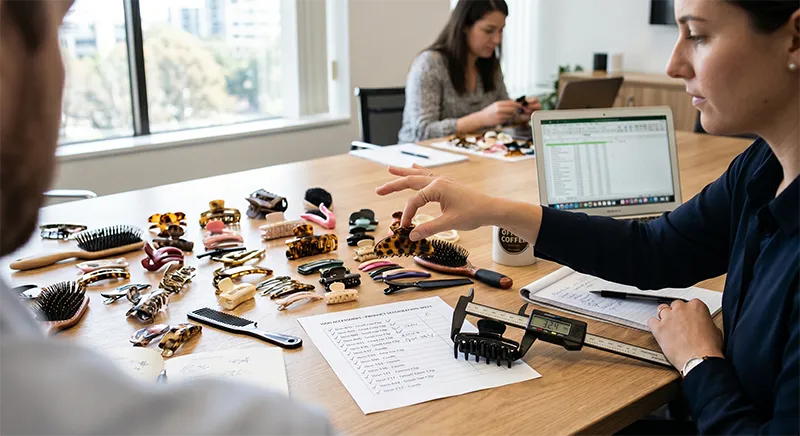
Launching a private label hair accessories line is a structured process with predictable costs, timelines, and decision points at each stage. The most successful launches share three characteristics: a focused initial assortment (3–5 SKUs) rather than an over-extended range, an emphasis on sample evaluation before committing to bulk production, and a manufacturer partnership selected on capability and certification rather than lowest quoted price alone.
For buyers seeking a manufacturer that supports private label programmes across clips, combs, and brushes — with an existing mould library of over 2,000 designs, in-house acetate processing, and certifications spanning ISO 9001, amfori BSCI, BRCGS, GRS 4.0, and FSC — JunYi Beauty, operated by Dongguan JunYi Beauty Technology Co., Ltd., provides a factory-direct OEM pathway from initial sampling through bulk production and international logistics. Documented partnerships with brands including MINISO, KKV, and OCE illustrate the production scale and quality standards available through this type of integrated manufacturing partner.