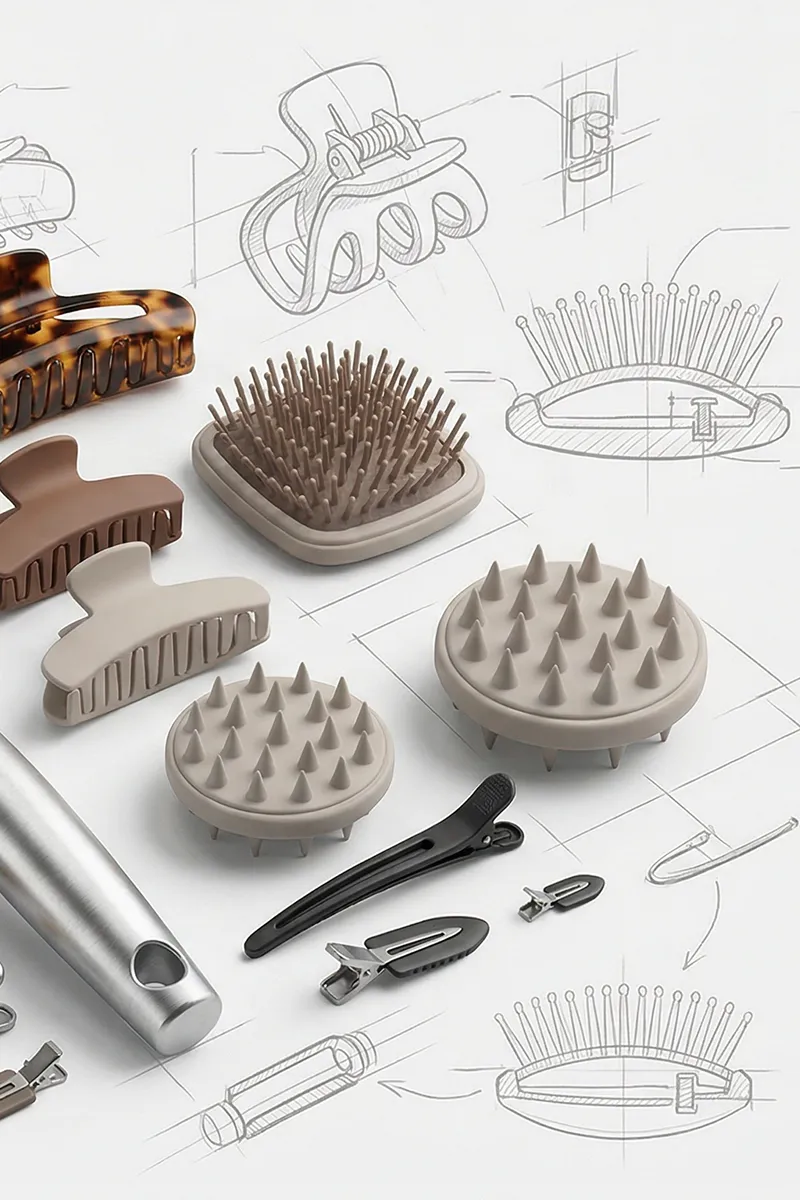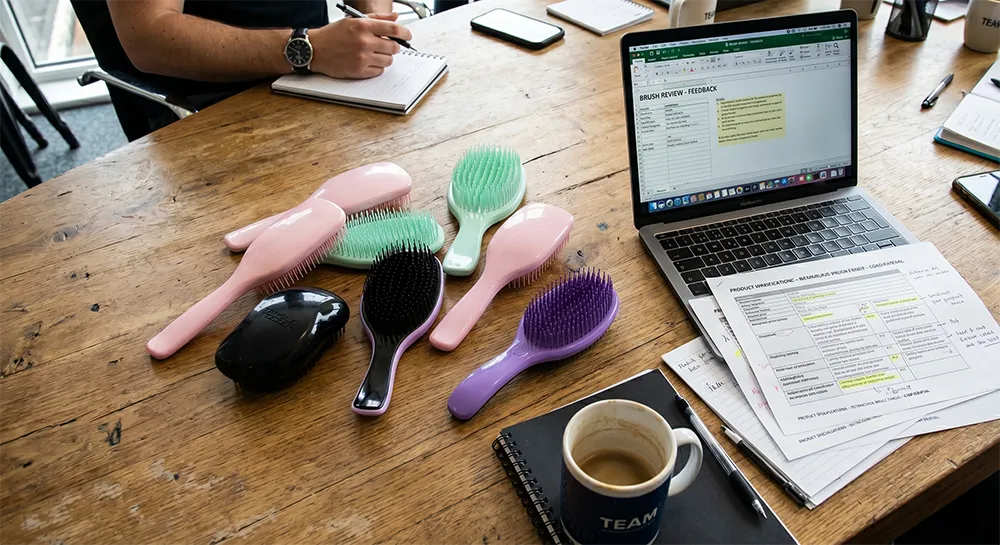
A custom detangling brush manufacturer is a factory that produces detangling-style hair brushes — characterised by thin, flexible bristles designed to bend around knots rather than pull through them — to a buyer's specifications for private label, OEM, or wholesale distribution. Detangling brushes have become one of the fastest-growing sub-categories in the global hair tools market, driven by consumer demand for gentler, breakage-reducing alternatives to traditional stiff-bristle brushes.
For hair care brands, Amazon sellers, and salon tool distributors, the detangling brush represents a high-volume, repeat-purchase product with strong consumer loyalty once the right bristle flexibility and ergonomic fit are achieved. However, the performance gap between a well-engineered detangling brush and a poorly specified one is significant — and it originates almost entirely in the manufacturing specification. This guide covers what brand owners and sourcing professionals should evaluate when selecting a custom detangling brush manufacturer.
1. Bristle Technology: The Core Differentiator
The bristle is the single most important component in a detangling brush. Unlike traditional paddle or cushion brushes where bristles are inserted into a separate cushion pad, detangling brush bristles are typically integrated directly into the brush head through a moulding process. This structural difference is what enables the flexibility that defines the category.
Bristle Materials
- TPE (thermoplastic elastomer): The most common bristle material for dedicated detangling brushes. TPE is a rubber-like plastic that can be formulated to precise flexibility specifications — from very soft (for sensitive scalps and wet hair) to medium-firm (for thick dry hair). TPE bristles bend sideways when they encounter a knot, allowing the tangle to pass without the pulling force that causes breakage.
- Flexible nylon: Nylon bristles can be manufactured in varying diameters and rigidity levels. Thinner-gauge nylon pins provide good flex for detangling, while thicker gauges offer more structural resistance for thick or coarse hair. Nylon is more heat-resistant than TPE, making it suitable for detangling brushes designed for use during blow-drying.
- PP (polypropylene): Used in some budget-oriented detangling designs. PP bristles are less flexible than TPE and more prone to becoming rigid over time. Not recommended for premium product lines.
Bristle Configuration
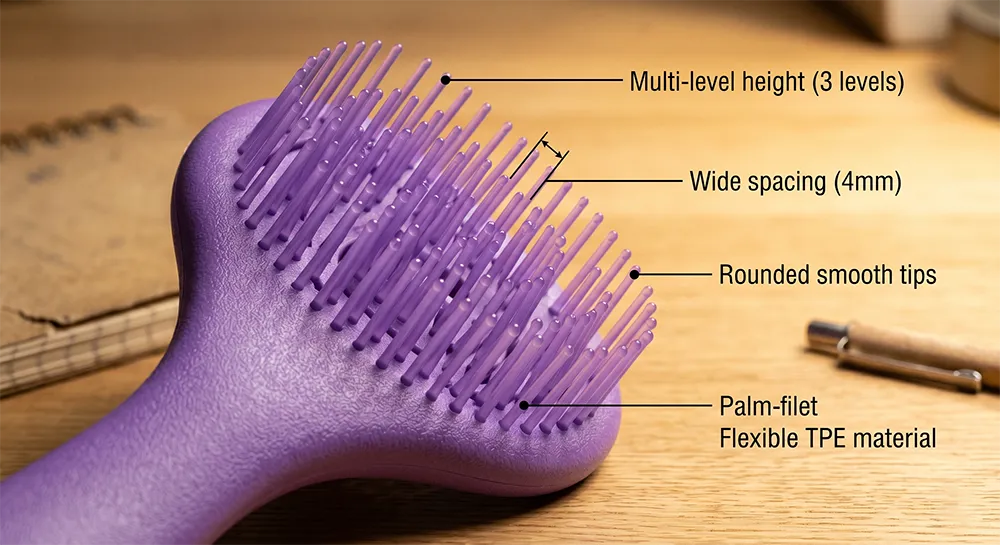
Detangling performance depends not only on bristle material but also on the spacing, height variation, and tip geometry of the bristles.
| Variable | Impact on Performance | Specification Range |
|---|---|---|
| Bristle spacing | Wider spacing reduces friction and allows easier passage through thick hair. Tighter spacing provides more contact points for finer hair. | 3–5 mm typical spacing |
| Height variation (multi-level) | Dual or triple-height bristle patterns allow shorter bristles to smooth while longer bristles penetrate deeper into the hair bundle. | 2–3 height levels, 2–4 mm difference between levels |
| Bristle diameter | Thinner bristles flex more easily. Thicker bristles provide more structural reach for dense hair. | 1.0–2.0 mm for TPE; 0.8–1.5 mm for nylon |
| Tip geometry | Rounded or ball-tipped ends prevent scalp scratching and hair snagging. Sharp or flat-cut tips create friction and can split hair. | Smooth rounded tips (machine-polished or mould-formed) |
| Total bristle count | Higher count provides more contact points and distributes force more evenly. Typical detangling brushes use 300–500 bristles. | 300–500 bristles per brush head |
For a deeper technical overview of bristle tip construction, see the article on epoxy resin bead tips on nylon bristles.
2. How Detangling Brushes Are Manufactured
Detangling brushes use a fundamentally different production method from traditional tufted brushes. Understanding this distinction helps buyers evaluate manufacturer capability and ask the right questions during supplier assessment.
Integrated Moulding (Standard Method)
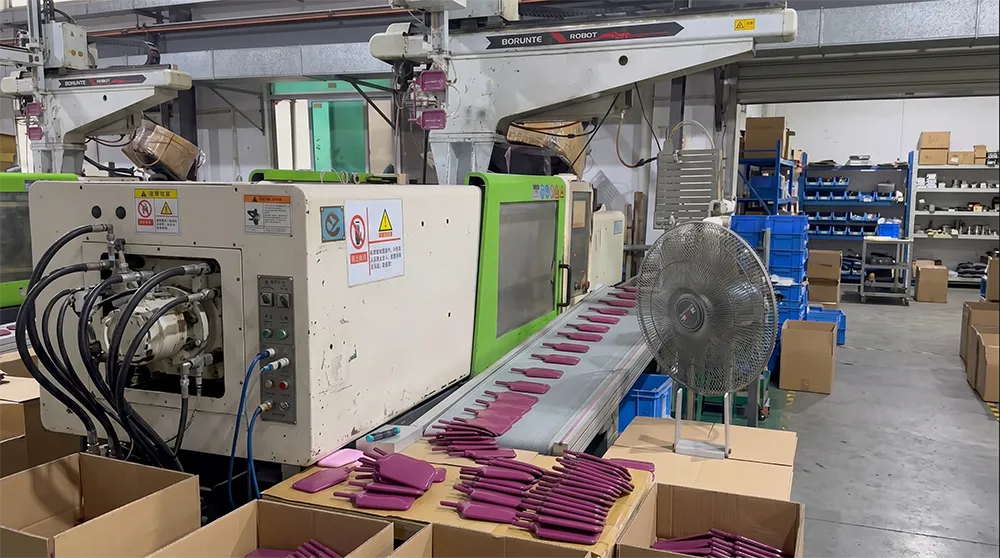
Most detangling brushes are produced through integrated injection moulding — the bristles and brush head are formed as a single piece in one mould cycle. Molten TPE or PP is injected into a precision mould that contains the negative impression of every bristle, producing a seamless one-piece brush head where bristles cannot be pulled out because they are structurally continuous with the base. This method is fast, consistent, and cost-effective at volume.
Two-Component (2K) Moulding
Premium detangling brushes may use two-component moulding, where two different materials are combined in a single production cycle. A typical application is a rigid ABS or PP handle and base combined with flexible TPE bristles. The two materials bond during the moulding process, producing a brush with structural rigidity in the handle and high flexibility in the bristles — without any adhesive or mechanical joining.
Overmoulded Handle Construction
Many detangling brushes feature a rubberised or soft-touch grip overmoulded onto a rigid plastic handle core. This requires a second moulding stage but significantly improves ergonomic comfort and wet-grip performance — a critical feature for brushes marketed for shower use.
The following table compares the main production methods:
| Method | Components | Bristle Bond | Tooling Cost | Best For |
|---|---|---|---|---|
| Single-shot integrated moulding | One material (TPE or PP) | Seamless — bristles are part of the base | Standard | Value and mid-range lines |
| Two-component (2K) moulding | Two materials (rigid base + flexible bristles) | Chemical bond during moulding | Higher | Premium lines requiring material differentiation |
| Tufted bristle insertion | Separate bristles inserted into cushion pad | Mechanical (wire staple or anchor) | Standard | Cushion-style detangling brushes (less common) |
3. Design and Customisation Options
A full-service detangling brush manufacturer offers customisation across multiple product dimensions. The following specifications should be defined during the product development stage.
Handle Design
- Traditional handle: Elongated grip similar to a standard hairbrush. Provides leverage and control, preferred for professional salon use and blow-dry styling.
- Handleless (palm-fit): Compact, ergonomic design that fits in the palm. Popular for wet detangling in the shower, children's brushes, and travel-size products.
- Hybrid (short handle): A shortened handle that combines the grip of a traditional design with the compactness of a palm-fit model. Increasingly common in DTC product lines.
Surface Treatment and Colour
- Solid colour injection (colour mixed into raw material — most durable, no surface coating to wear off)
- Spray painting (solid, gradient, or metallic effects)
- Soft-touch rubberised coating (premium tactile feel, improved wet grip)
- UV coating (high-gloss protective finish)
- Custom Pantone colour matching (standard at most established manufacturers)
Logo Application
- Pad printing (full-colour, cost-effective, moderate durability)
- Hot stamping (metallic foil effect, high visual impact)
- Laser engraving (permanent, premium appearance, best on darker materials)
- Embossed mould mark (subtle, permanent, built into tooling — no per-unit logo cost)
4. Quality Control for Detangling Brushes
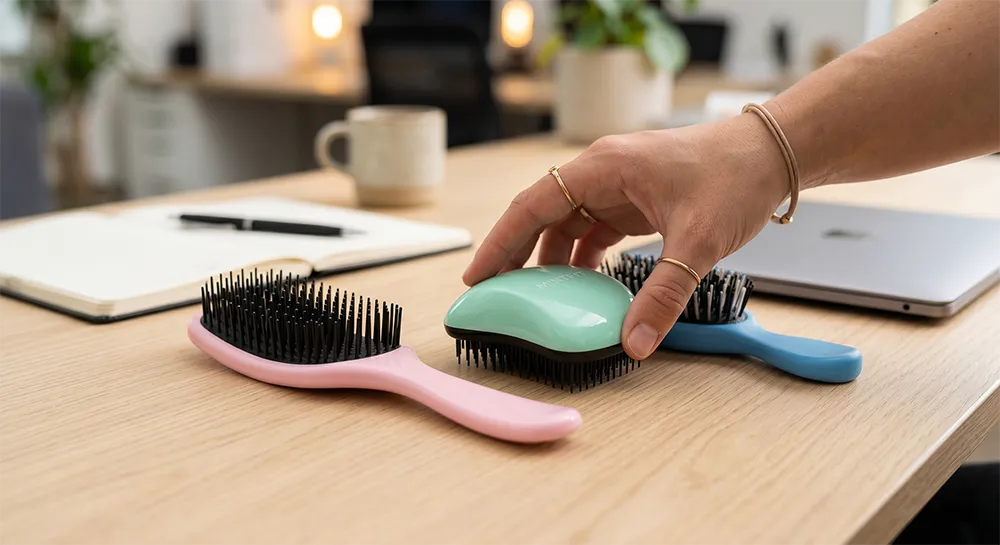
Detangling brushes have specific quality failure modes that differ from traditional brush types. A manufacturer's QC process should address each of these explicitly.
Critical Inspection Points
- Bristle flexibility consistency: Every bristle on the brush head should flex at the same rate. Inconsistent flexibility — caused by uneven mould filling or material temperature variation — results in some bristles pulling while others flex, negating the detangling benefit.
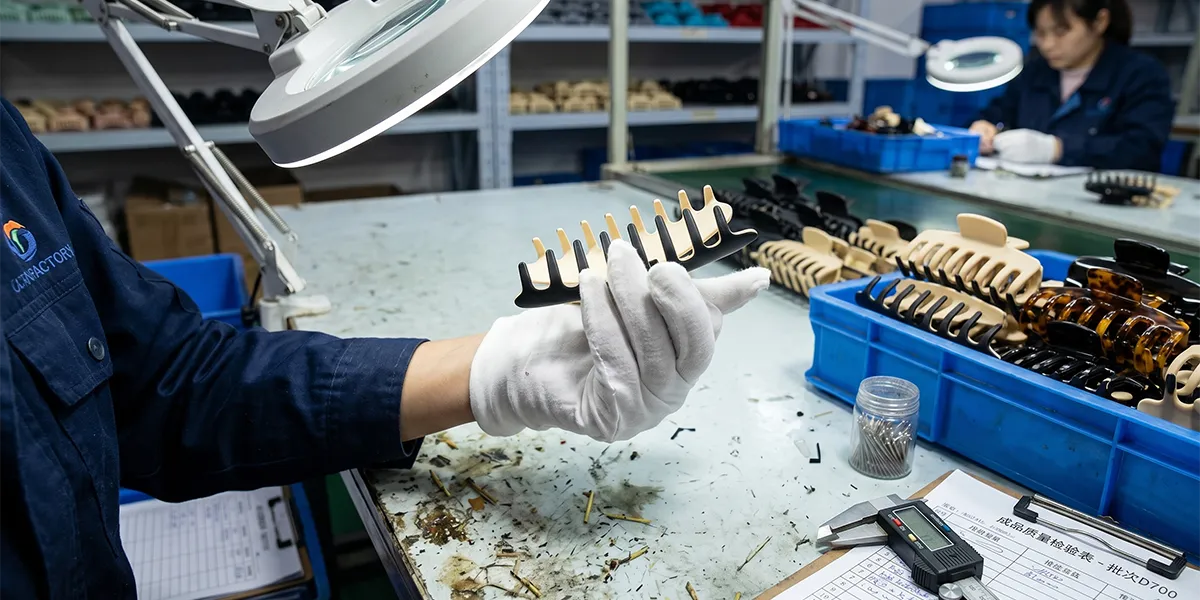
- Tip smoothness: Rough, sharp, or flat-cut bristle tips cause scalp scratching and hair snagging. Tips should be inspected under magnification. Mould quality directly determines tip finish — worn moulds produce progressively rougher tips.
- Bristle retention (for tufted styles): If the design uses inserted rather than integrated bristles, pull-force testing verifies that bristles cannot be extracted under normal use conditions.
- Handle grip under wet conditions: For brushes marketed for wet or shower use, the handle must maintain secure grip when wet and soapy. Rubberised or textured surfaces should be tested under simulated wet conditions.
- Colour consistency across batches: Solid-colour injection is the most reliable method. Spray-painted finishes require batch-to-batch colour matching against approved master samples.
Certifications
International buyers should verify the following certifications during supplier evaluation:
| Certification | Scope | Required By |
|---|---|---|
| ISO 9001:2015 | Quality management system | Most international retail buyers |
| amfori BSCI | Social compliance (labour, safety) | European and UK retailers |
| BRCGS Consumer Products | Retail supply chain safety | UK retail chains |
| GRS 4.0 | Recycled material content | Brands making recycled-content claims |
| FSC | Sustainably sourced wood (for wooden handle variants) | Eco-positioned brands |
For a detailed overview of quality control processes, see the quality control documentation.
5. Production Process and Lead Times
| Stage | Description | Duration |
|---|---|---|
| 1. Specification and quotation | Bristle material, flexibility level, handle design, colour, logo method, and packaging confirmed. | 3–5 days |
| 2. Mould selection or development | Existing mould selected from library, or new mould developed via CNC machining and testing. | 0 days (existing) / 30–45 days (new) |
| 3. Sample production | Pre-production samples manufactured. Includes bristle flex testing, tip smoothness inspection, handle grip verification, and logo/colour approval. | 5–7 days |
| 4. Bulk production | Injection moulding → surface treatment → logo application → QC inspection → packaging. | 25–40 days |
| 5. Packing and shipment | Individual packaging, carton preparation, export documentation. | 3–5 days |
Total lead time from enquiry to shipment is typically 6–8 weeks for existing mould orders and 10–14 weeks for custom tooling. For the sampling process in detail, see the samples and prototypes overview.
6. How to Evaluate a Detangling Brush Manufacturer
Detangling brushes require specific manufacturing capability that not all general hair brush factories possess. The following criteria help identify manufacturers with genuine expertise in this category.
- Integrated moulding capability: The manufacturer should operate injection moulding machines configured for TPE and multi-material (2K) processing. Factories that only offer tufted bristle insertion are not equipped for modern detangling brush production.
- Bristle flexibility control: Ask the manufacturer how they specify and test bristle flexibility. A capable manufacturer will reference TPE shore hardness ratings (typically 40A–60A for detangling bristles) and demonstrate batch-to-batch consistency testing.
- Mould library for detangling designs: Manufacturers with existing detangling brush moulds enable faster market entry. Key mould variants include handleless palm-fit, traditional handle, vented-base, and compact travel-size designs.
- Multi-category production: Brands building a broader hair tools line benefit from manufacturers that produce detangling brushes alongside paddle brushes, round brushes, and combs under one roof. Single-source consolidation simplifies logistics and quality management. For the full range of brush categories, see the guide on types of hair brushes.
- Wet-use testing infrastructure: Since many detangling brushes are marketed for wet hair use, the manufacturer should test handle grip, bristle performance, and material integrity under simulated wet conditions — not just dry bench testing.
- Packaging and fulfilment capability: In-house packaging — including custom box printing, blister packing, polybag preparation, and Amazon FBA labelling — reduces lead time and coordination complexity.
7. Conclusion
Custom detangling brushes are engineered products where bristle material, flexibility specification, tip geometry, and moulding method directly determine whether the end product prevents breakage or causes it. The difference between a well-specified detangling brush and a generic alternative is not visible in product photographs — it is felt by the consumer on the first use, and reflected in reviews and return rates within weeks of launch.
For brand owners evaluating manufacturers, the critical questions centre on bristle technology: what material is used, what flexibility range is achievable, how is consistency controlled across production batches, and whether the factory operates integrated moulding rather than basic bristle tufting. These technical capabilities separate manufacturers that produce genuine detangling brushes from those that simply relabel standard brushes with flexible-sounding marketing.
Manufacturers such as JunYi Beauty, operated by Dongguan JunYi Beauty Technology Co., Ltd., produce custom detangling brushes using integrated TPE and nylon moulding with multi-level bristle configurations, supported by ISO 9001, BSCI, BRCGS, GRS 4.0, and FSC certifications. The company's mould library includes handleless, traditional, and vented detangling designs across multiple sizes. For the full range of available models, see the detangling brush product catalogue. For shipping and logistics options, see the shipping service overview.