A hair clip is a fastening accessory designed to hold, section or style hair in place without the use of elastics or adhesive. Available in dozens of forms — from the simple bobby pin to the oversized jaw clip — hair clips differ significantly in their construction, material, holding strength and intended use. Understanding these differences is relevant not only for end users but also for brands, salon buyers and sourcing professionals looking to select or commission the right product.
This guide covers the main types of hair clips in detail, including a breakdown of materials, a comparison of functional characteristics and guidance on how different clip categories serve different market segments. For brands exploring the hair clips collection or developing a private label line, this overview provides a practical starting point for product selection and specification.
1. Overview: The Main Categories of Hair Clips
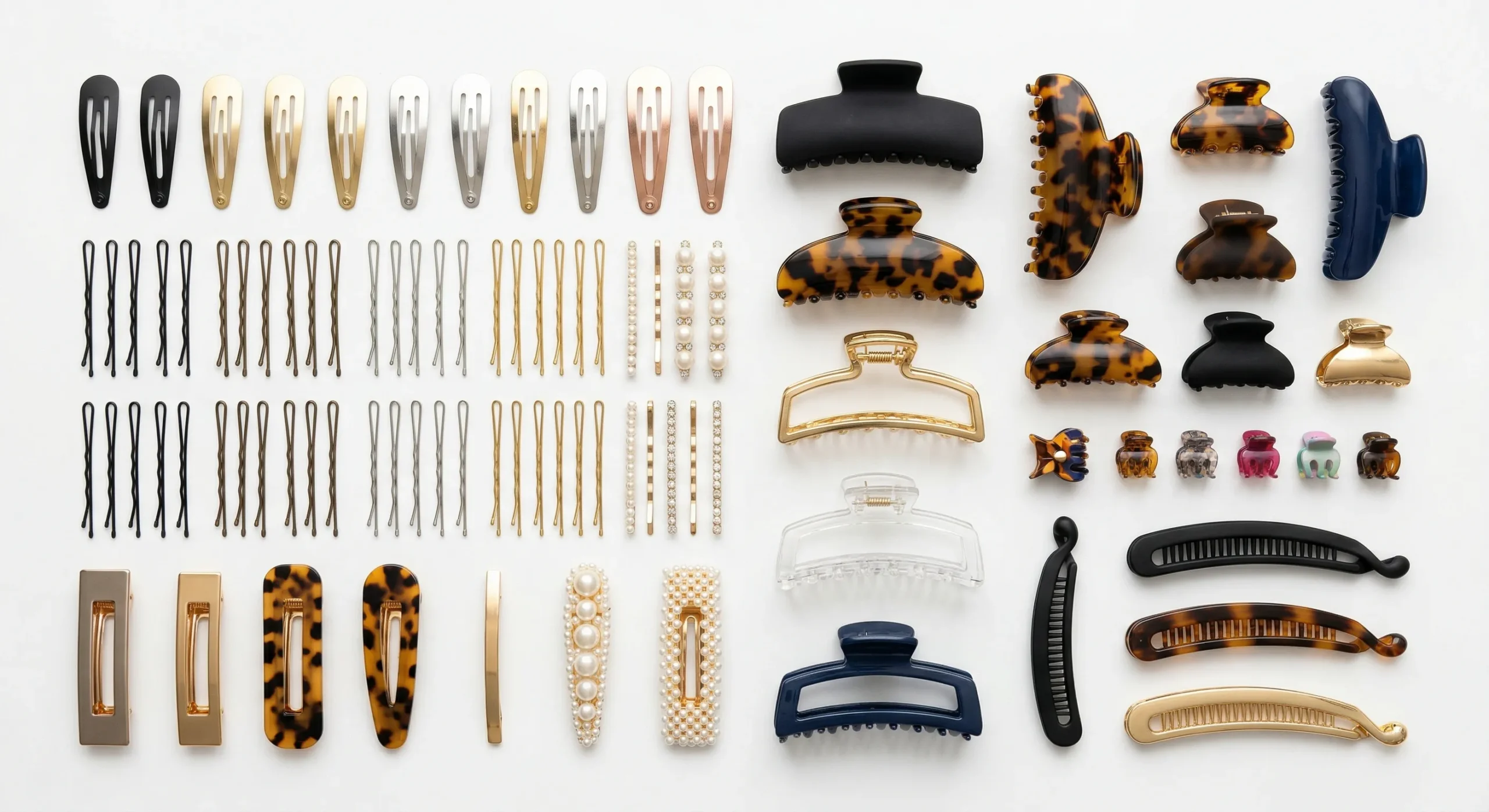
Hair clips can be broadly divided into two functional groups: securing clips, which hold finished styles in place, and sectioning clips, which are used during styling to separate and manage hair. Within these groups, there are at least six widely recognised clip types, each with distinct mechanical designs and typical use contexts.
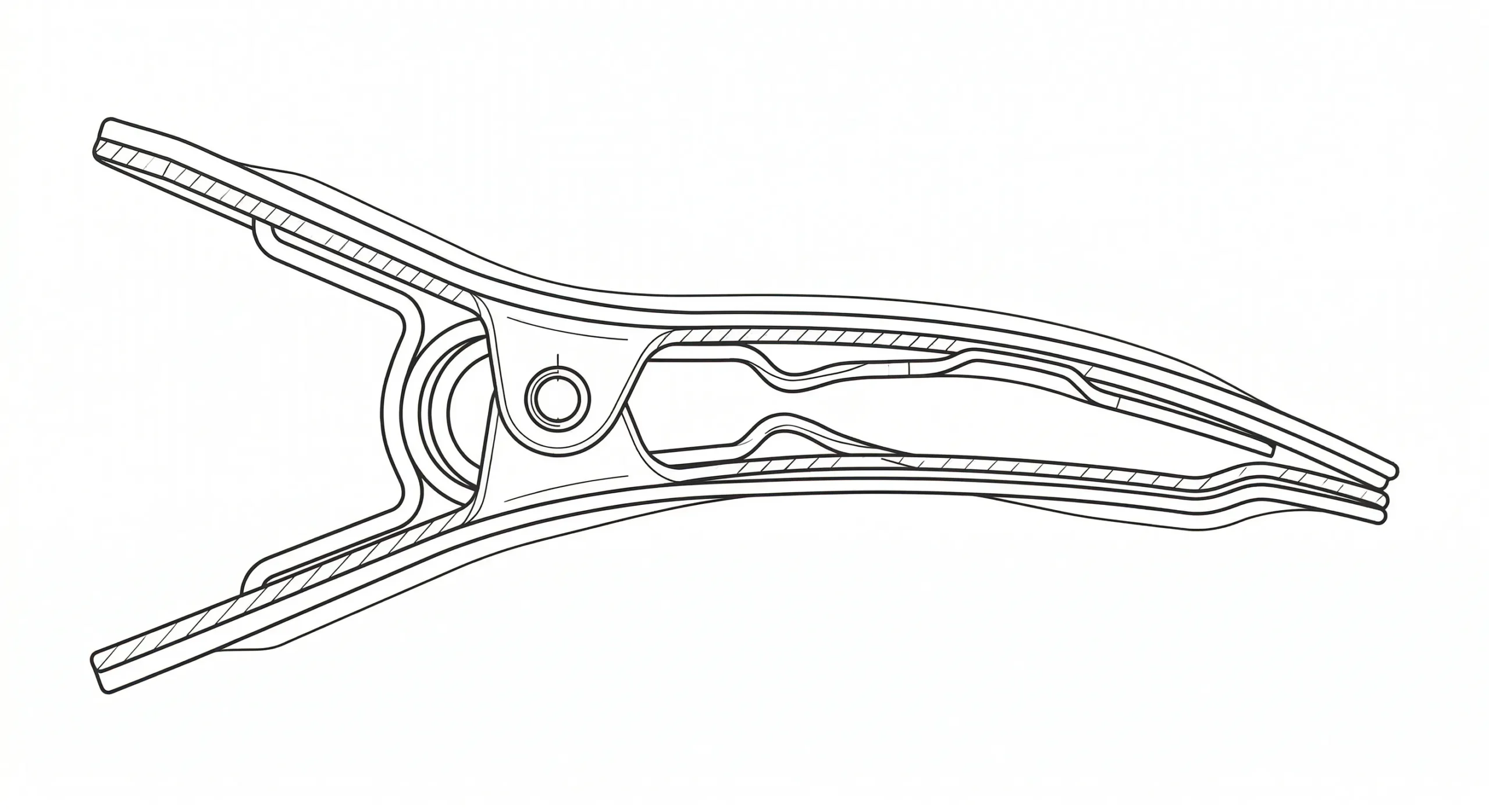
- Snap clips (alligator clips): Spring-loaded clips that open and close, used for sectioning or holding small amounts of hair.
- Bobby pins: Thin, two-pronged metal pins that slide into hair to secure strands close to the scalp.
- Barrettes: Decorative clips with a hinged clasp, used to hold larger sections of hair in a styled position.
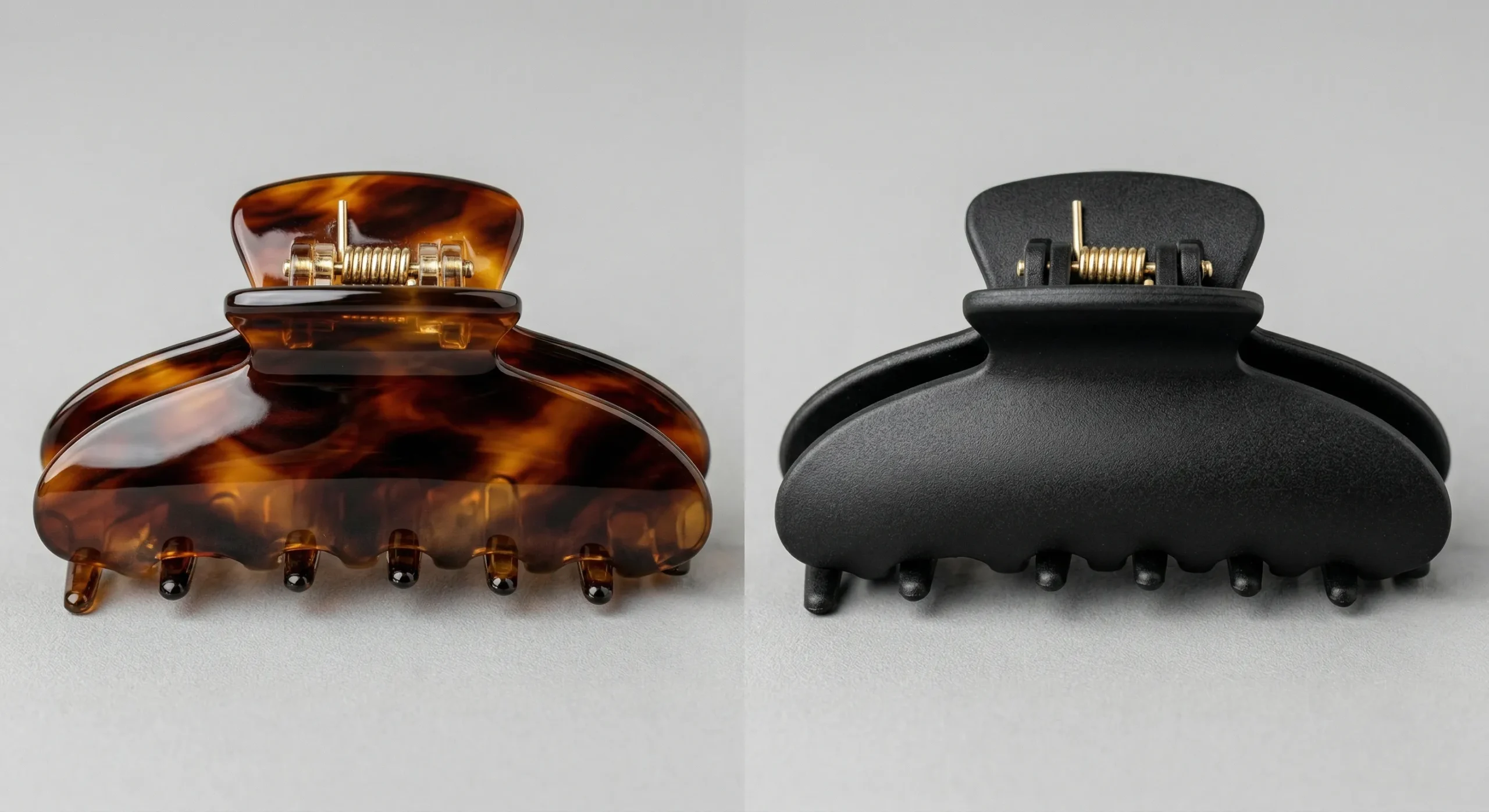
- Jaw clips (claw clips): Multi-pronged clips with a spring mechanism, designed to hold large volumes of hair in a loose updo.
- Banana clips: Elongated, curved clips that hold a gathered ponytail or bun along the length of the hair.
- French barrettes: A sliding-lock design commonly used in children's accessories and lightweight styling applications.
Each type is manufactured using different tooling, materials and assembly processes — a factor that directly affects minimum order quantities, unit cost and customisation options for wholesale buyers.
2. Hair Clip Types at a Glance: Comparison Table
The following table summarises the key characteristics of the six main hair clip types to support product selection and sourcing decisions.
| Clip Type | Common Materials | Hair Volume | Primary Use | Typical Market |
|---|---|---|---|---|
| Snap clip (alligator) | Steel, coated metal, ABS | Thin to medium | Sectioning, styling tool | Salon professional |
| Bobby pin | Steel, brass, coated metal | Very thin | Securing strands close to scalp | Mass market, retail |
| Barrette | Acetate, ABS plastic, metal | Medium to thick | Decorative styling, half-up looks | Retail, fashion, private label |
| Jaw clip (claw clip) | Acetate, ABS, nylon | Medium to very thick | Casual updo, quick hold | Retail, salon, e-commerce |
| Banana clip | ABS plastic, flexible nylon | Thick, voluminous | Ponytail, gathered updo | Retail, fashion |
| French barrette | Metal frame, ABS slide | Thin to medium | Decorative securing | Children's, fashion retail |
3. Hair Clip Materials: What Each Type Is Made From
The material used in a hair clip determines its weight, finish, durability, environmental profile and manufacturing cost. The three most commonly used materials in commercial hair clip production are cellulose acetate, ABS plastic and metal.
Cellulose Acetate
Cellulose acetate is a plant-derived thermoplastic produced from wood pulp or cotton fibres, making it a semi-natural material with bio-based origins. In hair accessories, acetate is valued for its dense, glass-like appearance, natural translucency and the rich, layered colour effects it produces. Clips made from acetate tend to be heavier and more rigid than those made from ABS, and carry a noticeably more premium feel. This makes acetate the preferred material for higher-margin retail lines and fashion-forward private label collections. For a detailed look at acetate applications in hair accessories, see the full range of hair claws and jaw clips produced in this material.
ABS Plastic
ABS (acrylonitrile butadiene styrene) is the most widely used material in mass-market hair clip production. It is lightweight, impact-resistant and available in a broad range of surface finishes — from high gloss to matte. ABS is injection-moulded at relatively low tooling costs, making it suitable for high-volume production runs and price-sensitive retail markets. For a technical side-by-side of the two materials, see cellulose acetate vs ABS plastic. Most hair clips available in mass-market retail and dollar-store channels are produced in ABS.
Metal (Steel and Zinc Alloy)
Metal is the primary material for bobby pins, snap clips and the internal spring mechanisms of jaw clips and barrettes. Steel offers high strength and flexibility for spring components, while zinc alloy is used for cast decorative elements. Metal clips are often coated — with enamel, epoxy, gold plate or matte lacquer — to improve aesthetics and resistance to corrosion.
4. Detailed Breakdown: Each Hair Clip Type Explained
Snap Clips and Alligator Clips
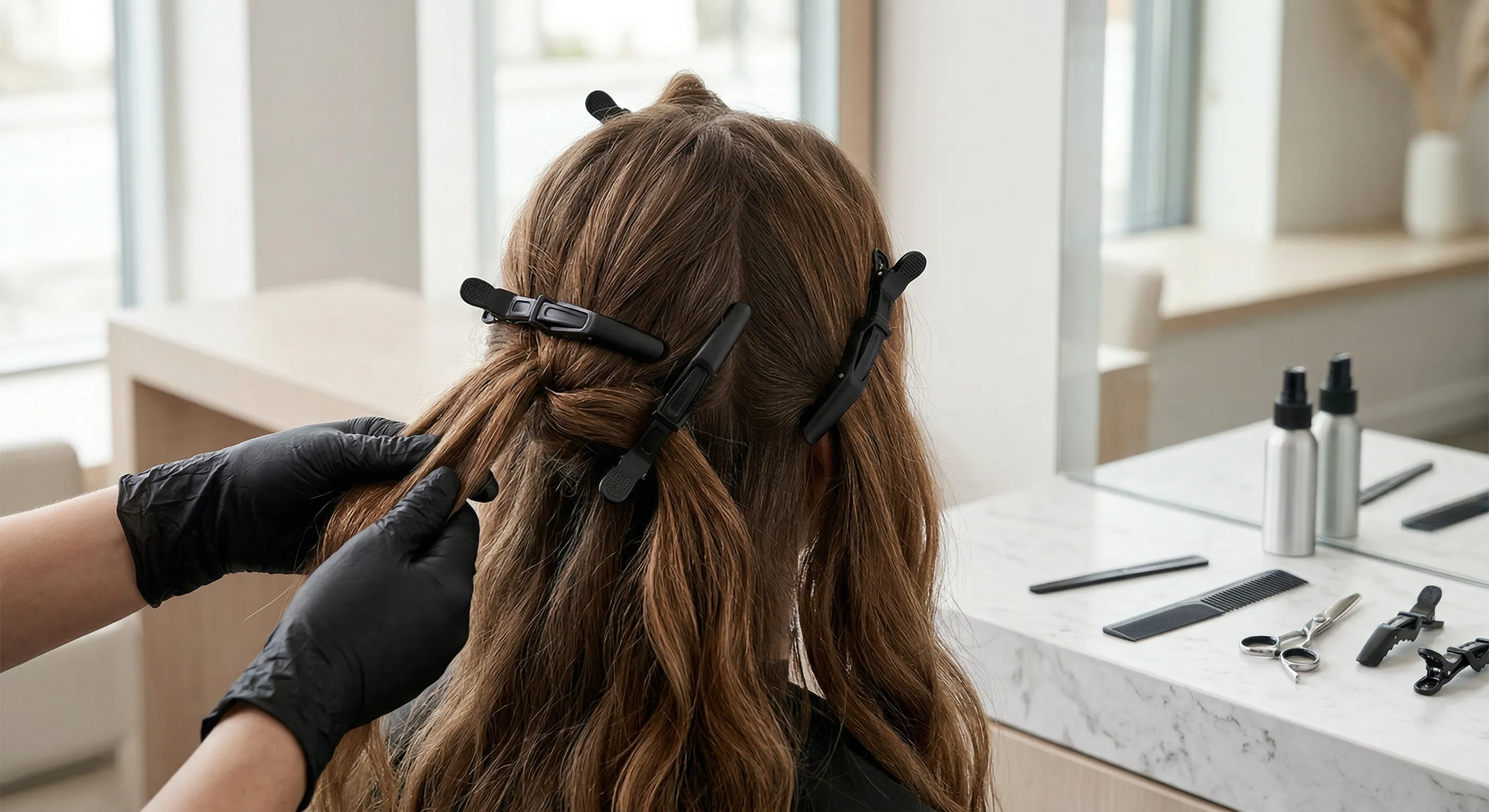
Snap clips use a steel spring to create an open-and-close mechanism. When squeezed, the top jaw rises; when released, it clamps shut. Alligator clips — named for their serrated, toothed edges — are the standard tool used by hairdressers to section off hair during cutting and colouring. They are produced in sizes from 4 cm (for fine sections near the hairline) to 12 cm (large sectioning clips). In professional salon supply channels, snap clips are typically sold in packs of 12 or more and are not considered fashion accessories.
Bobby Pins
Bobby pins consist of two parallel metal prongs joined at one end, with a slight wave in the lower prong to increase grip against hair. The quality of a bobby pin varies considerably based on metal gauge, coating quality and tip finish. Higher-quality bobby pins use rust-resistant coatings and have smooth, rounded tips that do not snag or break hair. Bobby pins are produced in standard sizes (approximately 5–7 cm) and in a range of finishes to match different hair colours.
Barrettes
A barrette consists of a decorative top element and a hinged clasp mechanism on the underside. When the clasp is opened, a section of hair is placed over the bar; when closed, the clasp locks the hair in position. Barrettes are available from small accent pieces (4 cm) to oversized statement styles (12 cm or more). The decorative top can be made from acetate, metal, resin or fabric-covered plastic. Barrettes represent one of the highest-design categories within hair clips and are particularly relevant for fashion retail and private label collections.
Jaw Clips (Claw Clips)
Jaw clips use a spring-loaded mechanism to drive a set of interlocking teeth together, allowing a large bundle of hair to be gathered and held with a single motion. They are produced in sizes from approximately 5 cm (mini claw) to 12 cm or more (for thick or long hair). Holding strength depends on the number of teeth, their interlocking precision and the spring tension. Cellulose acetate is the most sought-after material for premium jaw clips due to its weight, rigidity and visual appeal. For a consumer-focused guide on selecting claw clips that minimise hair breakage, see our article on what claw clips don't damage hair.
Banana Clips
A banana clip is a long, curved clip with teeth on both sides of a central spine. When closed, the two rows of teeth interlock to grip the hair along the full length of the clip, distributing hold across a wide area — particularly effective for thick, voluminous hair. They are typically produced in ABS plastic or flexible nylon, as some degree of flex is required for the teeth to engage reliably.
5. Application Scenarios: Where Each Clip Type Is Used
Professional Salon Use
In salon environments, functionality and durability take priority over aesthetics. Snap clips and alligator clips dominate this segment, used primarily for sectioning during cutting and colouring. They are purchased in bulk, expected to withstand repeated use, and are not typically branded decoratively. Steel construction with a rubber grip is the standard specification.
Everyday Consumer Use
For daily personal use, jaw clips and barrettes are the most widely purchased types. Claw clips suit consumers who need a quick, easy updo without tools; barrettes appeal to those who want a polished or decorative finish. This is also the segment where material aesthetics — particularly the appeal of acetate — have the strongest influence on purchasing decisions.
Fashion and Private Label Retail
Acetate barrettes and oversized jaw clips have become significant fashion accessories, appearing in seasonal collections from both independent brands and major retailers. For brands developing a private label line, these categories offer the highest scope for visual differentiation through colour, pattern and form. The ability to specify custom acetate sheets or proprietary colour combinations is a key advantage of working directly with a factory that runs acetate hair clip manufacturing in-house, from sheet selection through to tooling.
E-commerce and Direct-to-Consumer
E-commerce platforms such as Amazon and Shopify have significantly expanded the market for hair clips at accessible price points. Jaw clips in particular have performed consistently well in this channel, with strong search volume and repeat purchase rates. For DTC brands, the ability to start with a low MOQ is critical, as it allows product testing before scaling inventory commitment.
6. How to Choose the Right Hair Clip Type for Your Brand
- Target customer hair type: Fine or thin hair requires clips with strong grip but minimal weight (bobby pins, small snap clips). Thick or coarse hair needs clips with sufficient holding force — oversized jaw clips or banana clips are better suited.
- Price positioning: Acetate clips carry a higher unit cost but support premium retail pricing. ABS clips are appropriate for value or mid-range positioning.
- Branding flexibility: Acetate allows for highly distinctive colour effects and custom patterns. ABS is more suitable when a wide range of finishes is needed at lower cost.
- Order volume: Custom acetate hair clips typically start from 300–500 pieces per SKU. Standard ABS clips generally have a higher MOQ threshold of 500–1,000 pieces per SKU, depending on the production run and finish requirements.
- Certification requirements: Brands supplying UK retail chains may require BRCGS compliance from their manufacturer. European buyers often require BSCI social audit documentation. Confirming these requirements early in the sourcing process avoids delays at the approval stage.
7. Wholesale and OEM Sourcing: Key Considerations for Buyers
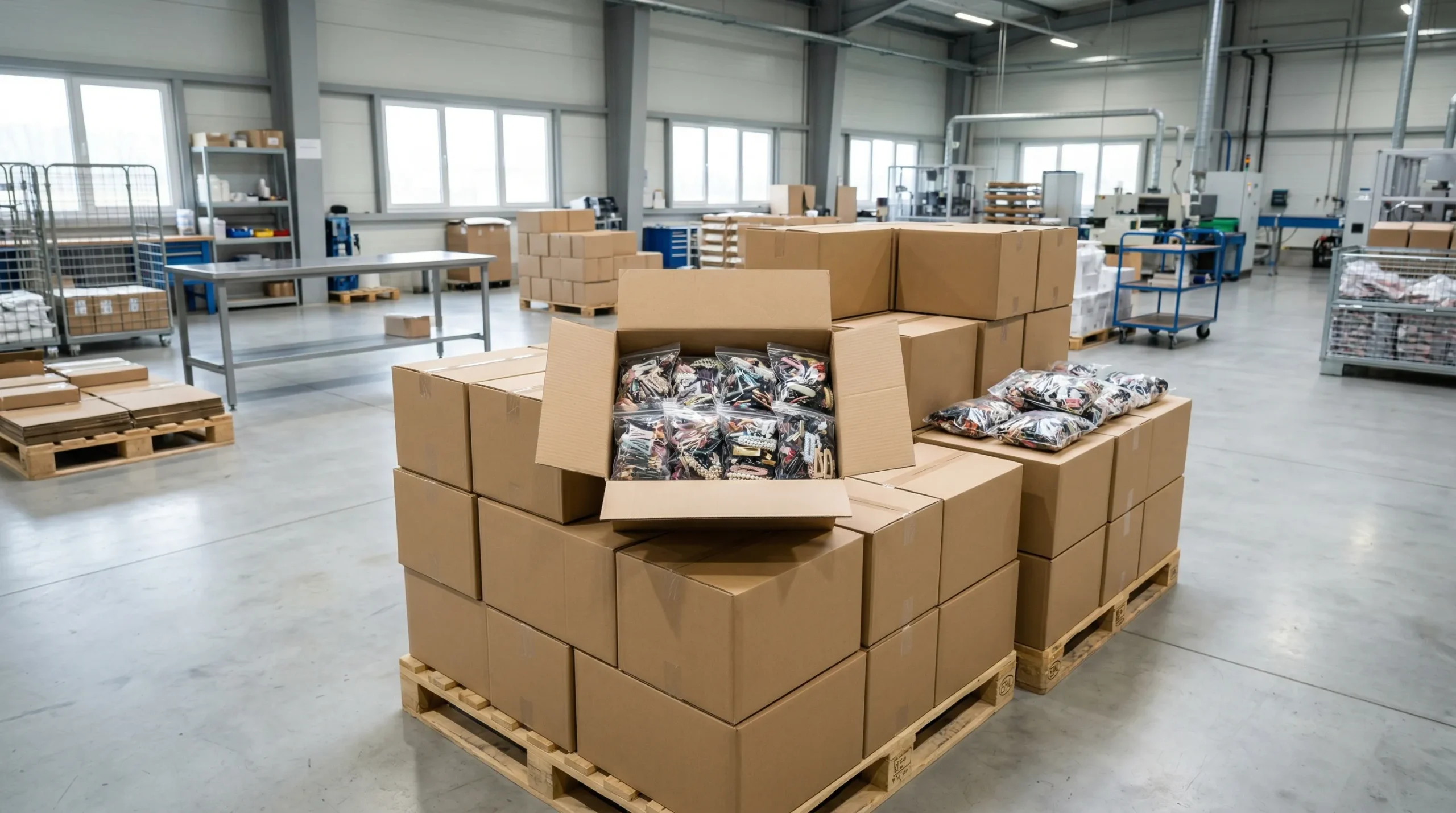
China remains the primary production base for hair clips at commercial volumes, with manufacturing clusters in Guangdong province particularly active in this product category. For a side-by-side comparison of verified manufacturers in this region, see our guide to the top 10 hair clip manufacturers in China. When evaluating a hair clip manufacturer for OEM or private label supply, buyers typically assess the following:
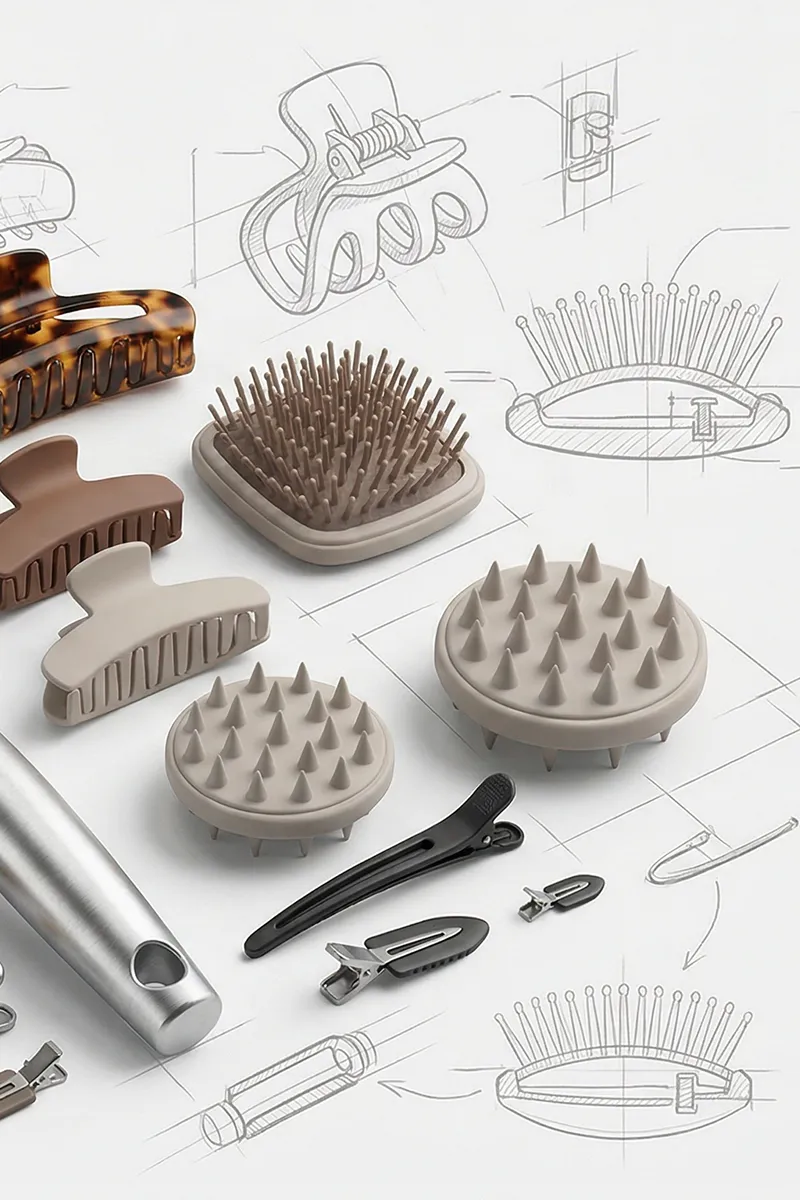
- Mold availability: Manufacturers with large existing mold libraries allow buyers to launch quickly without tooling investment. New tooling for a custom silhouette typically requires approximately 35 days from design confirmation to first sample.
- Sampling lead time: Pre-production sample turnaround is typically 5–7 days, allowing buyers to assess colour accuracy, finish quality and structural integrity before committing to a full order.
- Production lead time: Bulk production for confirmed orders generally takes 25–30 days, depending on order volume and complexity of the design. See the full lead time breakdown for custom hair accessories.
- Material sourcing: The quality and consistency of acetate sheet supply directly affects product colour accuracy across batches. Buyers should request material certificates and batch samples.
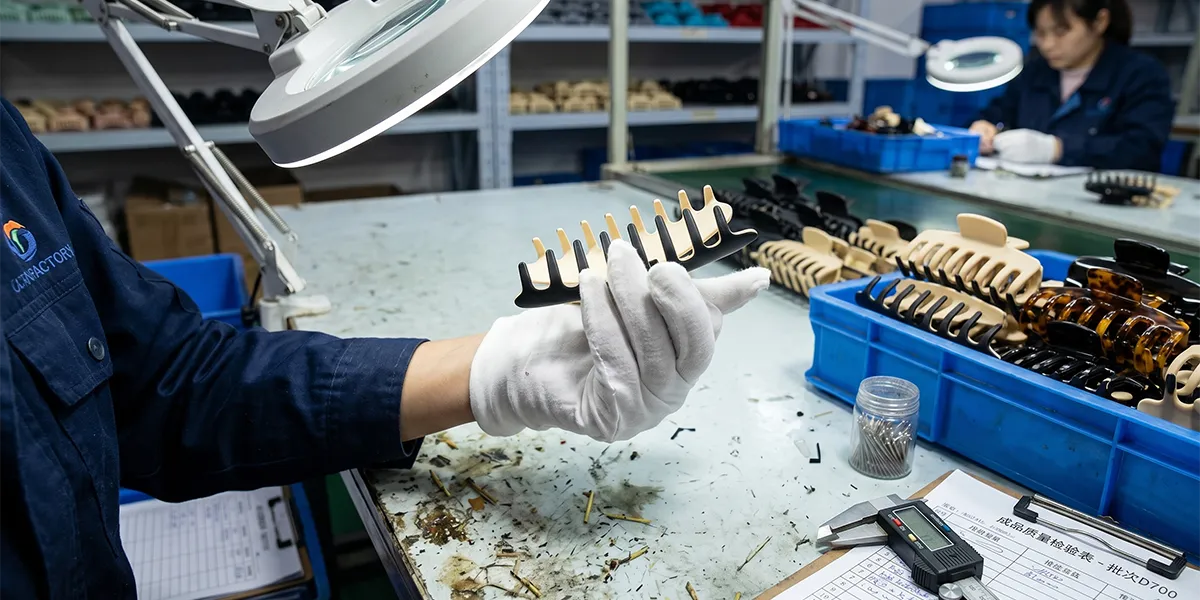
- Quality control infrastructure: Multi-stage inspection covering dimensional checks, surface finish assessment and spring mechanism testing is standard at established manufacturers.
- Certifications: ISO 9001, BSCI and GRS certifications are commonly required by European and UK retail buyers and serve as a baseline indicator of production governance.
- Packaging capability: Retail-ready packaging — including custom backing cards, polybag printing and labelling — handled in-house reduces lead time and coordination complexity.
8. Conclusion
Hair clips represent one of the most diverse product categories in hair accessories, spanning functional salon tools, everyday consumer items and fashion-forward retail products. The key differentiators — material, mechanism design, size and holding strength — determine which clip type is appropriate for a given application, customer hair type and price point.
For brands building a product range, the choice between acetate and ABS, and between different clip mechanisms, has direct implications for production cost, MOQ and the level of visual customisation available. Understanding these variables at the specification stage leads to more efficient sourcing and more coherent product positioning.
Manufacturers such as JunYi Beauty, operated by Dongguan JunYi Beauty Technology Co., Ltd., represent the type of integrated, factory-direct OEM partner suited for brands seeking to develop or scale a custom hair clip line — with in-house mold libraries, material sourcing capability and multi-certification compliance supporting production across the range of clip types discussed in this guide. For brands moving from selection to specification, our breakdown of what it costs to manufacture custom hair clips in China explains how tooling, material and finishing choices affect the unit price.