Hair clips, claw clips, brushes and combs are not covered by a single “hair accessory” safety standard. Instead, three sets of rules do most of the work for brands selling in Europe and the United States: the EU REACH Regulation, the US Consumer Product Safety Improvement Act (CPSIA) where a product is intended for children, and California’s Proposition 65. Each targets specific substances in specific materials, which is why compliance is planned material by material rather than product by product.
This guide explains which rules apply to which materials, the limits buyers most often test against, how to build a test plan without testing every SKU, and which documents to request from a manufacturer. It is written for brand owners and importers. It is not legal advice: regulations change, and the business placing a product on the market remains responsible for its compliance.
Scope and limits of this guide: The limits quoted below are summarised from the regulations named. Where a rule applies only under certain conditions — for example CPSIA testing to children’s products — the condition is stated. Confirm the final test plan with an accredited laboratory for the exact materials, colours and markets of your range.
1. Which Rules Apply Where
| Rule | Market | Applies to | What it controls |
|---|---|---|---|
| EU REACH, Regulation (EC) No 1907/2006 | European Union; Great Britain has a separate UK REACH with largely the same restrictions | All articles placed on the market, including hair accessories, brushes and combs | Restricted substances (Annex XVII) and substances of very high concern |
| General Product Safety Regulation (EU) 2023/988 | European Union | Consumer products in general | General safety, traceability, an EU responsible person and product information |
| CPSIA | United States | Children’s products designed or intended primarily for children aged 12 or under | Lead limits, phthalates in toys and child care articles, third-party testing, certificates and tracking labels |
| California Proposition 65 | California, and in practice much of US retail | Consumer products sold in California | Warnings for exposure to listed chemicals such as lead, cadmium and DEHP |
2. EU REACH: The Restrictions That Matter for Hair Tools
REACH affects hair accessories in two ways: fixed limits on restricted substances listed in Annex XVII, and information duties for substances of very high concern.
Restricted substances (Annex XVII)
| Substance | Limit | Where it matters in hair tools |
|---|---|---|
| Nickel (entry 27) | Release of no more than 0.5 µg/cm² per week from parts in direct and prolonged skin contact, tested to EN 1811 | Metal clips, pins, springs and plated decorations |
| Cadmium (entry 23) | 0.01% by weight in listed plastics and in metal parts of jewellery | Pigmented plastics, metal alloys and brazed parts |
| Lead (entry 63) | 0.05% by weight in articles or accessible parts that children may place in the mouth, with limited exemptions | Children’s hair accessories, painted and metal parts |
| Phthalates DEHP, DBP, BBP and DIBP (entry 51) | 0.1% by weight, individually or combined, in plasticised material | Soft PVC grips, pouches and flexible parts |
| PAHs (entry 50) | 1 mg/kg for each of eight PAHs in rubber or plastic parts in direct and prolonged, or short-term repetitive, skin contact | Rubber brush cushions, soft-touch handles and black plastics |
| Azo dyes (entry 43) | 30 mg/kg for listed aromatic amines in textiles and leather in prolonged skin contact | Fabric scrunchies, bows and headbands |
Substances of very high concern (SVHC)
If an article contains a substance on the ECHA Candidate List above 0.1% by weight, the supplier must give recipients enough information to allow safe use — at minimum the name of the substance — under Article 33, and must answer a consumer’s request for that information within 45 days. Suppliers of such articles in the EU also have to notify them to ECHA’s SCIP database. The Candidate List is updated regularly, so a test report or supplier declaration should state which version of the list it covers.
General Product Safety Regulation
Since 13 December 2024, the General Product Safety Regulation has required consumer products sold in the EU to carry traceability information — a type, batch or serial number and the manufacturer’s contact details — and to have an economic operator established in the EU who is responsible for the product. For hair accessories this mainly affects labelling and packaging, which is far easier to plan before production than after it.
3. US CPSIA: For Children’s Products — But Check the Definition
CPSIA’s testing and certification requirements apply to children’s products: products designed or intended primarily for children aged 12 or under. Whether a hair accessory counts depends on how it is designed, packaged, marketed and sold — small sizes, cartoon prints, glitter and children’s packaging all point that way. A plain acetate claw clip sold to adults is normally a general-use product.
If the product is a children’s product
- Lead content: no more than 100 ppm total lead in any accessible part.
- Lead in paint and surface coatings: no more than 90 ppm.
- Phthalates: eight phthalates are limited to 0.1% each, but this limit applies to children’s toys and child care articles — so it applies to a hair accessory only if it is also a toy.
- Third-party testing: by a laboratory accepted by the CPSC for the relevant test.
- Children’s Product Certificate (CPC): issued by the importer or domestic manufacturer on the basis of those test results.
- Tracking labels: permanent marks on the product and its packaging identifying the manufacturer, production date and batch.
If the product is for general use
A General Certificate of Conformity (GCC) is required only where a CPSC rule, ban, standard or regulation applies to the product. Many adult hair brushes and combs are covered by none, but large retailers commonly set their own testing requirements that go beyond the legal minimum, so buyers should check the retailer’s requirements before production starts.
4. California Proposition 65: Warnings, Not Bans
Proposition 65 does not ban substances. It requires a clear and reasonable warning when a product exposes consumers in California to a listed chemical above the level that triggers a warning, and businesses with fewer than ten employees are exempt. The list contains more than 900 chemicals. Those that come up most often for hair tools are lead and cadmium in metals, pigments and coatings, DEHP and other phthalates in PVC, and bisphenol A in some hard plastics.
Because enforcement is often brought by private enforcers rather than a regulator, many brands and retailers prefer to meet agreed content limits rather than rely on a warning label. A buyer selling across the United States should decide early whether the range will carry Proposition 65 warnings or be specified to avoid needing them, because that decision changes which materials and coatings are acceptable.
5. Material by Material: What to Test
| Material | Typical checks | Why |
|---|---|---|
| Cellulose acetate | Phthalates; heavy metals in colorants | Plasticisers and pigments are what vary between sheets |
| ABS and PP plastics | Cadmium and lead in pigments; PAHs in black and recycled grades | Colour masterbatch is a common source of heavy metals |
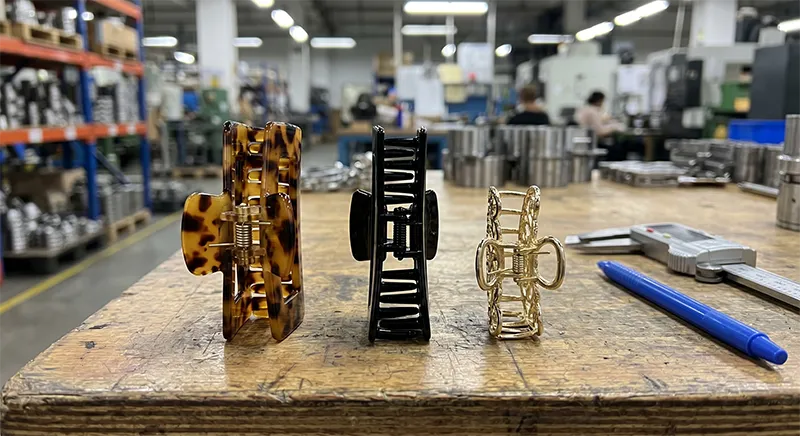
| Zinc alloy and steel parts | Nickel release (EN 1811); lead and cadmium in the alloy and plating | Springs, pins and decorations can stay in skin contact for long periods |
| Rubber and soft-touch parts | PAHs; phthalates if the part is PVC | Brush cushions and grips are in repeated skin contact |
| Wood and bamboo | Heavy metals in paints and lacquers; formaldehyde from adhesives in laminated bamboo | Coatings and glues, rather than the wood itself, carry most of the risk |
| Fabric (scrunchies, bows) | Azo dyes; formaldehyde; nickel on metal findings | Dyes, finishing chemicals and metal trims |
FSC and GRS certificates confirm where wood or recycled content comes from. They are not chemical safety certificates and do not replace REACH or CPSIA testing. For how acetate parts are made and where plasticisers and colour enter the process, see how cellulose acetate hair clips are manufactured.
6. Building a Test Plan Without Testing Every SKU
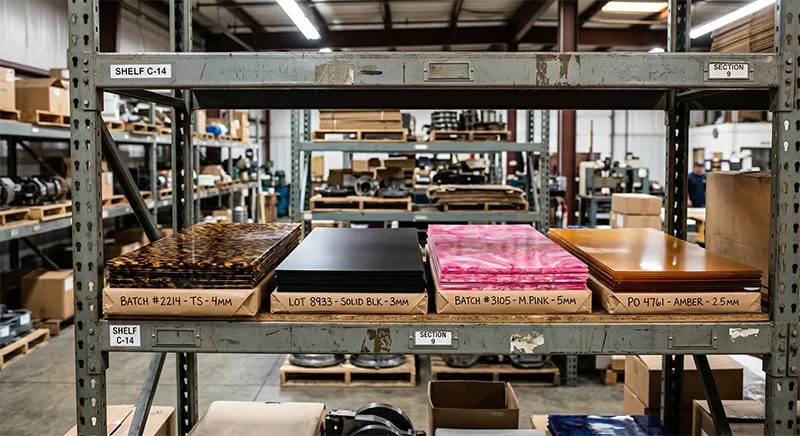
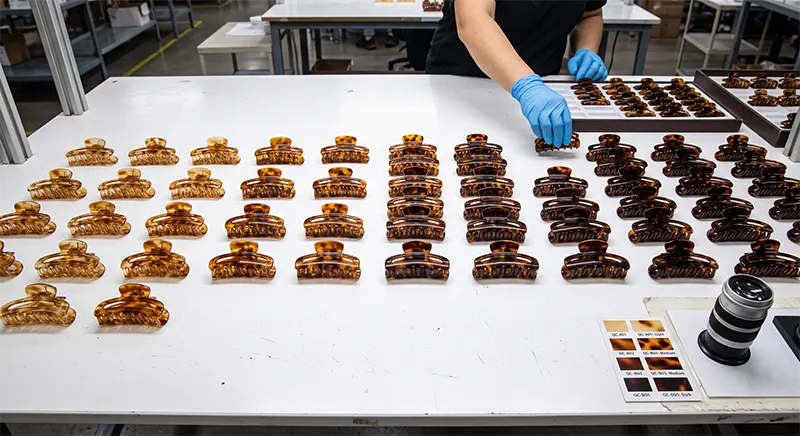
Laboratories test materials, not product names. A range of twelve claw clip styles made from the same three acetate colours and one spring type can often be covered by testing those four materials rather than twelve finished products. A practical plan looks like this:
- Decide markets and product status first. EU, US or both; children’s product or general use. This decides which limits apply.
- List every material and colour. Base material, colour, coating, metal part, adhesive and packaging component each count separately.
- Group identical materials. The same acetate sheet in the same colour used across several styles can usually share one result — agree the grouping with the laboratory before testing.
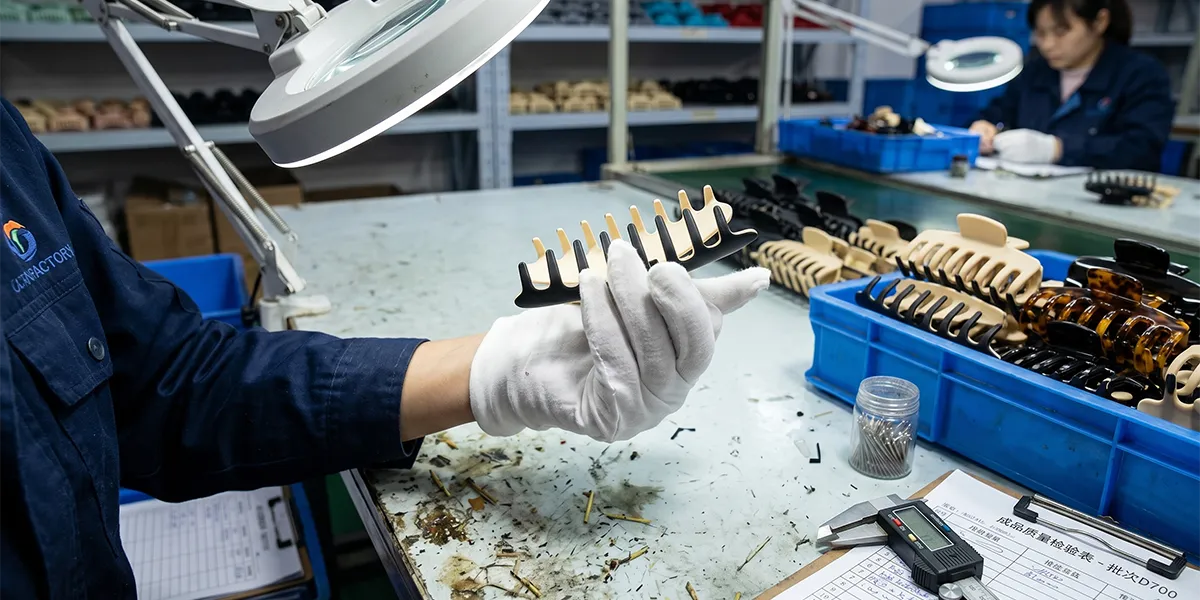
- Test pre-production materials, then check bulk. Testing approved samples catches problems before tooling is committed; a check on bulk production confirms the same material batches were used.
- Tie the paperwork to batches. Reports should name the material, colour and batch they cover, so they still mean something when the product is reordered.
Laboratories commonly used for consumer goods include SGS, Intertek, TÜV Rheinland and Bureau Veritas. For US children’s products the laboratory must be CPSC-accepted for the specific test being run.
7. Documents to Request from Your Manufacturer
| Document | What it shows | Who issues it |
|---|---|---|
| Material test reports | Results for restricted substances on named materials, colours and batches | An accredited laboratory, commissioned by the factory or the buyer |
| SVHC declaration | Whether any Candidate List substance exceeds 0.1% by weight | The manufacturer or its material suppliers |
| Children’s Product Certificate or GCC (US) | Certification that the product meets the applicable CPSC requirements | The US importer, based on test reports |
| Material and batch records | Which material batches went into which production lot | The manufacturer |
| Factory certificates | Quality, social compliance and product safety management at the production site (for example ISO 9001, amfori BSCI, BRCGS) | Certification bodies |
| Inspection reports | Whether bulk production matches the approved sample and specification | Factory QC and third-party inspectors |
For where testing and inspection fit into the production timeline, see the lead time guide for custom hair accessories.
8. Who Is Responsible: the Factory or the Brand?
Legally, responsibility sits with the business that places the product on the market. In the EU, obligations fall on the manufacturer and, for products made outside the EU, on the importer and the EU responsible person. In the United States, the Consumer Product Safety Act treats the importer as the manufacturer. A factory cannot take over that responsibility, but it decides the materials and processes that determine whether a product passes.
The practical split is therefore: the brand defines the markets, the product’s status and the test plan; the factory supplies traceable materials, supports testing and keeps bulk production consistent with the tested samples. When the supplier is an intermediary rather than the producer, it matters to know which factory made each part — see how to tell a factory from a trading company.
9. How JunYi Beauty Supports Compliance
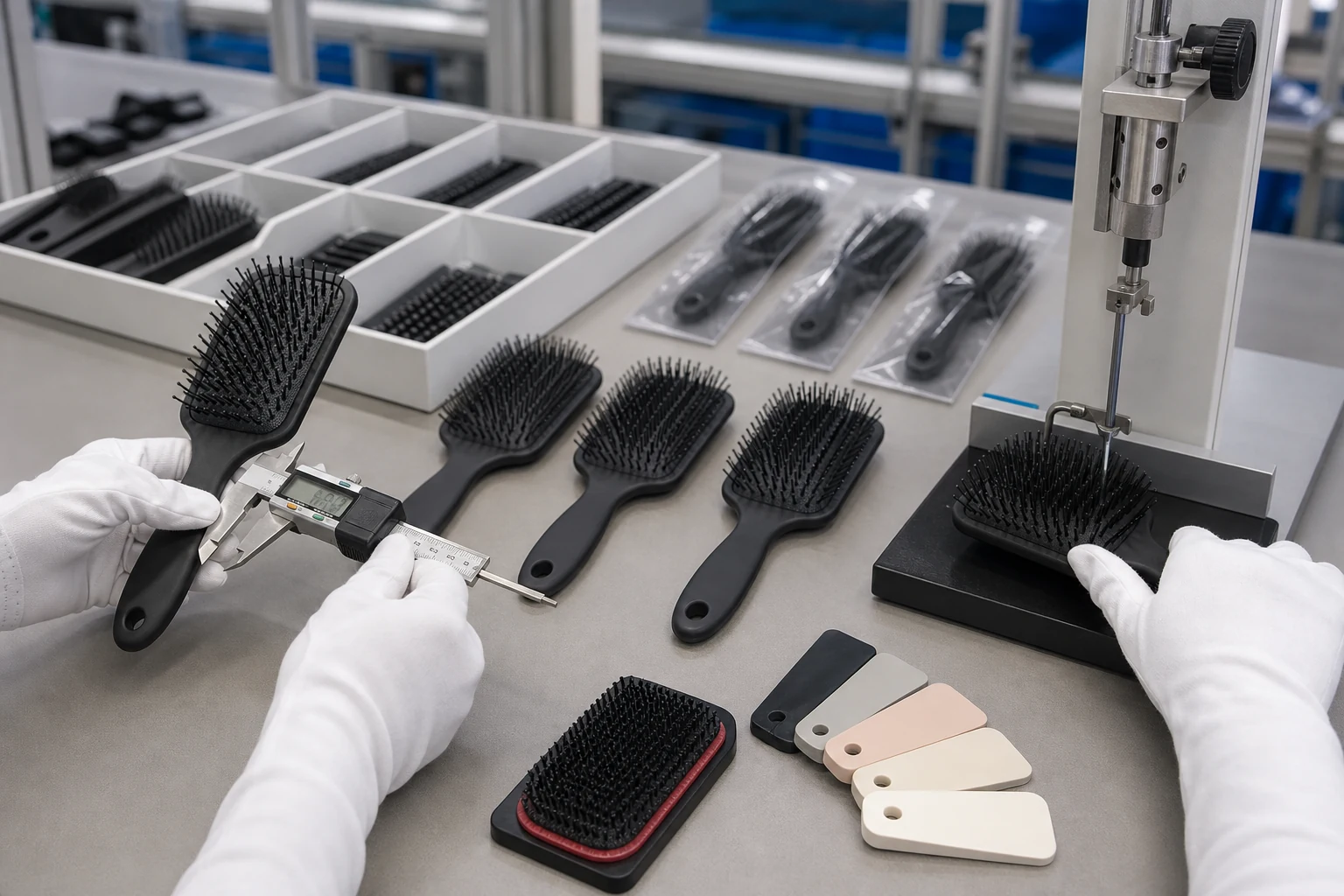
- Incoming materials: raw materials go through incoming inspection, including chemical safety checks, before production begins.
- Standards: products are made to meet EU REACH and US CPSIA safety requirements, and certification documents and audit reports are available on request.
- Factory certifications: ISO 9001:2015, amfori BSCI, BRCGS Consumer Products (SGS), GRS 4.0 (Intertek) and FSC.
- Testing and inspection: buyer-appointed laboratories and third-party inspections are supported.
- Samples first: pre-production samples can be sent for testing before tooling and bulk production are committed.
See the quality control process, how to request samples, and the ranges of custom hair clips and custom hair brushes.
10. Conclusion
Compliance for hair accessories, brushes and combs is decided by materials: nickel in metal parts, heavy metals in pigments and coatings, phthalates in soft plastics and PAHs in rubber. Decide the markets and whether the product is for children, map every material and colour, test materials rather than SKUs, and keep reports tied to production batches. Done before tooling, that plan is far cheaper than discovering a failed material after bulk production.